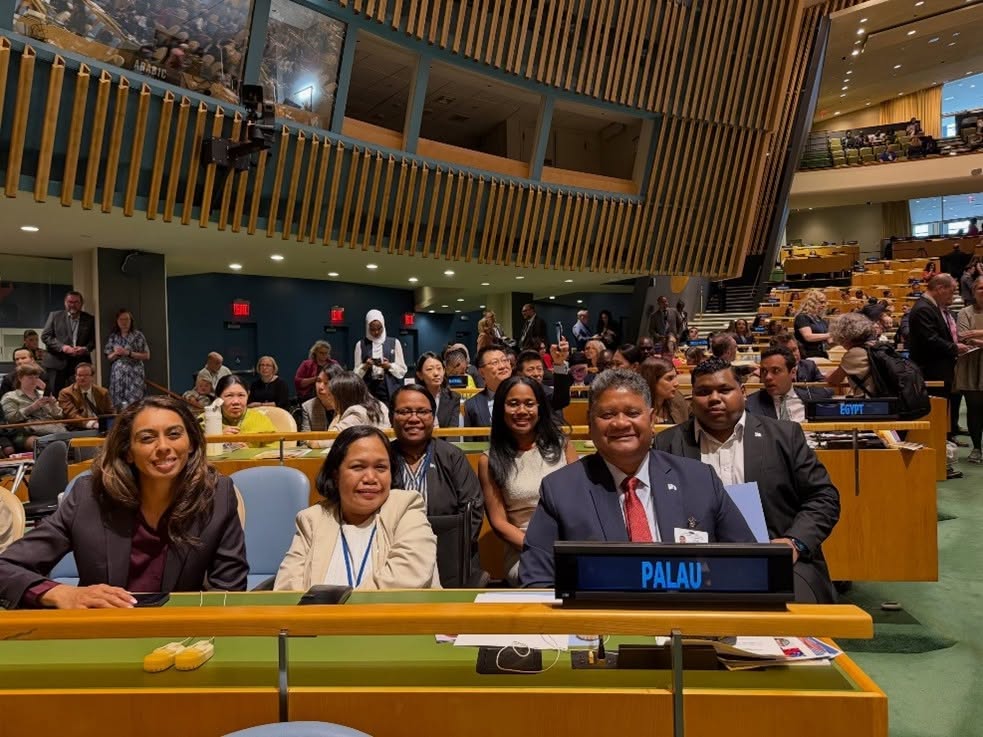
The Pacific Islands Forum has called for increased international support to strengthen disability inclusion across the region, highlighting persistent barriers faced by persons with disabilities and urging action on capacity building, data collection and climate resilience.
Speaking on behalf of the Pacific Islands Forum’s 18 countries and territories at the 19th Session of the Conference of States Parties to the Convention on the Rights of Persons with Disabilities (CRPD), Palau Minister of State Gustav Aitaro said the focus must extend beyond celebrating achievements made since the Convention was adopted 20 years ago.
“As we mark twenty years since the adoption of the CRPD, our focus must not only be on celebrating achievements, but on preparing for the challenges ahead.”
“Accelerating climate impacts, technological change, and growing inequality continue to shape the lives of persons with disabilities around the world and require renewed commitment from all of us,” he said.
Aitaro said the Pacific had made significant progress in advancing disability rights, noting that 14 Forum members have ratified the Convention.
“The Pacific has made important progress in advancing disability rights. Fourteen Forum members have ratified the Convention, and we are currently refreshing the Pacific Framework for the Rights of Persons with Disabilities to align with the 2050 Strategy for the Blue Pacific Continent.”
He also highlighted ongoing regional efforts to strengthen disability inclusion and policymaking.
“Our region continues to demonstrate leadership. This year, the Pacific has two candidates seeking election to the CRPD Committee, and in 2025 we launched the Pacific Regional Guidebook on Disability Statistics to strengthen evidence-based policymaking across our region.”
Aitaro said inclusion must remain a priority for Pacific Island countries.
“For the Republic of Palau and many Pacific Island countries, inclusion can never be an afterthought.”
“Meaningful inclusion requires accessible services, sustained engagement, and policies grounded in the lived experiences of persons with disabilities and their families.”
“The next chapter of the Convention must be measured by the opportunities we create for persons with disabilities to participate fully and equally in society,” he said.
Despite progress, Aitaro said major challenges remain across the region.
“Approximately 1.7 million people in the Pacific – around 16 percent of our population – live with a disability.”
“Many continue to face barriers in accessing education, employment, healthcare, infrastructure, and social protection.”
‘These challenges are compounded by climate change and disasters, where persons with disabilities are often among the most vulnerable,’ said Aitaro.
He reaffirmed the Forum’s commitment to ensuring disability inclusion is incorporated across all sectors.
“Guided by the principle of ‘Nothing about us, without us,’ the Pacific Islands Forum remains committed to ensuring disability inclusion is integrated across all sectors, including climate action, health, education, and emerging technologies.”
Drawing on a Palauan proverb, Aitaro highlighted the importance of collective action.
“It is bad if we each paddle our own way, but good if we paddle as one.
“This spirit of collective action underpins our call to partners,” he said.
Aitaro outlined three priority areas where the Pacific is seeking support from the international community.
“We therefore urge the international community to support the Pacific in three priority areas:
“First, invest in Pacific capacity and institutions to strengthen implementation at the national level and support organisations of persons with disabilities.”
“Second, strengthen disability data and knowledge systems to ensure evidence-based decision-making and more effective policies.”
“Third, support resilience and inclusion by ensuring persons with disabilities are prioritised in disaster preparedness, health responses, and climate adaptation efforts,” he explained.
Aitaro said the Pacific Way would continue to guide regional efforts to advance disability inclusion.
“The Pacific Way, grounded in dialogue, partnership, and respect, guides our efforts to advance disability inclusion as a core element of our Blue Pacific identity.
“Let us ensure that COSP19 delivers meaningful outcomes that uphold rights, strengthen participation, and empower persons with disabilities across our region and around the world,” he said.