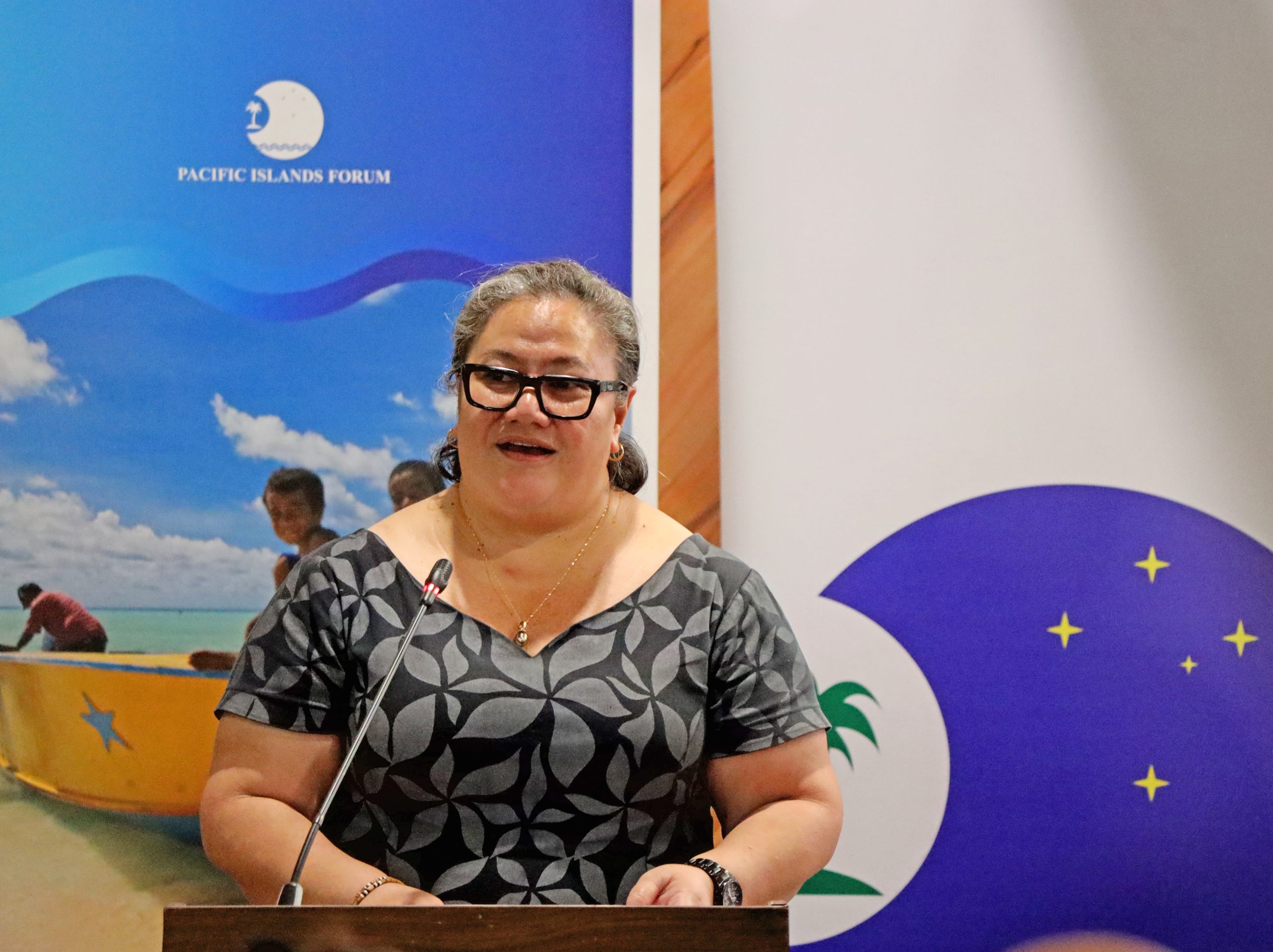
Forum deputy Secretary General Desna Solofa has called for a stronger focus on implementation of key trade agreements, saying the Pacific must turn trade commitments into tangible benefits as global uncertainty reshapes international commerce.
Speaking at the Pacific ACP Trade Officials Meeting Thursday , Solofa said the region was meeting at a critical time marked by geopolitical shifts, climate change, supply chain disruptions and rapid technological change.
Solofa said Pacific countries were strengthening their collective voice through the Blue Pacific agenda while pursuing national reforms aimed at inclusive growth and sustainable development.
“We meet at a time of profound global transformation. International trade faces unprecedented challenges and opportunities—driven by shifting geopolitical dynamics, climate change, supply chain disruptions, and rapid advances in digital technologies.
Regionally, the Blue Pacific is asserting its collective voice, strengthening economic integration, and advancing implementation of the 2050 Strategy for the Blue Pacific Continent. Nationally, Members are pursuing reforms aimed at promoting inclusive economic growth, enhancing resilience, and driving sustainable development,” she told PACP officials.
She said growing participation by Pacific ACP States in the interim Economic Partnership Agreement (iEPA) and the Samoa Agreement had strengthened the foundation for deeper engagement with the European Union.
“Against this backdrop, the expanding membership of Pacific ACP States to the interim Economic Partnership Agreement (iEPA) and the Samoa Agreement lay a robust foundation for deepening trade relations with the European Union,” said Solofa.
Solofa highlighted recent ratifications of the Samoa Agreement by Solomon Islands and Timor-Leste in September 2025 and Samoa’s ratification four weeks ago, alongside growing interest from Pacific countries in joining the iEPA.
“The recent ratifications of the Samoa Agreement, Timor Leste and Solomon Islands in September 2025, and most recently Samoa’s ratification just 4 weeks ago, together with the expressed interest of nine PACPS to accede to the iEPA, is a testament to our partnership. This reflects a collective commitment to advancing open and predictable trade, sustainable development, and deeper regional economic integration in our Blue Pacific,” she stressed.
She said the iEPA had already created new opportunities for Pacific exporters through preferential market access to the European Union.
“The iEPA has unlocked new market access opportunities, albeit at differing levels for the iEPA parties, under the global sourcing rules of origin derogation and cumulation provisions and the broader duty-free and quota-free entry for Pacific exports to the EU.
It also provides a framework to address technical barriers, sanitary and phytosanitary standards, and supports capacity building for our economies,” Solofa explained.
Solofa said attention must now shift from policy development to implementation through the upcoming Pacific Trade and Sustainable Development Programme.
“The timely shift from policy formulation to more impactful implementation of the iEPA and private sector development under the upcoming Pacific Trade and Sustainable Development (or Pac-TSD) programme will reinforce our partnership, further transitioning it from aspiration to results.
The Pacific Protocols under the Samoa Agreement will provide the enabling governance structure within which the region will collectively advance these shared objectives,” she said.
She said global uncertainty and changing geopolitical alliances reinforced the importance of strong partnerships and trade frameworks.
“Current global uncertainties and shifting geopolitical alliances underscore the importance of these frameworks. Against that backdrop, we recognise the EU as a vital and stable trading partner, supporting our efforts to diversify exports, improve quality infrastructure, and foster innovation.”
Solofa urged officials to maximise the opportunities provided by both agreements and ensure that regional trade programmes deliver real benefits to Pacific communities.
“As we deliberate today, let us focus on harnessing the full potential of the iEPA and the Samoa Agreement—ensuring that Pacific trade strategies under the new Pacific Trade and Sustainable Development programme, the Pacific EU Marine Partnership programme II are resilient, sustainable, and strategically poised to deliver tangible benefits to our communities,” she said.
She also highlighted the importance of strengthening institutional capacity within the Forum Secretariat to meet European Union requirements.
“As your Secretariat, our ability to effectively deliver outcomes for Members is closely linked to the institutional capacity and resources required to meet EU compliance, reporting, and implementation requirements. The Secretariat has completed its pillar assessment and with submission to the EU.
I acknowledge the key findings and recommendations of the pillar assessment as a valuable opportunity to further strengthen internal policies, procedures, and operational practices,” said Solofa.
Solofa said a stronger partnership between the Pacific and the European Union would help the region navigate external pressures while advancing economic integration and long-term development goals.
“By strengthening our EU-Pacific partnership, we can as a region confidently navigate external challenges, deepen economic integration, and advance our collective vision for a prosperous Blue Pacific,” she said.