

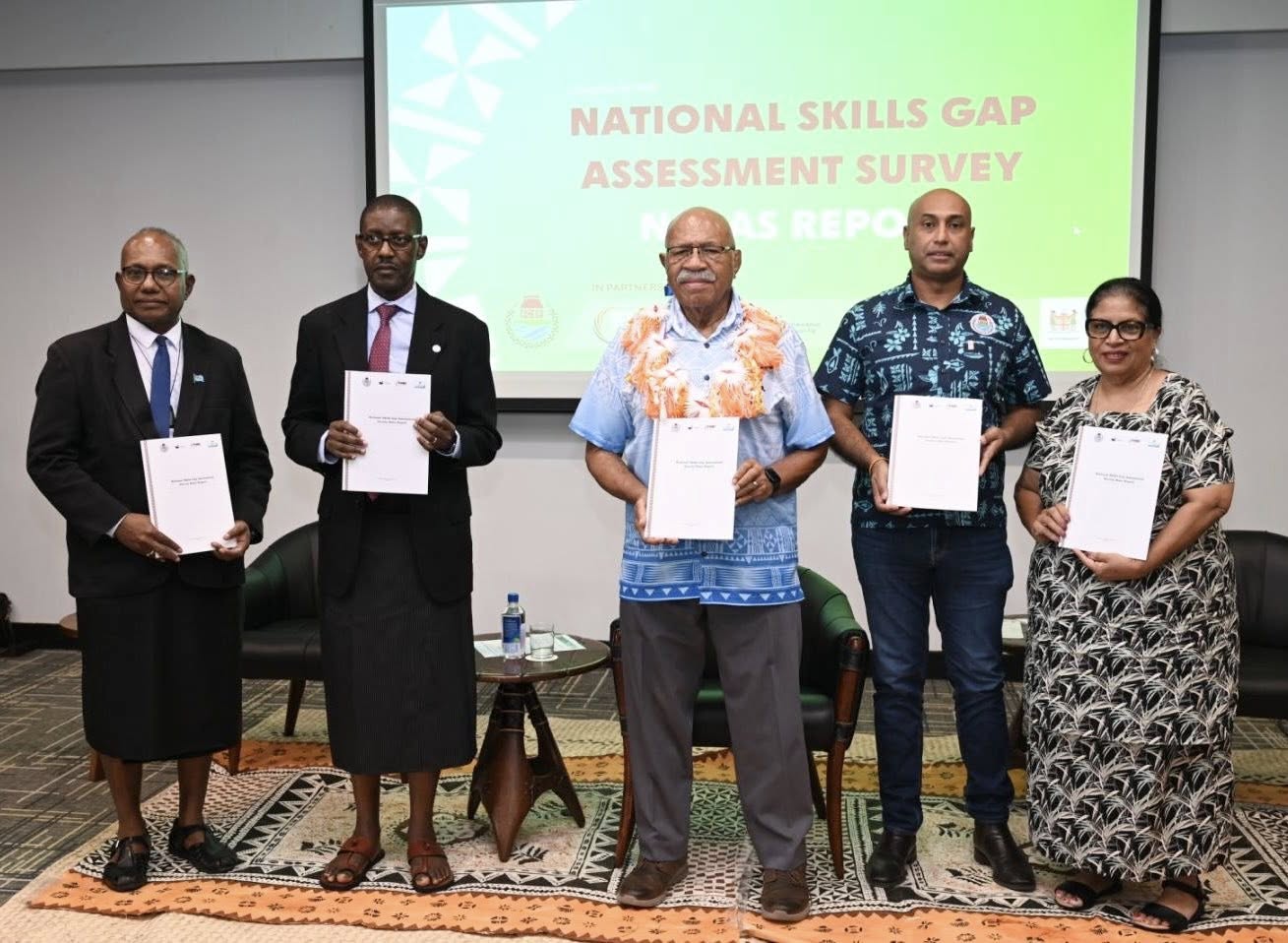
Fiji Prime Minister Sitiveni Rabuka has launched the 2026 National Skills Gap Assessment Survey in Suva, describing it as a critical national tool that will guide Fiji’s workforce planning, strengthen labour market intelligence, and support the country’s long-term economic transformation.
In his address, Prime Minister Rabuka said the survey is a strategic initiative grounded in evidence to help align Fiji’s workforce with the demands of a rapidly evolving global economy.
“At the heart of Fiji’s national development agenda is a simple but powerful principle, that our people are our greatest asset. Similarly, our vision is clear: To build a resilient economy, empower our people, and uphold good governance,” he said.
“As outlined in our national development framework, and our long-term ambition to achieve high-income status by 2050, sustained growth will depend on productivity, innovation, and a workforce that is skilled and future-ready.
“This requires a deliberate shift from fragmented interventions to a coordinated, whole-of-system approach to skills development, education, and workforce planning.”
Rabuka commended the collaboration between the Fiji Commerce and Employers Federation, the Fiji Bureau of Statistics, Government agencies, development partners, businesses and the private sector in delivering the national initiative.
He asserted that the survey presents a clear and urgent message, stating that labour shortage is now a binding constraint to national growth.
“The findings point to significant and widespread gaps across key sectors, particularly in construction, nursing and specialised healthcare, telecommunications engineering, and aviation safety. Demand for technical trades—including electricians, plumbers, joiners, and construction workers—continues to outpace supply,” he added.
“At the same time, shortages are emerging in professional and regulatory roles, including quality assurance officers, human resource professionals, and occupational health and safety inspectors.”
The Prime Minister acknowledged that Fiji continued to face increasing labour market pressures driven by migration, rising domestic demand, and global competition for talent.
He revealed that approximately 15,500 Fijians migrated overseas for employment opportunities between January 2023 and February 2024, intensifying domestic labour shortages and increasing reliance on foreign workers in key sectors.
Prime Minister Rabuka said the findings confirmed the need for stronger coordination between education, training institutions, industry, and Government to ensure Fiji develops a skilled, adaptable, and future-ready workforce.
He said Government had already strengthened its focus on coordinated labour and skills planning through the establishment of the National Taskforce on Labour and Skills and would continue working closely with national universities and training institutions to better align labour supply with industry demand.
“We must realign education and training systems with industry demand, strengthen school-to-work transitions, and embed values such as work ethic, discipline, and responsibility alongside technical skills,” stated the PM.
“We must also accelerate digital capability—ensuring that our workforce is not only prepared for today’s jobs but equipped for the future of work.
“At the same time, stronger partnerships between Government, industry, and training institutions will be essential. No single institution can address these challenges alone,” he concluded.