
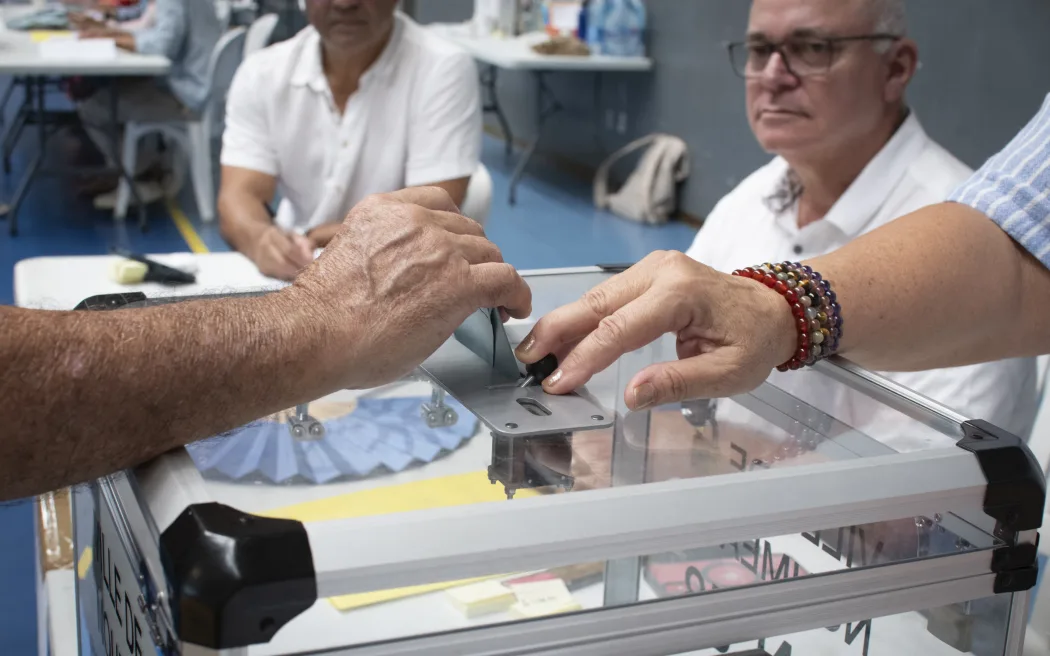
New Caledonia’s crucial provincial elections will be held on Sunday 28 June, French Prime Minister Sébastien Lecornu has announced.
Lecornu’s announcement was widely relayed by New Caledonian politicians who have just participated in a video conference meeting early on Thursday, Nouméa time.
The announcement also came with a condition: that the current restrictions on voter eligibility will be relaxed and that people born in New Caledonia and their spouses should now be allowed to cast their votes.
Even though the partial reopening of the electoral roll is reported to have been agreed by politicians from across the political spectrum during the same meeting with Lecornu, both pro-independence and pro-France have reacted expressing dissatisfaction on the compromise.
This concerns about 10,000 voters who will be allowed to vote and could not under the current restrictions as part of the “freeze” imposed by the 1998 Nouméa Accord.
The new conditions, however, remain to be enacted by an organic law yet to be endorsed by French lawmakers.
“It’s obviously not the ‘unfrozen’ electoral that we were calling for,” pro-France Rassemblement party leader Virginie Ruffenach reacted on social media.
“But this is a way forward”, she commented.
Ruffenach said political stakeholders in New Caledonia had pledged to resume talks in July 2023 regarding a broader political agreement on New Caledonia’s future status after the much-awaited provincial elections.
Any modification to the French Pacific territory’s status would then be subjected to a Constitutional Amendment, which has so far failed to be endorsed by French lawmakers.
The latest setback to a Constitutional Amendment Bill was on 2 April 2026, as a result of unlikely alliances and convergences between left and far-left parties (such as La France Insoumise -LFI-) and far-right Rassemblement National.
Another prominent pro-France leader, Sonia Backès, commenting on this partial “opening” of the restrictions, said this was “insufficient” and “democratically unacceptable”.
She also mentioned local moves to bring the matter before the European Court of Human Rights “to have other excluded” voter categories re-included in New Caledonia’s “special electoral list”.
Altogether, the “special list” excluded about 37,000 voters(about 17 percent of the “general” list of 218,000 registered voters in New Caledonia), who are otherwise allowed to vote at other elections (such as French national polls), but do not meet the requirement for provincial elections (including being born outside New Caledonia or having arrived after November 1998).
Pro-independence FLNKS party, who also took part in the video talks on Thursday at the French High Commission in Nouméa, also reacted saying it “takes note’ of the date announced by Lecornu and that the polls would be now open to “natives” and their spouses.
But it added that the electoral provisions and conditions are “at the heart of the Nouméa Accord” and are “not negotiable”.
“They are at the heart of the Nouméa Accord and of the decolonisation process”, the pro-independence party pointed out in a release on Thursday.
“There should be no passage en force and unilateral decision”, it stressed.
New Caledonia’s provincial elections are crucial because their results determine not only the members of New Caledonia’s three provincial assemblies (North, South and the Loyalty Islands), but also, by way of trickle-down effect, the members of the Congress (New Caledonia’s Parliament), the members of its “collegial” government and its future president.
The last time provincial elections were held in New Caledonia was in 2019.
They were then supposed to have been held in 2024, but since then, the poll was postponed three times.
The last time it was re-scheduled to be held no later than Sunday 28 June 2026, France’s Constitutional Council warned it would no longer tolerate more postponements.