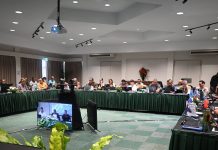




Fisheries and maritime surveillance personnel across the 17 Members of the Pacific Islands Forum Fisheries Agency (FFA) have received a major upgrade to their surveillance capabilities, with the rollout of a new system designed to improve the detection of suspicious fishing and maritime activities and strengthen maritime domain awareness (MDA) across the Pacific.
FFA Director-General Noan David Pakop announced the operational launch of the new Pacific Guardian Surveillance System (PacGuard), marking a significant advancement in the region’s efforts to combat illegal, unreported and unregulated (IUU) fishing, address transnational organised maritime crime and strengthen the security of the Blue Pacific.
The new web-based platform is accessible to authorised fisheries and maritime surveillance personnel across all 17 FFA Members, allowing them to securely log in from anywhere with an internet connection and a web browser.
PacGuard replaces the Google Earth-based Regional Surveillance Picture (RSP), a legacy vessel monitoring and surveillance platform that has supported regional fisheries surveillance operations since 2009.
Fully designed and developed in-house by the FFA Secretariat, PacGuard builds on the previous system with improved capabilities tailored to the operational needs of FFA Members and emerging technologies.
The system provides detailed vessel profiles, expanded historical tracking, fishing licence information, satellite surveillance data and advanced mapping tools. These improvements help officers assess vessel movements and patterns, investigate potential violations and plan surveillance operations more effectively.
Previously, surveillance analysts had to access much of this information through separate systems and tools. PacGuard now brings these capabilities together into a single platform.
One of PacGuard’s key improvements is its automated risk assessment capability, which analyses vessel behaviour and flags suspicious activities, including unexplained gaps in vessel tracking, unusual vessel encounters and movements into monitored areas.
Director-General Pakop applauded the Secretariat’s efforts in developing the upgraded surveillance system.
He said PacGuard represents an important step forward in strengthening the region’s collective ability to protect its valuable fisheries resources and support regional peace and security priorities.
“PacGuard represents an important milestone achievement and advancement in strengthening our regional monitoring, control and surveillance capabilities and the services we provide to our Members. It reflects our continued commitment to equipping Pacific countries with modern tools and technology to better monitor and protect our fisheries resources,” Pakop said.
The platform underwent operational testing during Operation KURUKURU 2026 (OPKK26), one of FFA’s annual regional fisheries surveillance operations conducted in October. The system was further improved using feedback from participating surveillance personnel.
FFA Surveillance Operations Officer, Yohni Fepuleai, said the post-operation survey assessed PacGuard’s performance, data reliability, information-sharing capabilities and operational challenges, drawing feedback from MCS officers, intelligence analysts and watchkeepers across FFA Members and partner agencies.
“The feedback from our surveillance personnel has been very positive. PacGuard has demonstrated significant improvements in how we assess vessel risks, gather intelligence and monitor activities across our region. Having these capabilities in one platform makes it easier for our officers to access and analyse information to support surveillance operations,” Fepuleai said.
“This technology represents the future of intelligence-led maritime surveillance. We will continue improving the system, integrating more data and supporting our Members through training to strengthen maritime domain awareness across the Pacific.”
Brian Kwaimani, a fisheries compliance officer from the Solomon Islands Ministry of Fisheries and Marine Resources seconded to the Regional Fisheries Surveillance Centre (RFSC) during OPKK26, said the new system was already improving surveillance work.
“We are fortunate to use a new platform, PacGuard. With this platform, it’s more time efficient and effective in our joint member countries’ effort in fighting [illegal fishing],” he said.
With PacGuard now operational, FFA will continue supporting Members and surveillance partners through technical assistance, user training and its application in regional surveillance operations.
The live rollout marks the operational soft launch of PacGuard, with a formal launch planned at the 30th FFA Monitoring, Control and Surveillance Working Group (MCSWG) Meeting in April 2027.