



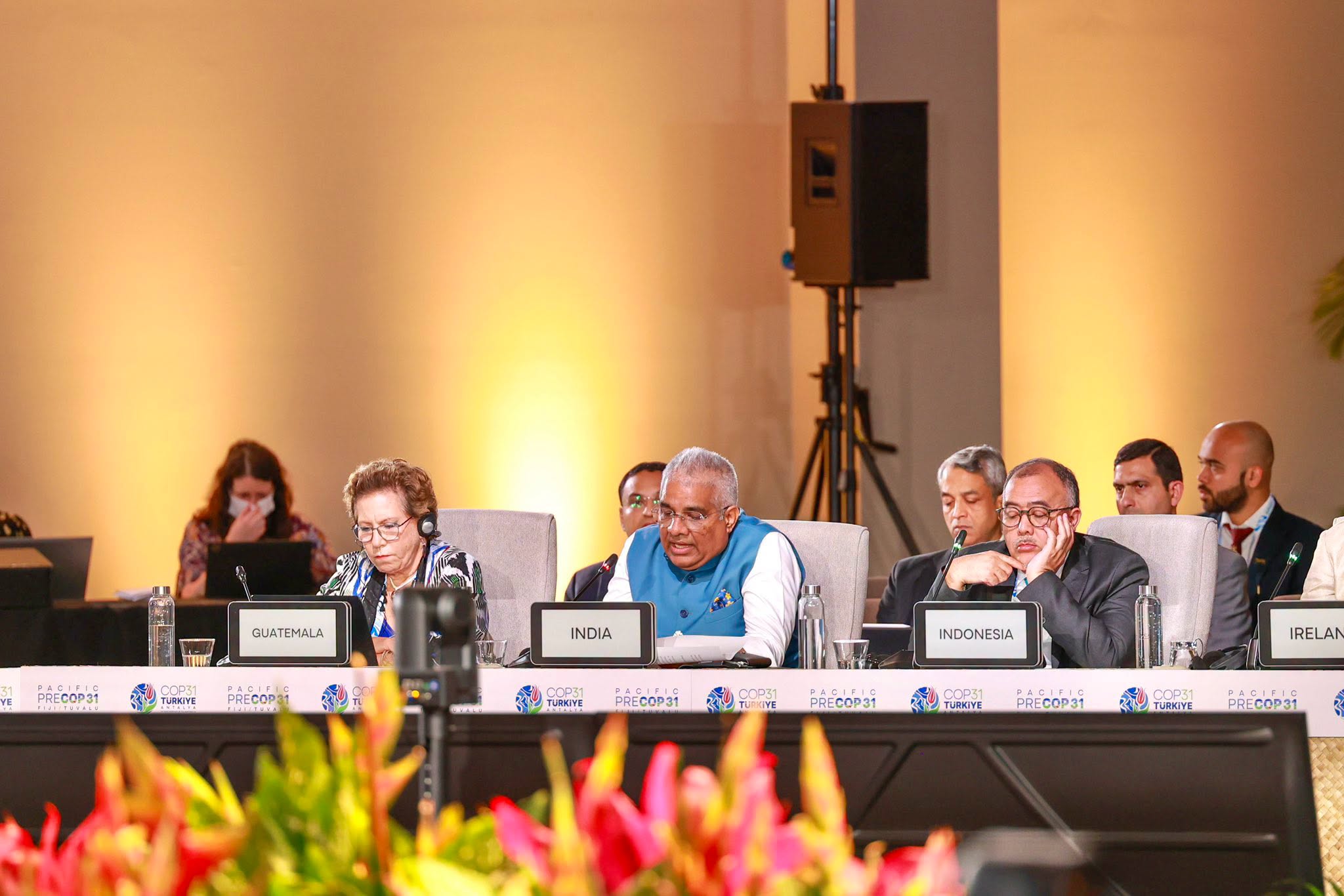
India has offered to share its expertise in ocean science, coastal monitoring, early warning systems and climate risk assessment with Pacific island countries as leaders push for stronger climate action ahead of COP31.
Union Minister for Environment, Forest and Climate Change Bhupender Yadav said India’s experience as a country with a vast coastline and numerous islands gave it a strong understanding of the challenges facing Pacific island states.
Speaking at the Pacific Pre-COP31 plenary in Denarau, Yadav said there was no single pathway to addressing climate change and solutions must reflect the specific circumstances of each country.
“We have seen that there can’t be one-size-fits-all pathway to climate action,” Yadav said.
He said India was prepared to make its knowledge and technical expertise available to Pacific countries, particularly in areas such as shoreline monitoring, coastal management, cyclone and extreme weather early warning, and climate risk assessment.
“We will be happy to share this knowledge and expertise with our Pacific brothers,” he said.
Yadav highlighted India’s work through institutions including the Indian Space Research Organisation, the National Centre for Sustainable Coastal Management and the National Centre for Coastal Research.
He said India’s capabilities included mapping shoreline changes, developing marine spatial plans, integrated coastal management and using Earth observation and space-based applications to address climate and environmental challenges.
The Indian minister also pointed to the Tuvalu Coastal Adaptation Project as an example of how international cooperation and adequate means of implementation could translate into practical resilience.
“The Tuvalu Coastal Adaptation Project is a strong reflection of how international cooperation, especially the provision of means of implementation, can translate into tangible resilience on the ground,” he said.
Yadav said India had worked closely with Pacific partners across several sectors, including health, renewable energy, resilient infrastructure, early warning information technology, agriculture and capacity building.
He said the direct impacts of climate change witnessed during the leaders’ visit to Tuvalu underscored the urgency of international action.
“To be here in the Pacific among communities experiencing the direct impact of climate change is a powerful reminder of what is at stake for all of us,” he said.
Looking towards COP31 in Türkiye, Yadav said adaptation, mitigation and the means of implementation must receive equal attention.
“India believes that adaptation, mitigation and means of implementation must receive equal attention,” he said.
He also called for the principle of equity and the principle of common but differentiated responsibilities and respective capabilities to remain central to global climate negotiations.
Yadav said climate assessments and studies were essential to identifying the specific adaptation and mitigation measures required by different regions and the resources needed to implement them.
He said India remained committed to working with Pacific island countries on climate resilience and sharing its technical capacity to support locally relevant solutions.