
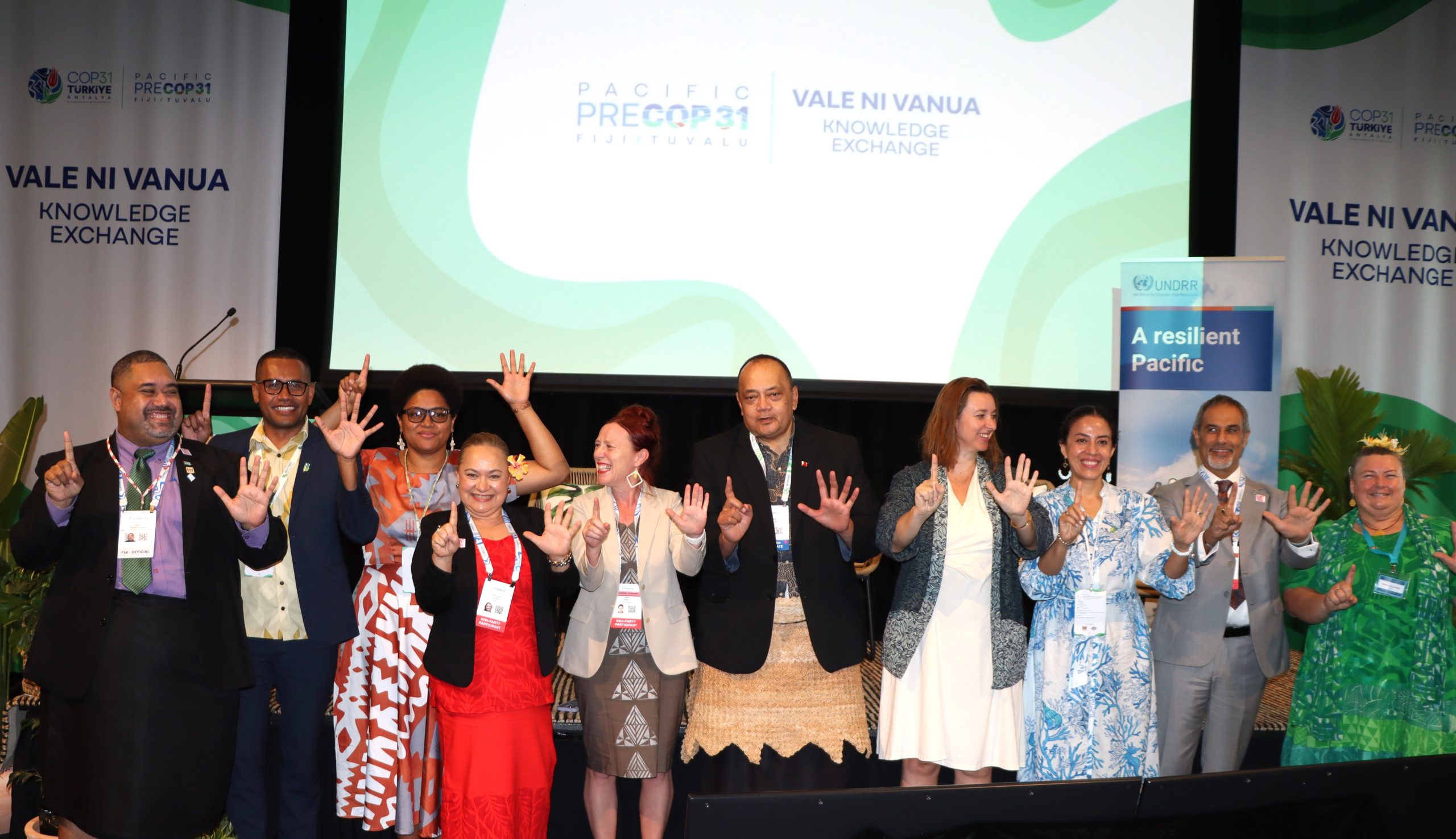
Pacific Political Champion for climate-induced Loss and Damage, Hu’akavameiliku Siaosi Sovaleni, has a clear message to world leaders gathering in Fiji to prepare for COP31 in Türkiye next month.
“Responding to loss and damage is not charity,” he said.
“The advisory opinion of the International Court of Justice, which our region fought for, confirmed that States have binding obligations on climate change, and that breaching them has legal consequences. This is a matter of justice.”
Hu’akavameiliku was speaking on the margins of the ongoing pre-COP in Nadi where discussions about the impact of climate induced loss and damage have taken centre stage as part of the push for improved access to climate finance. It is one of four priorities being pushed in Fiji, the other three are keeping 1.5°C within reach, placing the Ocean at the heart of global climate action; and amplifying Pacific leadership and voices.
As the Pacific’s Political Champion for Loss and Damage, Hu‘akavameiliku is amplifying five key messages for world leaders at pre-COP: “Firstly, our losses go far beyond what can be measured in money, secondly recognition is not enough, our communities need action now; thirdly our losses, our solutions, Pacific voices must lead, fourthly one methodology cannot capture the full range of Pacific losses and and the fifth one is Ambitious climate action remains fundamental.”
According to Hu’akavameiliku, intensifying cyclones, floods, rising seas, drought increasingly drive unavoidable loss and damage.
“These extreme weather events take what no payout can return: ancestral land, the graves of our elders, and ways of life bound to place,” he said. “Yet these losses are undercounted. Non-economic losses are barely measured, data is scattered and capacity is stretched. What is not counted is rarely financed. That is why evidence is the foundation of our case for action and for finance.”
This is where the Secretariat of the Pacific Regional Environment Programme (SPREP) plays a key role. Over the years, SPREP with funding from New Zealand’s Ministry of Foreign Affairs and Trade funded Loss and Damage Capacity and Capability Project and IKI-funded Building Our Loss and Damage (BOLD) Response project, has supported the Pacific’s leadership on climate action, and on climate-induced loss and damage through dialogues, collecting evidence and implementing projects on the ground with countries and communities.
SPREP has conducted more than 25 Loss and Damage Dialogues at regional, national, state, island and community levels.
The dialogues brought together government, private sector, NGOs, CSOs, FBOs, youth groups, partners, donors, traditional leaders, outer islanders and more. From the Cook Islands Pa Enua to the outer islands of Chuuk state in the Federated States of Micronesia to the three atolls of Tokelau, SPREP prioritised the inclusion of communities, especially from the outer islands.
“These engagements with communities are not just performative,” said Tagaloa Cooper, SPREP Director Climate Change Resilience.
“We are seeing tangible benefits.”
In Solomon Islands, the dialogue outcomes are feeding into the development of a loss and damage policy. In the Cook Islands and Niue, pilot projects to address loss and damage are underway. In Tonga the findings and priorities from the outer islands fed directly into their application for funding from the Fund to Responding to Loss and Damage.
“The dialogues confirmed what we already know- loss and damage is experienced throughout the Pacific including complex non-economic losses and damages.”
One of the most significant outcomes of the dialogues was The Pacific Youth Apia Declaration on Loss and Damage. “Youth are the future and will live through an increasingly difficult climate. It is essential that we centre their perspectives and provide opportunities for empowerment and leadership,” Ms Cooper added.
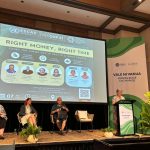
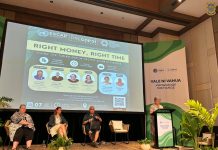
Hu’akavameiliku and Cooper were amongst the speakers at the “Pacific Loss and Damage: Evidence to Action” side event on Wednesday.
Organised by the United Nations (UNDRR), SPREP, Secretariat of the Pacific Community (SPC) and the Santiago Network Secretariat, the session connected evidence with financing readiness, investment decisions and practical support, while informing continued collaboration and future work.
Co-moderated by Nacanieli Speigth, of the Santiago Network Secretariat and Gabriele Emery, of UNDRR Sub Regional Office for the Pacific, other speakers were Caroline Fuentes Castellanos, Director Santiago Network Secretariat, Mathilde Laurans, Deputy Executive Director FRLD and Ms Alisi Rabukawaqa, Indigenous Knowledge Holder Fiji.
“The science is clear. Losses and Damages are inevitable, and they are already being felt and will continue under all emissions scenarios,” said Cooper.
“But we will keep pushing for every inch of action,” she said.