


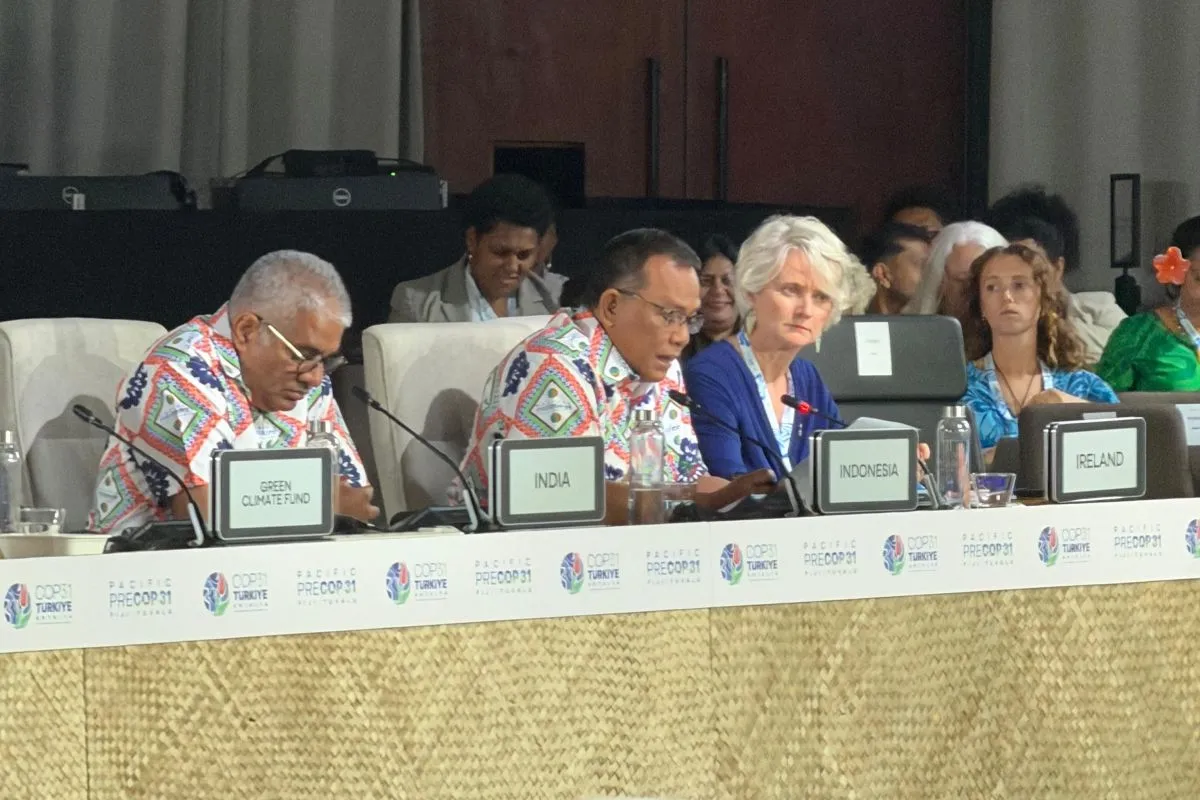
Indonesia has called for a stronger global response to climate change, saying the focus of international negotiations must now shift from setting ambitions to delivering results on the ground.
Indonesia’s Environment Minister Mohammad Jumhur Hidayat told Pacific Pre-COP31 leaders in Fiji that the gap between climate commitments and actual results must be closed, with equity and the principle of common but differentiated responsibilities remaining central to the response.
“The Paris Agreement is our compass, yet the window of alive is closing fast. We must close the gap between promises and the result,” Hidayat said.
He said Indonesia’s second Nationally Determined Contribution (NDC) sets a pathway towards net zero emissions by 2060 or sooner, while climate action must be pursued alongside economic growth, energy security, poverty eradication and resilience.
“Climate action must advance alongside growth, energy security, poverty eradication and resilience,” he said.
Hidayat said Indonesia was accelerating economy-wide measures to reduce emissions, including action on waste and methane, industrial decarbonisation and the development of low-carbon industries.
He said Indonesia’s energy transition must also protect vulnerable communities and ensure energy remained affordable and secure.
“Our energy transition must be just, orderly and people-centred while strengthening energy security, affordability and protecting vulnerable communities,” Hidayat said.
The minister placed particular emphasis on adaptation, saying it must receive the same attention as mitigation.
“Indonesia underscores adaptation must stand equal to mitigation,” he said.
As an archipelagic country, Hidayat said Indonesia understood the risks faced by small island and coastal communities from rising sea levels.
He said the leaders’ visit to Tuvalu’s coastal adaptation project had reinforced the need for urgent action in island and archipelagic states.
“For island and archipelagic countries, sea level rise affects not only land and livelihood but also raises broader long-term questions for states and their people,” he said.
Hidayat also addressed the issue of statehood and sovereignty in the face of rising sea levels, saying Indonesia understood the concerns of vulnerable island states.
“In this context, Indonesia understands the appeal of continuing statehood and sovereignty in the face of sea level rise as reflecting the presumption in favour of continued statehood, consistent with international law,” he said.
He cautioned, however, that the legal status, content and consequences of that presumption required further consideration under international law.
While that discussion continues, Hidayat said governments could not delay practical measures to protect communities.
“Action to protect our people and communities cannot wait,” he said.
He said Indonesia was strengthening resilience through measures including mangrove restoration, coral reef protection and community-based climate adaptation programmes.
Looking ahead to COP31 in Türkiye, Hidayat said the central challenge was no longer a lack of climate ambition but the failure to turn commitments into action.
“Our challenge is no longer ambition; it is implementation.
“Moving from ambition to implementation requires concrete support. We need a global response that matches the scale of climate impact and safeguards our future generation,” he said.