



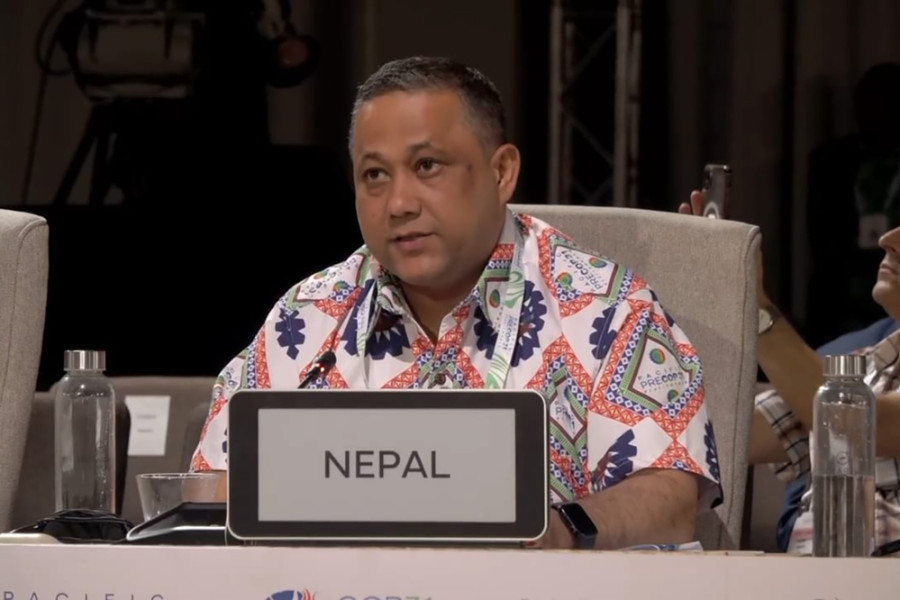
Nepal has called for a stronger alliance between Himalayan and Pacific nations to confront the shared impacts of climate change, with Foreign Minister Shisir Khanal urging countries to take a united message to COP31.
Speaking at the Leaders Plenary in Nadi, Khanal proposed a formal “Sagarmatha to the Sea” partnership to link mountain and ocean communities through cooperation, knowledge exchange and a stronger collective voice on climate action.
He said the geographical distance between Nepal and Pacific island countries masked a common vulnerability.
“Geographically, we stand on the opposite end of the earth, yet ecologically, we share the exact same front line,” Khanal said.
“From Sagarmatha, the highest peak to the sea, one warming planet is transforming our lives, our landscape, and our future.”
Khanal said the impacts of climate change could not be considered separately between mountains and oceans, arguing that changes in the Himalayas have consequences for communities in the Pacific.
“The mountains and the oceans belong to a single individual planetary continuum.
“What begins in our high mountains inevitably cascades into your rising sea,” he said.
He said Nepal was facing the consequences of climate change through disasters in its mountain regions, while Pacific countries were dealing with rising tides and increasingly severe cyclones.
Khanal referred to what he described as a recent “Himalayan tsunami” in Nepal, which he said was caused by an abrupt high-altitude glacial and rock collapse that sent a large, sediment-filled flood through the Bhotekoshi River Valley.
“In minutes, roaring floodwaters swept away over 1,400 lives. About 6,000 are still missing,” he said.
Khanal said the disaster also destroyed vital highways, clean hydroelectricity power plants and entire communities.
He drew a direct connection between such events and the climate vulnerabilities faced by Pacific nations.
“Our vulnerabilities are not identical, but our stakes are shared, because the melting mountain ice adds to the rising sea,” he said.
“Mountains and oceans are not opposite. They’re one water, one story, one shared future.”
Khanal said countries such as Nepal were contributing relatively little to global emissions while bearing significant consequences from climate change.
“In Nepal, 46 percent of land is covered by forest. 70 percent of new consumer vehicles are EVs. All of our electricity comes from hydro,” he said.
“Yet our people pay with their lives and development gains for a crisis they had no hand in creating. This is the very definition of climate injustice.”
Ahead of COP31, Khanal called for continued commitment to limiting global warming to 1.5 degrees Celsius.
“As we prepare for COP31, Nepal calls for uncompromising fidelity to the 1.5 degree threshold. This is not a theoretical anymore.”
He called for predictable, grant-based adaptation finance that would provide direct funding without imposing further debt on vulnerable countries.
“We ask for predictable grant-based adaptation finance that delivers direct liquidity without imposing further debt,” Khanal said.
He also called for a fully capitalised operational loss and damage fund, with fewer bureaucratic barriers to ensure support reaches vulnerable communities.
Khanal’s proposed “Sagarmatha to the Sea” partnership would bring mountain and ocean communities together around cooperation, knowledge exchange and collective advocacy.
He also pointed to traditions of collective action in both regions.
“In Fiji, you live by Solesolevaki. In Nepal, our ancient tradition teaches Shramadana, the selfless offering of collective effort,” he said.
Khanal urged the Pacific to also highlight the climate changes taking place in the Himalayas.
“Nepal will always highlight rising sea. I hope Pacific will also talk about ice that melts in the Himalayas.”
He said shared vulnerability should become the basis for stronger collective action between the two regions.
“Let us turn our shared vulnerability into shared action, our shared challenges into shared solutions, and our solidarity into a stronger voice for climate justice.”
Khanal called for countries to approach COP31 with a common position and a shared message.
“Let’s, let us go to Antalya with one voice, sending the world the same message.”
“The climate crisis is already here. Our response must be equally urgent. Equally united and equally ambitious,” he said.