

What happens when you wake up one day and your receding coastal land has now disappeared? Or the king tide last week, the week before and last month has made the drinking water supply from the well salty, and root crops can’t grow as big as before.
For small islands states like the Kiribati, Republic of Marshall Islands and Tuvalu this is their reality, that will only get worse if we go over 1.5 degrees Celsius.
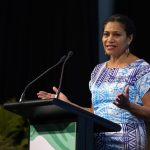
Pacific Climate Envoy, Kristina Stege, in her keynote address at the 1.5 to Stay Alive Forum hosted by the University of the South Pacific, highlighted “How even small increases in sea level rise leads to disproportionately large increases in coastal flooding for atoll nations like Tuvalu.”
“Thirty-centimetre sea level rise by 2050 under a low-emissions pathway could turn a 1-in-100-year coastal inundation event into a 1-in-10-year event. Tuvalu, Kiribati, my home country, the Marshall Islands, we are facing a shift from occasional disasters to recurrent and persistent national crisis.”
“Projections show that warming could lead to drastic declines in coastal fishery catches, translating to a food gap of 2 meals per week per family by 2050. We are talking about the decline of up to 65% of coastal fisheries catches in the most affected atolls under a medium warming scenario of 2.7C.”
It also means that risks and losses increase greatly compared with a world without that level of warming. Therefore every additional fraction of a degree makes those risks worse.
These are sobering assessments from the Pacific Community (SPC) further compounded by forecasts ahead.
“We’ve urged Pacific communities to remain alert as our climate forecasts for 3 – 16 October indicate that temperatures are expected to exceed 1.5°C above average in parts of Kiribati, the northern Cook Islands, and the Marquesas Islands of French Polynesia,” said Salesa Nihmei, Director of Climate Science and Information of the Secretariat of the Pacific Regional Environment Programme (SPREP).
“The whole world is expected to get warmer this El Nino. Additionally, an increased risk of tropical cyclone development is forecast near the northern Marshall Islands and Northern Mariana Islands from 05–11 October. Communities are encouraged to monitor official weather updates and preparedness advisories.”
Findings from the UN Environment Programme (UNEP) “Limiting Overshoot – Navigating exceedance of 1.5°C and pathways towards return” report launched in September this year, threaten that overshoot of 1.5 is now unavoidable but can still be brought down.
“It’s the scenario that keeps us up at night, listening to the waves that were once a source of comfort and are now a source of fear.”
The good news is we can return. “1.5 is still within reach and overshoot could be temporary, but we need to urgently implement effective, proactive, and bold measures now to make that a reality. This is still the critical decade for action.”
As a prelude to Pre-COP in Nadi from 05-08 October, 20026, Stege challenged policymakers, academia, climate advocates and community leaders at the Forum to “course-correct, to reset the narrative on climate change and double-down on 1.5°C. Discussions like today’s are so important in setting this direction for collective action. The Pacific is leading with knowledge, experience and solutions needed to confront this existential challenge.”
She pointed to past Pacific victories as proof that ambition delivers. From securing 1.5°C in the Paris Agreement, the COP28 commitment to transition away from fossil fuels, to the International Court of Justice Advisory Opinion led by university students from the Pacific.
“We have dreamed the impossible dream before. Not only have we dreamed it, but we made it reality.”
She said COP31 in Antalya, Türkiye, “has to be a COP of action”, delivering deeper emissions cuts, accessible climate finance and stronger protection for the ocean.
“Because, for the Pacific, ‘1.5 to stay alive’ is not a slogan, it is a lifeline.”
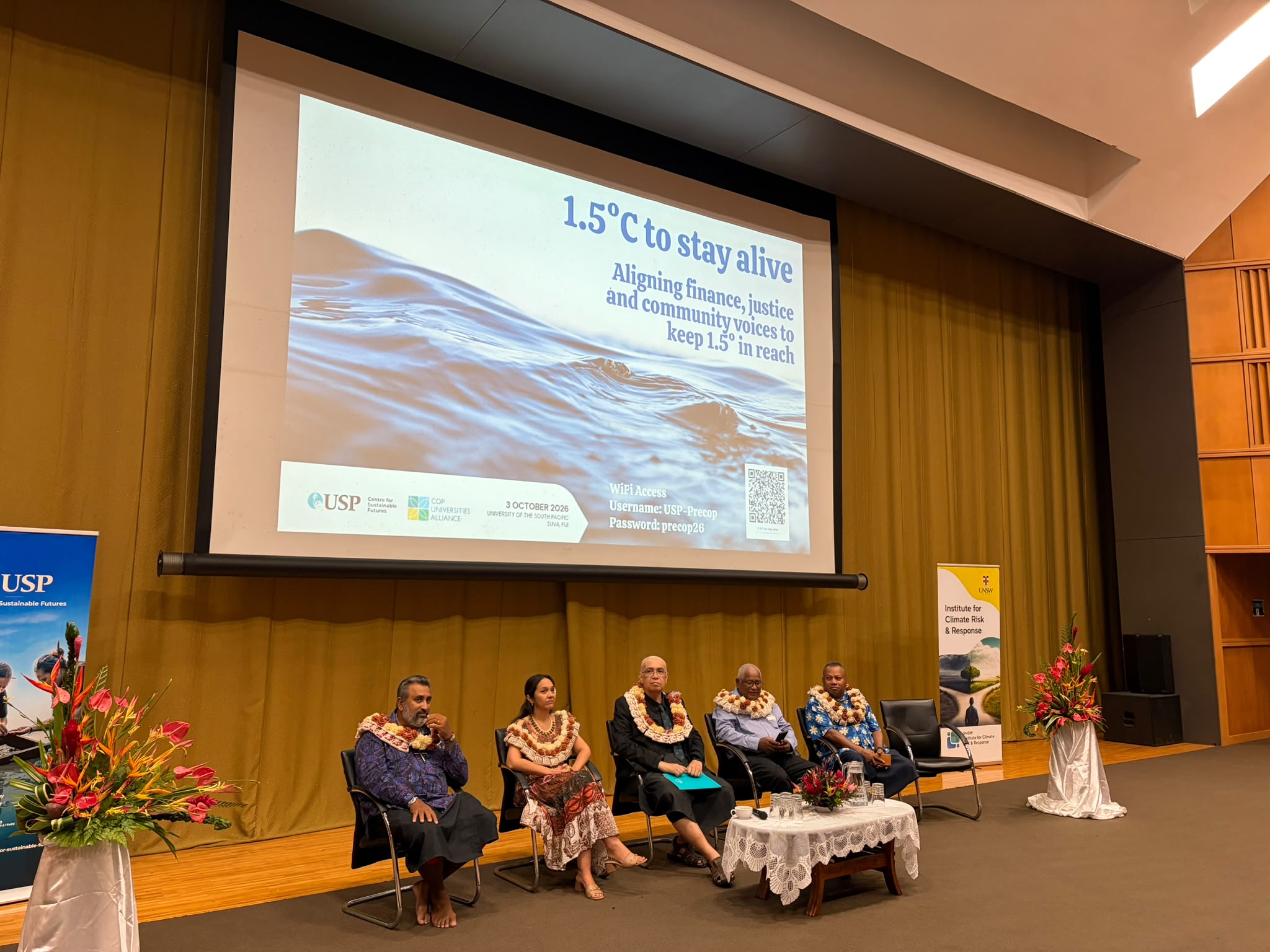
The 1.5 to Stay Alive Forum was organised by the COP Universities Alliance and hosted by the University of the South Pacific in Suva, Fiji, on 02 October 2026.