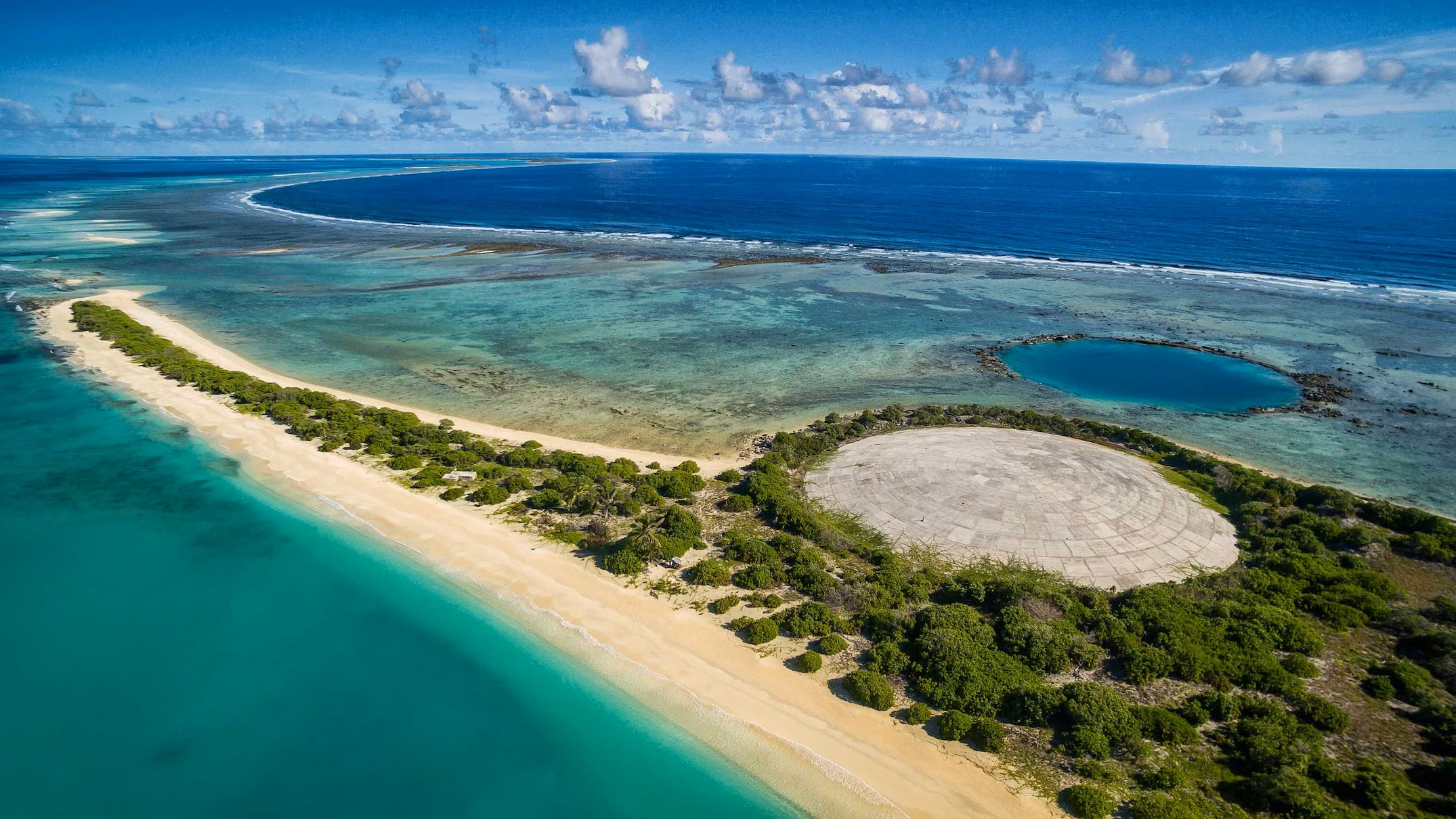
Eighty years after the first nuclear test was conducted in the Marshall Islands, survivors and their descendants are still seeking justice for the health, environmental, cultural and economic damage left by 67 nuclear tests.
The tests conducted by the United States between 1946 and 1958 had a combined explosive yield equivalent to more than 7,000 times the atomic bomb dropped on Hiroshima, with impacts continuing across generations.
“Nuclear testing has been a part of our lives now, 80 years now, and it has become a sad reality for the people of the Marshall Islands,” said Randon John, director for education and public awareness at the Marshall Islands National Nuclear Commission (NNC).
John was speaking at a side event during the 63rd session of the UN Human Rights Council in Geneva on “Nuclear Justice and Transitional Justice: Addressing the Human Rights Implications of the Nuclear Legacy in the Pacific.”
A UN Human Rights report says nuclear justice remains incomplete, with affected communities continuing to seek truth, recognition, accountability, remedies and reconciliation.
The report documents the immediate and intergenerational human rights consequences of nuclear testing and identifies legal, institutional and resource barriers that continue to limit access to justice.
It calls for reparatory and restorative approaches grounded in Marshallese culture, traditions and community priorities.
Benetick Kabua Maddison, Executive Director of the Marshallese Educational Initiative, said the nuclear legacy remains an active issue.
“The nuclear legacy is an unfinished issue.
“It is obviously ongoing, environmentally, medically as well as culturally. It is a legacy that we are still trying to fight to seek justice, that our people rightly deserve,” Maddison said.
The consequences include displacement, loss of traditional livelihoods, radioactive contamination and continuing uncertainty over whether land and locally produced food are safe.
The UN report notes that Bikini and Enewetak atolls suffered extensive environmental destruction, while radioactive contamination left Marshallese communities exposed to concerns over the safety of food from fishing and farming.
The economic and social impacts have also continued. Communities dependent on natural resources have faced restrictions on selling products from Enewetak and Rongelap because of radiation concerns, affecting their ability to participate in and benefit from economic, social and cultural development.
The Marshall Islands established the NNC in 2017 to address the continuing consequences of the nuclear legacy, including health impacts, displacement, cultural loss and environmental damage.
Since 2023, the UN Human Rights Office has provided technical assistance and capacity-building to support implementation of the NNC’s Nuclear Justice Strategy for Coordinated Action.
Heike Alefsen, UN Human Rights Regional Representative for the Pacific, said the support includes strengthening institutions, raising community awareness and helping the Marshall Islands engage with international human rights mechanisms.
“This is very practical work: raising awareness in communities, strengthening institutional capacity, providing legal guidance, and supporting engagement with international human rights mechanisms.
“Reporting and technical cooperation complement one another. They are not separate aspects of the mandate because our work on the ground helps identify opportunities, capacities and barriers to justice,” Alefsen said.
Alefsen said justice must extend beyond courtrooms and include education, customary law, art and Indigenous practices.
“The continued denial of an effective remedy is itself an ongoing human rights violation,” she said.
For Marshallese families, the nuclear legacy is also about the loss of ancestral lands.
Alice Ward, a youth representative of the Marshallese diaspora, said she cannot return to her home island of Bikini because of radiation concerns.
“Knowing that I can’t go back to my homeland Bikini due to the radiation … There’s no way I can go back and live where I belong,” Ward said.
The UN Human Rights Council has mandated the UN Human Rights Office to provide technical assistance and capacity-building support to the Marshall Islands and report every two years on progress towards a human rights-based approach to the nuclear legacy.
Marshallese representatives say justice must include acknowledgement, accountability, reparations, truth-telling, healing, remembrance and reconciliation.
They are also using their experience to warn against any repeat of the harm caused by nuclear weapons.
Speaking on the International Day for the Total Elimination of Nuclear Weapons on 26 September, NNC Commissioner Alson Kelen urged the international community to confront the continuing consequences of nuclear testing.
“Look at us, when you talk of the nuclear legacy in the Marshall Islands.
“Look at us, look at what we have been through and what we are still going through and what we will go through,” Kelen said.
Kelen said most Marshallese either have relatives who have suffered illnesses such as cancer or know families affected by illnesses associated with the nuclear testing legacy.
For the Marshall Islands, the nuclear issue is therefore not confined to history. Eight decades after the testing began, communities continue to seek remedies for harms that remain part of everyday life.