
By Pita Ligaiula in Koror, Palau
The Pacific Network on Globalisation (PANG) has warned Pacific Islands Forum Leaders against approving negotiations on two proposed regional security agreements, arguing they could formalise an already expanding military architecture without sufficient political control or public oversight.
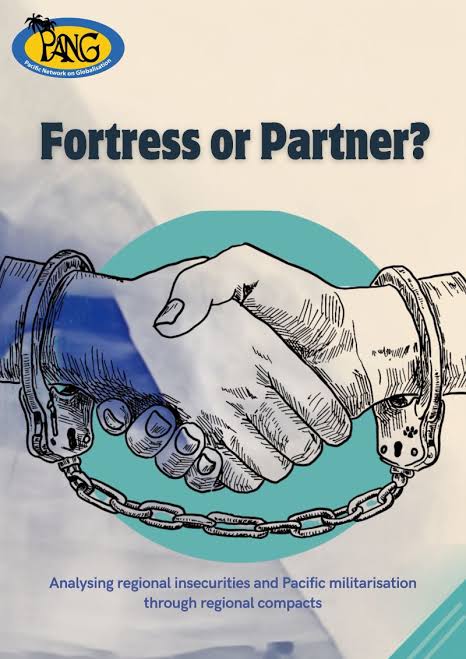
In a new report, Fortress or Partner? Analysing Regional Insecurities and Pacific Militarisation Through Regional Compacts, PANG said the key question facing the region was not whether the Pacific needed security, but “who defines it, who controls it, and who bears its consequences.”
The report comes as Forum Leaders meet in Palau, where the proposed Blue Pacific Ocean of Peace Regional Security Treaty (BPOPRST) and the Regional Operations Deployment Framework (RODF) are moving through regional processes.
PANG said the proposals should not be considered in isolation.
“The Pacific is experiencing a rapid build-up of overlapping, uncoordinated security frameworks driven by intense geopolitical competition,” the report said.
It argued that the proposed treaty and deployment framework would formalise a security architecture already being built through standing forces, bilateral security agreements and operational bodies supported by external powers.
PANG warned that new legal arrangements could “entrench foreign military access and conventional militarisation” while remaining silent on demilitarisation, autonomous weapons and nuclear non-proliferation.
‘Operationalised before it is governed’
A central concern raised by the report is that security capabilities are already being deployed before regional political and legal oversight has been fully established.
PANG pointed to the Pacific Response Group (PRG), a multinational military body for humanitarian and disaster response, and the Pacific Police Support Group (PPSG), which is part of the Pacific Policing Initiative.
The report said the PRG had already deployed to Vanuatu and the PPSG had been deployed to Samoa before a comprehensive regional framework governing the legal status and movement of personnel was in place.
“The RODF is not a proposal developed ahead of operational needs. It is being drafted to legalise a force that is already deploying without settled legal status,” the report said.
PANG argued that the sequence of events matters because operational capability, funding arrangements and bilateral security commitments have advanced ahead of the proposed regional legal and political framework.
“The question is not simply who is in charge today, but what exactly is being made permanent, under whose authority, and with what limits,” it said.
Call for Leaders to hold back
PANG is urging Forum Leaders not to authorise treaty negotiations for either the BPOPRST or the RODF during the Palau meeting.
Instead, it wants a consolidated assessment of how the proposed instruments would interact with other security structures already taking shape in the region.
These include the South Pacific Defence Ministers’ Meeting Status of Forces arrangements, the Integrated Regional Response Mechanism and proposals for a Pacific Peace Institute.
The report said allowing multiple security processes to proceed separately risked creating overlapping and uncoordinated regional arrangements.
PANG is also calling for Forum-level political oversight, ongoing civil society participation and explicit limits on militarisation if treaty negotiations eventually proceed.
“Pacific Leaders must establish strict political control and comprehensive civil oversight before signing permanent international agreements,” the report said.
‘Ocean of Peace’ or military architecture?
The report also raised concerns about the growing number of bilateral security agreements across the Pacific, particularly those involving Australia.
It argued that several Forum members had already entered into different security arrangements with Australia, meaning any future regional treaty would not begin from a “blank page”.
PANG said the Australia-Fiji Ocean of Peace Alliance was particularly significant because it shares the Ocean of Peace name with the proposed Pacific-wide treaty.
“A Pacific-wide treaty proposing to consolidate the region’s declarations is entering a field where a bilateral alliance already carries the same name,” the report said.
It warned that bilateral agreements with provisions allowing other Pacific countries to join could develop into wider regional security arrangements without going through a Forum-wide negotiation process.
The report said this raised questions about who would ultimately shape the meaning and practical implementation of the Blue Pacific Ocean of Peace concept.
Silence on nuclear issues
PANG said one of its major concerns was the absence of clear provisions on demilitarisation and nuclear issues.
It said neither the RODF nor publicly available information on the proposed BPOPRST addressed the Treaty of Rarotonga or nuclear weapons.
The report argued that this was significant as new defence arrangements, military exercises and emerging technologies expand security activity across the region.
“The absence of any commitment to demilitarisation is especially striking given the history the Ocean of Peace draws on,” PANG said.
It argued that earlier Pacific peace movements had explicitly opposed foreign military bases, military alliances and nuclear weapons, while the current security architecture was more focused on managing military activity.
“This is the infrastructure of a more heavily militarised region, arriving under the language of assistance,” the report said.
PANG said the issue before Leaders in Palau was ultimately about sovereignty and political control.
It is calling for wider consultation and greater transparency before permanent international agreements are negotiated and signed.
“The question is not whether the Pacific needs security,” the report said. “It is who defines it, who controls it, and who bears its consequences.” .