
By Nic Maclellan in Koror, Palau
Over the weekend, Pacific leaders started to arrive in Koror, Republic of Palau, for the 55th Pacific Islands Forum.
For this year’s host, Palauan President Surangel Whipps Jr, it’s a chance to showcase the Micronesian nation’s work on environment and development and an opportunity to bring in partners for programs on oceans, renewable energy and tourism.
Speaking to journalists before the summit, Pacific Islands Forum Secretary General Baron Divavesi Waqa said: “This year’s Forum theme – ‘B.E.L.A.U: Building Economies, Life, Action, Unity’ – reflects the collective journey of our Blue Pacific. It speaks to the imperative of building resilient economies, improving the lives of Pacific people, and translating commitments into tangible actions.”
For President Whipps, the rare opportunity to host the regional summit has been tempered by the absence of a significant number of Forum leaders, who will be represented by their foreign ministers or other nominees.
President Taneti Maamau of Kiribati has announced that he will not attend, to be represented by Director of the Foreign Service David Teaabo, a former Kiribati ambassador to China. Vanuatu Prime Minister Jotham Napat and his Sāmoan counterpart Laʻauli Leuatea Schmidt will both be absent, while the newly elected President of New Caledonia Milakulo Tukumuli is leading a delegation to Paris for financial talks this week, and will be represented by his predecessor Alcide Ponga. At time of writing, Fiji Prime Minister Sitiveni Rabuka is another possible no show.
The greatest shock, however, will be the absence of the outgoing Forum Chair Matthew Wale, Prime Minister of Solomon Islands. Wale flew to Palau over the weekend but turned around to head straight home after the announcement of a no-confidence motion lodged by his own Home Affairs Minister Manasseh Maelanga.
The complexities of coalition politics across Melanesia are not new, but Wale’s absence from the Palau summit will affect this week’s debates over missile testing and regional security. The Solomon Islands leader has been working with Australia’s Albanese government on a proposal for a Pacific-wide regional security agreement, which will likely be a drawn-out process.
Packed agenda
For the remaining Presidents and Prime Ministers, the Forum agenda in Palau is overloaded with issues at a time of fast-shifting geopolitics.
Pacific countries are concerned by the economic fallout of the ongoing US and Israeli aggression against Iran, which has raised fuel, energy and transport costs for small island states, adding extra debt to already stretched national economies.
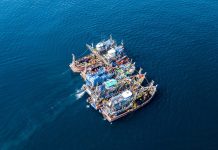
Another central topic will be the effects of transnational crime, at a time when narco-cartels are increasing the transit of cocaine and ice shipments through the islands towards the large Australian and New Zealand markets. There are however significant spillover effects into the islands, through local manufacture, corruption of police and community leaders, and adverse effects on public health (highlighted by the rapid spread of HIV in Fiji through the sharing of needles and blue-toothing drugs).
Leaders this week will also consider adoption of a Belau declaration on climate change. The statement will set out current regional concerns in the lead up to the preliminary Pre-COP to be held in Fiji and Tuvalu in October, followed by the 31st Conference of the Parties (COP31), to be hosted by Türkiye in Antalya between 9 – 20 November.
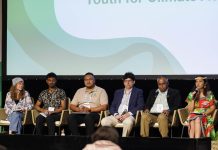
Karlos Lee Moresi, the Forum’s advisor on Climate Finance and Resilience, said that the region had adopted four key pillars for their advocacy in coming months.
“One is obviously keeping 1.5 degrees within reach – it’s the core driver of climate change,” he said. “Then finance, it’s the second pillar. The third pillar is the ocean–climate nexus, elevating this to the UNFCCC process, and the fourth pillar is amplifying Pacific voices.”
A key priority is the promotion of the newly created Pacific Resilience Facility (PRF), a Pacific fund that will manage financing and small grants for disaster resilience projects at grassroots and community level. With US$173 million already pledged for the PRF’s capital base, Forum leaders are expected to issue a renewed call for global pledges to this innovative climate financing mechanism.
For PRF General Manager Finau Soqo, “the pathway from this leaders meeting to the Pacific Pre-COP in Tuvalu and Fiji, and onwards to Antalya, is a very key pathway for the PRF.”
Previous discussions with donors had been hampered by the delay in formalising the PRF structure and governance, but the treaty entered into force in May. For Soqo, “now PRF is a reality, the focus is on bringing forward the PRF as a legal entity, as a channel for climate financing to be channelled through to our regional communities.”
Ocean partnership
On Sunday, President Whipps hosted an Ocean Partnership Roundtable, highlighting the need for co-operation for the 30 by 30 challenge: a global target to protect and conserve at least 30 per cent of the world’s oceans by the year 2030.
“Far beyond our shores, the blue Pacific is a vital life force for the entire planet,” Whipps said. “It stabilises the global climate, provides food security for millions across the globe, and safeguards some of the richest marine biodiversity on Earth. Yet, the ocean that sustains us is in deep crisis. The triple planetary crisis, climate change, biodiversity loss, and pollution is threatening the very life force that has nurtured us for generations.”
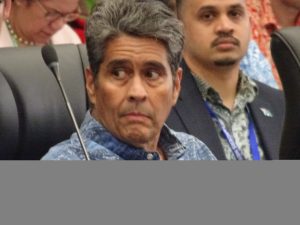
Peter Thomson, the UN Secretary General’s Envoy for the Ocean, noted: “A healthy planet without a healthy ocean, and the ocean’s health is currently generally in decline. Pollution, fisheries malpractice, random atmospheric greenhouse gas emissions, leading to the heating of the ocean, rising sea levels, ocean acidification, death of coral, fast-offering marine habitats, loss of biodiversity, weakening ocean currents, and changes to the planet’s weather system.”
In response, Pacific Ocean Commissioner Filimon Manoni stressed that advocacy and research on ocean protection is a central element of this week’s regional dialogue in Palau: “We have taken many steps: we have participated in international agreements and negotiations that underscore the centrality of the ocean to our lives to our identity and home.”
“Leaders are going to have a look at issuing another statement,” Manoni said, “renewing their call for more important, more urgent action on the health of the ocean. The statement defines our existing and regional position on the ocean. It sets the Pacific’s direction toward COP 31 and taking forward regional collective action under the 2050 Strategy [for a Blue Pacific Continent].”
Regional Architecture
For Forum member countries, engagement with overseas players is an ongoing problem, reflecting the increasing importance of the islands region in Asia-Pacific geopolitics.
Over many years, participation at the annual Pacific Islands Forum has grown, with an increasing number of Forum Dialogue Partners, official observers and media, joined by delegations from civil society and the Pacific Islands Private Sector Organisation (PIPSO). This year, an estimated 2,000 participants may arrive in Palau, and the official program of meetings is complemented by a dizzying array of side events.
The Forum currently has 21 Dialogue Partners (key regional players like China, Japan, the European Union and France, along with a range of countries – such as Italy, Thailand and Cuba – that are not centrally involved in regional affairs). The eagerness of many nations to engage with the PSIDS group at the United Nations is highlighted by the queue of another six nations hoping to obtain Dialogue Partner status (Israel, Saudi Arabia, Ukraine, Denmark, Ecuador, and Portugal), each with their own agendas.
In response, a key item this week is the implementation of the Leaders’ Partnership Policy, adopted at last year’s summit in Honiara.
Over the past year, Forum officials have been assessing the role and capacity of the 21 Dialogue Partners, and this week they’ll present leaders a recommendation to implement a two-tiered system to transform current arrangements.
Forum Deputy Secretary Esala Nayasi said: “There are two key categories for partners that will be discussed by leaders: one is the strategic partners, and the second are sectoral partners. Instead of 21 partners that engage with leaders annually, leaders will only be engaging with strategic partners. Sectoral partners will engage at the ministerial level.”
While the Forum is the Pacific’s policy and political hub, there are many other members of the Council of Regional Organisations of the Pacific (CROP), such as the Forum Fisheries Agency (FFA), the Pacific Community (SPC), the Pacific Tourism Organisation (SPTO), the University of the South Pacific (USP), the Regional Environment Program (SPREP) and more.
Esala Nayasi said that another key element of this week’s summit is to consider the latest recommendations of the Review of Regional Architecture, seeking to streamlining this network.
“It’s about how do we work together as CROP agencies as one regional system, even though we have different mandates and membership issues,” Nayasi explained. “The way we run our organisations also differ, but the important thing is we need to look beyond that to see ourselves as one regional system.”
The Forum Secretariat is also working to clear the decks, integrating diverse mechanisms for regional co-ordination on peace and security.
Over many years, the Forum has adopted a series of declarations on peace and security, from the 2000 Biketawa Declaration to the 2018 Boe Declaration on Regional Security and last year’s Ocean of Peace Declaration. But each of these declarations has an implementation plan that often overlaps or conflicts with other frameworks – so in Palau this week, leaders will consider a new consolidated plan.
Salome Taufa, the Forum’s Director for Governance and Engagement, explained: “We have a number of security regional policies, so the action plan here is one that consolidates all those security policies into a single action plan. That is something that the leaders will consider this year.”
Taiwan and China
With host nation Palau maintaining diplomatic ties with Taipei rather than Beijing, the annual China-Taiwan stoush is already underway in Koror.
Taiwan’s Minister of Foreign Affairs Lin Chia-lung flew into Palau for meetings on the sidelines of the leaders’ summit with the three remaining Forum members that maintain bilateral diplomatic ties (Palau, Tuvalu and Republic of Marshall Islands).
His trip was welcomed by Forum host Surangel Whipps and the US State Department, which issued a statement that “strongly supports Taiwan’s continued participation in the Pacific Islands Forum, where it has been a development partner for over three decades.”
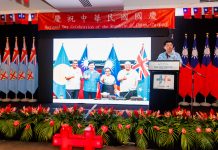
At a ceremony on Sunday, President Whipps joined with Foreign Minister Lin at the launching ceremony of a Taiwan-Palau Hydrogen Station Initiative. Whipps said: “This gives us a great opportunity to share with the Pacific and the strength of our partnership, the successes we have achieved together, and what more we can do together.”
But despite widespread international headlines that Taiwan is “back at the Forum”, its relationship with the regional body is unchanged. At last year’s Forum in Honiara – where no partners were present – leaders reconfirmed the status quo on Taiwan, which has never been a Forum member nor a Dialogue Partner (the status currently granted to 21 non-member countries).
For years, Taiwan has contributed to the Forum Secretariat and its regional allies as a so-called “development partner.” But last year’s Forum communique also stated that the new Leaders Policy on Partnership approved last year does not apply to development partners (i.e. Taiwan).
This uneasy compromise ensures ongoing debates about Taiwan’s relationship with the regional organisation. China’s Special Envoy to the Pacific Qian Bo is leading the PRC delegation to Palau, so the issue will drag on throughout the week, drawing international attention away from the Forum’s Blue Pacific agenda of climate action, ocean protection and human development.
Despite all these tensions, the Forum Secretariat continues to argue for the importance of collective, united action in the face of growing international uncertainty and strategic competition.
For Deputy Secretary General Esala Nayasi, “there is an appreciation of the value of regionalism and there is acknowledgement that we all need regionalism to work. We can’t implement or we can’t do things on our own as individual countries. It is important that there are issues that we need to work together, to deliver together as one collective voice, as one unit.”