

By Pita Ligaiula in Koror, Palau
Pacific Islands Forum leaders are set to consider a major overhaul of how the region engages its 21 dialogue partners and how the nine Council of Regional Organisations in the Pacific (CROP) agencies work together as one regional system.
Forum Deputy Secretary-General Esala Nayasi said the changes are part of the wider review of the Forum’s regional architecture, aimed at ensuring the regional system can better deliver the priorities of Pacific leaders.
He said the partnership review would move away from the current arrangement where all 21 dialogue partners engage directly with leaders each year.
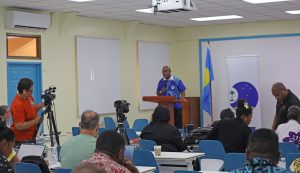
“Leaders have made the decision and instructed that we need to re-look at the way that we engage with our partners. It cannot be on the same format that we normally have,” Nayasi told Pacific journalists in Palau.
Under the proposed arrangement, partners would be placed into two categories — strategic partners and other partners — with only strategic partners engaging directly with Forum leaders.
“Instead of the 21 that engage with leaders annually, leaders will only be engaging with strategic partners,” Nayasi said.
He said other partners would engage at ministerial level, while strategic partners would also be able to participate in ministerial discussions.
“There are various criteria or factors that we have considered in this process,” he said.
Nayasi said officials and foreign ministers had considered the issue and would provide recommendations for leaders to consider during their retreat next week.
He stressed that the proposed changes did not mean some partners would be given less importance.
“In no way does it mean that we discriminate against any partner, or does it put lesser value to some of our partners.
“It is due to the engagement that the leaders have with partners during the leaders’ week. We want to elevate discussions at a strategic level,” he said.
Nayasi said the new approach would allow leaders to focus their engagement with partners on issues affecting the region and its changing strategic environment.
“The strategic context that we have under this mechanism will allow for some of those direct discussions on key issues that affect the region and how the leaders in the region would want to manoeuvre through this challenging strategic environment,” he said.
He said a large number of partners and observers would still be present in Palau during the Forum Leaders Meeting.
“You will see a large number of partners will be here next week,” Nayasi said.
He said the regional architecture review went beyond the partnership mechanism and included the structure and operation of the nine CROP agencies.
Nayasi said the review was driven by a 2019 leaders’ decision that the regional architecture needed to support implementation of the Forum’s 2050 Strategy for the Blue Pacific Continent.
“Leaders were clear in their wisdom that for us to be able to implement the 2050 Strategy, we need an architecture that can best support it.
“Therefore, we have instructed that we review the CROP mechanism and see that it basically comes up with a regional system that can best support the delivery of leaders’ priorities and also their expectations,” he said.
The review has examined four areas: institutional arrangements, governance, membership and political participation, and partnerships.
Nayasi said a high-level political team had previously presented recommendations to leaders, who requested further work on specific issues.
A review committee then undertook further work this year, with its recommendations going through officials and foreign ministers before being presented to leaders next week.
He said the central question was how the nine CROP agencies could work more effectively as one regional system despite their different mandates, memberships and organisational structures.
“So it’s about how do we work together as CROP agencies, the nine CROP agencies as one regional system, even though we have different mandates, membership issues, differences within the different organisations, and the way we run our organisations also differ.
“But the important thing is we need to look beyond that to see ourselves as one regional system where we can deliver as one.
“After all, we are serving the same people and the same members that need our support ,” Nayasi said.
The partnership mechanism and the wider CROP review are expected to be among the key issues considered by Forum leaders in Palau next week.