
A special audit into how the Solomon Islands National Hosting Authority (NHA) spent public money for the 2023 Pacific Games has uncovered serious failures in procurement, financial controls and record-keeping.
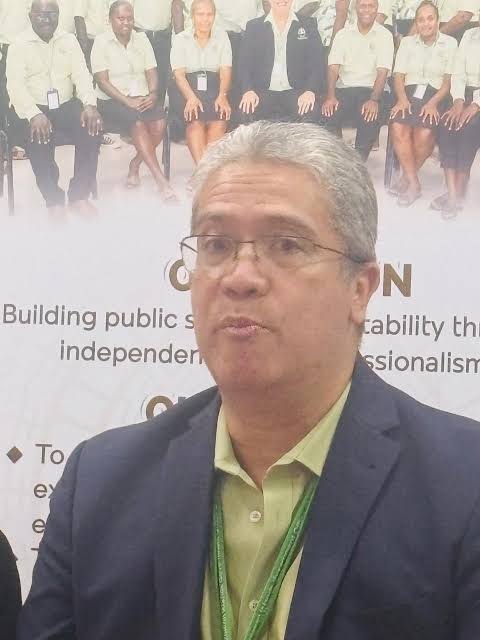
Outgoing Auditor General David Teika Dennis released the report last week
His audit examined a sample of 16 procurement activities worth SBD$222.4 million (US422.75 million) from a total of SBD$502.16 million (US$62.67 million) in purchase orders associated with the Games.
Dennis described the findings as “serious“.
“My overall conclusion is serious,” Dennis told reporters.
“The National Hosting Authority failed to comply with key requirements of the Public Financial Management Act in its expenditure and procurement practices,” he added.
“We also found that the Authority did not have the legal authority needed to incur expenditure from the Special Fund.
“We found procurement practices that were contrary to the law and contributed to waste and probity concerns.”
One of the major findings was that competition between contractors was bypassed without sound justification.
The audit also found that evaluation decisions did not follow prescribed processes and that due diligence checks were not properly carried out.
Dennis said conflict-of-interest controls also failed to adequately protect the procurement process.
The audit identified the misuse of customs duty exemptions as another area of concern.
“Poor records management and inadequate audit support further compounded the problems.
“The result was a procurement system in which auditors struggled to establish how some key decisions were made.”
Dennis said the audit uncovered multiple layers of weak practice, missing records and errors.
In some cases, he said, those problems overlapped and reinforced each other.
This made it difficult to trace the sequence of events and determine how particular procurement decisions were reached.
The scale of the spending puts the findings into sharp focus.
The audit’s detailed review covered 16 procurement activities totalling $222.4 million(US422.75 million), selected from $502.16 million(US$62.67 million) in purchase orders.
“The Pacific Games were one of Solomon Islands’ largest national events, requiring major investment in sporting venues, accommodation, transport, equipment, logistics and other infrastructure and services.
“The audit was therefore intended to establish whether public funds associated with the Games were spent lawfully, properly and transparently.
“Instead, it has exposed significant weaknesses in the systems used to manage that money.”
Dennis said the underlying details of the cases examined had been documented and that referrals would be made where there were concerns about fraud or wrongdoing.
“That does not mean the audit has established that fraud occurred.
“But it means cases raising sufficient concern will now be referred for further consideration,” Dennis explained.
The audit also highlighted a fundamental problem: missing or inadequate records.
Public entities, the Auditor-General said, must maintain complete, signed and properly organised records of significant receipts, payments, approvals and decisions.
“Those records must be readily available when audits are conducted,” he added.
The report found that this standard was not consistently met.
Dennis said public officers responsible for approving or managing financial transactions must understand their responsibility to maintain proper records.
“Where records are missing, incomplete or unreliable, there should be clear accountability for that failure.”
The audit also warned that major projects and special funds require properly resourced financial management functions.
That includes qualified personnel with the necessary time, skills and authority to maintain records, respond to audit requests and ensure spending is lawful, approved and properly documented.
The Office of the Auditor-General and KPMG said the report should help the country strengthen its systems before hosting similar events.
The audit office said its recommendations should assist the Government and relevant ministries to improve the planning and delivery of future national events.
It also stressed the need to uphold transparency and accountability in the use of special funds.