

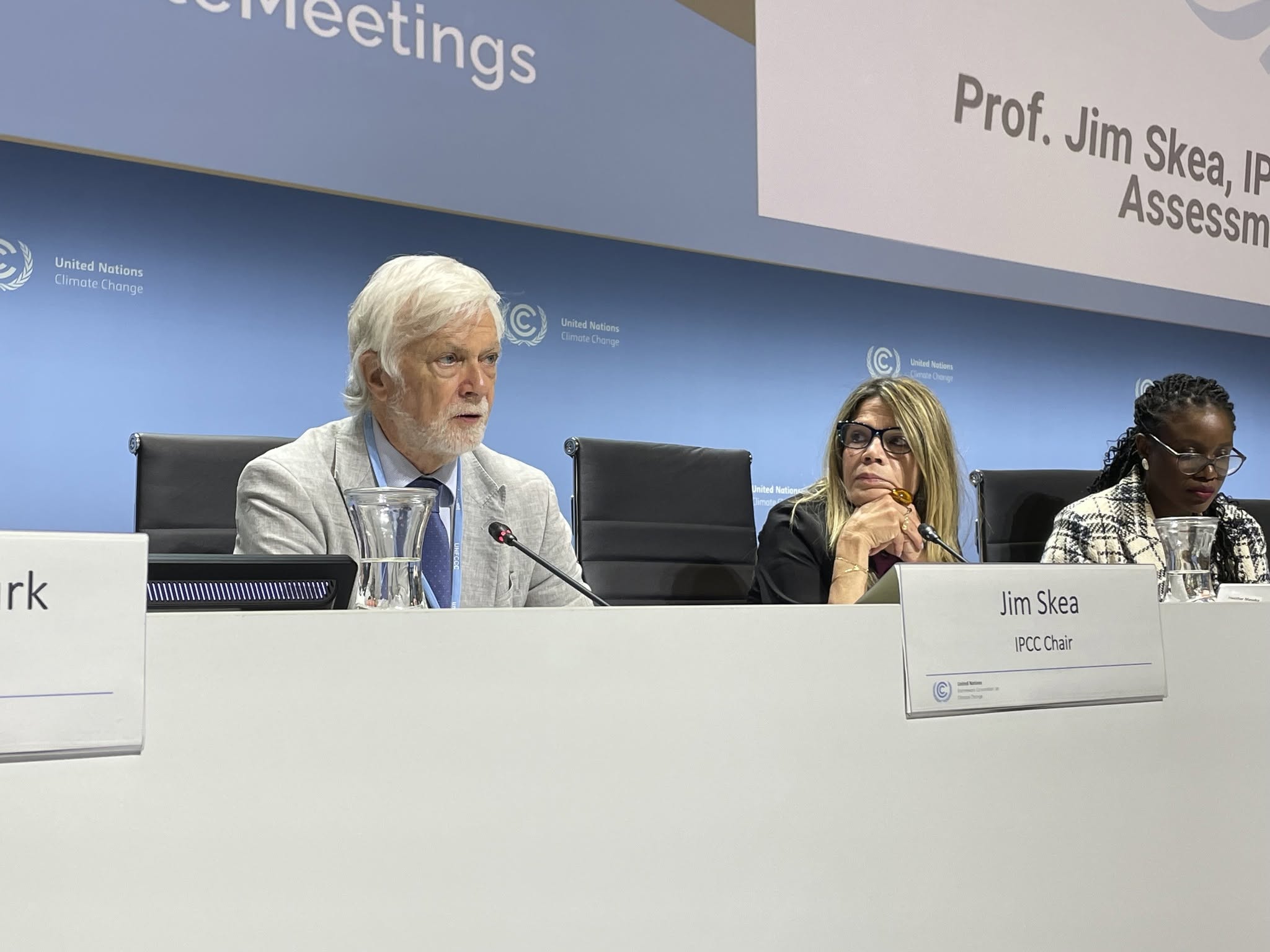
IPCC Chair Jim Skea has warned that the world is now approaching a point where exceeding 1.5 degrees Celsius of global warming is “almost inevitable,” while outlining major scientific work underway for the Seventh Assessment cycle of the Intergovernmental Panel on Climate Change (IPCC).
Addressing the 18th Meeting of the Research Dialogue during the 64th Session of the Subsidiary Body for Scientific and Technological Advice (SBSTA64) in Bonn, Skea said the IPCC’s latest assessment cycle is now well advanced, with all planned reports scoped and authors selected.
“Nearly three years into the cycle, the scientific content of all our planned reports has been agreed, and authors have been selected. We already have three reports scheduled for release next year.”
Skea said the first report expected from the cycle will be the 2027 Special Report on Climate Change and Cities, which is currently undergoing government and expert review.
“In about nine months, the IPCC will hold an approval plenary for the 2027 Special Report on Climate Change and Cities. As we meet here, the Government and Expert Review of the Second Order Draft of the Special Report and the first draft of its Summary for Policymakers is under way and will close in the first week of July,” he said.
He also highlighted progress on two methodology reports that will provide guidance to governments on measuring and reporting greenhouse gas emissions and removals.
Meanwhile, all three IPCC Working Groups are advancing their contributions to the Seventh Assessment Report, although timelines for the reports remain under discussion.
“This brings me to the Panel´s pending decision on the timelines for the three Working Group contributions to the Seventh Assessment Report. I have started consultations with the IPCC member governments, Bureau members, and the Secretariat on criteria for assessing timeline options, with a view to reaching consensus at the IPCC’s next Plenary in October,” he said.
Skea stressed that a decision on timelines is critical for the thousands of scientists contributing voluntarily to the assessment process.
“As a scientist myself and the Chair of the IPCC, I cannot overstate the importance of this decision for the scientific community gathered around IPCC. We have more than a thousand scientists from every continent and region who volunteer their time and expertise to work on IPCC reports. They deserve clarity about the duration of their voluntary commitment to the IPCC, allowing them to plan their professional and private lives accordingly,” he said.
A major part of Skea’s address focused on climate scenarios, where he sought to clarify misconceptions about the IPCC’s role.
“First, on scenarios. And let me stress from the start that there are no IPCC Scenarios. There are only published scenarios assessed by IPCC. IPCC does not conduct research and decided nearly 20 years ago not to engage in scenario development,” he said.
He said the Seventh Assessment Report will assess a broad range of scientific scenarios from multiple community databases rather than relying on a single IPCC-endorsed database.
“Importantly, there will be no single IPCC-endorsed ‘scenarios database’ to support the Seventh Assessment. Instead, authors aim to assess multiple ‘community databases’.”
Skea noted that advances in clean energy and recent emissions trends have altered expectations about future emissions pathways.
“Note that the range of emissions covered by the CMIP 7 Assessment Fast Track will be narrower than in CMIP 6. The upper end of the range is no longer considered plausible, partly due to progress in clean energy.”
“At the lower end, due to a lack of progress in reducing global emissions, many CMIP6 emission trajectories have become inconsistent with recent trends,” he said.
However, he cautioned that this does not necessarily mean uncertainty about future warming will narrow.
“However, the range of temperature responses may not narrow in the same way because of uncertainties in the physical climate system. We must be very careful to distinguish between emission scenarios and warming scenarios, a distinction not always evident in recent commentaries,” Skea said.
Turning to adaptation, Skea said climate resilience will receive greater attention in the Seventh Assessment Cycle as global temperatures continue to rise.
“It is now almost inevitable that we will soon exceed global warming of 1.5 degrees Celsius above pre-industrial levels, the warming level beyond which risks start to accelerate. The urgent need to enhance resilience and step up adaptation efforts is obvious.”
He said adaptation is receiving increased prominence within the new assessment.
“The word ‘adaptation’ appears in three chapter titles of the Working Group II report on impacts, adaptation and vulnerability. This is three more times than in the sixth assessment cycle. This signals clearly a new emphasis on climate action.”
Skea said the IPCC is also updating technical guidelines first developed in 1994 to improve how adaptation progress is measured and assessed.
“The update will emphasise indicators, metrics and methodologies. These should provide useful guidance on planning, including mainstreaming adaptation of a more transformational character into existing policies and practices,” he said.
The IPCC Chair also highlighted efforts to strengthen engagement with Indigenous knowledge systems and local knowledge holders.
“This Workshop, as the title suggests, addressed how IPCC could engage with Indigenous knowledge alongside local knowledge holders and practitioners, considering the effective and equitable engagement of Indigenous knowledge holders and building on experience built up in other fora, such as IPBES,” he explained.
He said workshop participants developed recommendations covering expert selection, knowledge assessment, participation, capacity building and institutional reforms, although these recommendations have not yet been endorsed by the IPCC Panel.
Skea said the Seventh Assessment Cycle is gathering momentum and will begin delivering reports next year.
“But to conclude, the IPCC Seventh Assessment cycle is now well under way and we look forward to start delivering our reports from early 2027 onwards,” he said.