
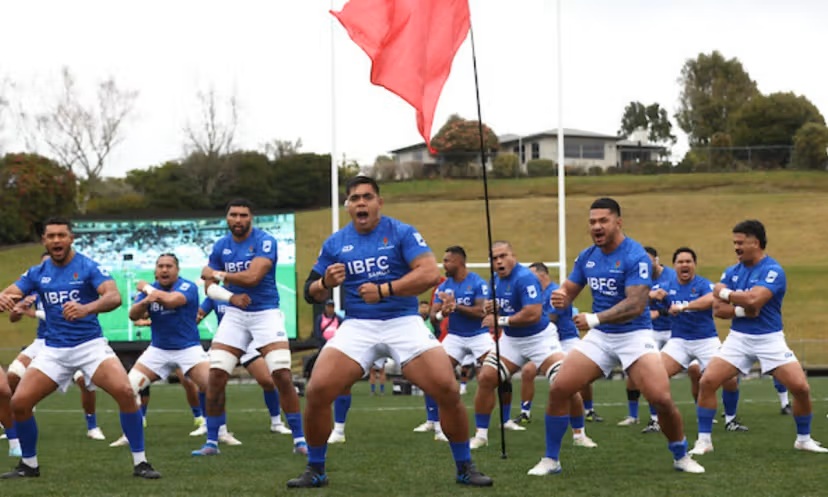
Sāmoa is considering a long-term push to establish its own Super Rugby franchise as it reshapes its future in the sport around homegrown talent and stronger local pathways.
In an exclusive interview with Tuilagi William Leolahi from Pacific Huddle, Lakapi Sāmoa chief executive Seumanu Douglas Ngau Chun says the idea is still developing but could become realistic within a few years if new funding and domestic competitions are strengthened.
“Probably in the next two to three years, that’s when we’re able to fund a team with assistance from the Australian government,” he said.
The push comes as Sāmoa looks to reduce reliance on overseas-based players with fewer eligible athletes now coming through from New Zealand and Australia.
The proposal is part of a five-year, AU$150 million (NZ$182.23m) regional funding package known as the Veimoana Partnership, which aims to strengthen rugby pathways across Sāmoa, Tonga and Fiji.
The plans also come as Lakapi Sāmoa continues to navigate wider governance and leadership challenges at home including tensions over the direction of the sport in the Pacific Island nation.
Seumanu says the biggest challenge is keeping players in the local system long enough to develop.
“The biggest gaps that we have at the moment is that we’re trying to hold our players back on the island,” he told Leolahi.
“There’s a high turnover of players moving overseas through seasonal workers, through other schemes, and going to play club rugby overseas.
“So we tend to have a high number of players that are missing out at the development stage from the 20s up to Manu Sāmoa level.”
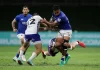
Sāmoa already has a structured pathway from school rugby through to development squads and the national team, the Manu Samoa.
But officials say the system is under pressure as more players leave and eligibility rules tighten.
Work is already underway to strengthen domestic rugby with school and village competitions being reshaped to give young players more consistent game time.
Lakapi Sāmoa has cut competition zones and increased the number of matches played while recent school tournaments have helped restart momentum in the grassroots game.
The aim is to build depth at home so players are better prepared for higher levels.
The debate comes amid uncertainty over the future of Moana Pasifika, which was created to provide a professional pathway for Pacific players.
Seumanu says frustration grew over limited opportunities for locally developed talent, leading to Lakapi Sāmoa withdrawing support earlier this year.
“We were frustrated with not even selecting the players from here,” he says.
He adds players were brought into combined development squads with Tonga but struggled to break into the Super Rugby side itself.
Super Rugby Pacific chief executive Jack Mesley has reportedly said the competition is still stable despite uncertainty around Moana Pasifika.
Super Rugby Pacific chief executive Jack Mesley says there is ongoing interest from new parties looking to join the competition as discussions continue about its future direction. Photo/Super Rugby Pacific
He described the franchise as “about something bigger than just winning the games” and confirmed there is ongoing interest from new parties looking to join the competition.
“We have inbound interest to join this competition.”
Mesley’s comments come as organisers continue discussions on the future of the tournament and possible expansion.
Attention is now turning to the regional funding support including a proposed Australian-backed package aimed at strengthening Pacific rugby pathways.
Australia has already invested in Pacific rugby through the Fijian Drua, which is based in Fiji and has become a key example of a successful locally rooted franchise.
That model is now being closely watched in Sāmoa as it considers its own long-term ambitions.
Seumanu says any future Super Rugby team must be built on strong domestic foundations first.
“We can’t have a super team, but we don’t have a competition, a feeder competition here on the island,” he says.
Under current proposals, Sāmoa could eventually field teams in a wider regional competition involving Tonga, Fiji, and Australia to give local players regular high-level matches.
For Seumanu, the priority is still clear: strengthen the system at home first, then build outward.
“I wanted to leave a legacy here of an organisation that is very powerful,” he says. “And from there, we’ll get to have more opportunity for local Sāmoans to be exposed to higher-level representations overseas.”
With funding discussions ongoing and Pacific rugby in a period of change, Sāmoa is now weighing whether its future could include a place in Super Rugby built on its own talent and on its own terms.