Home Blog Page 1237

Palau President Whipps says PIF apology over Secretary-General selection requires action

Palau President Surangel Whipps Jr said while Micronesia welcomes the apology made by the Pacific Islands Forum (PIF), the sub-region will remain steadfast on leaving the regional grouping unless changes are made.

“I am sorry for what. So the apology should come with the remedy. I assumed there are working on a remedy,” he said.

The remedy he said would be for incoming Secretary-General Henry Puna to step aside and let Gerald Zackios, Micronesia’s preferred candidate to take the post.

“So that is what I am hoping and that we are moving forward in that direction. If Micronesia is in, Puna is out, if Puna is in, Micronesia is out,” Whipps said in an interview.

Federated States of Micronesia (FSM) President David Panuelo in an interview with ABC Radio Australia said the withdrawal of the membership of Micronesia remains.

Panuelo says the decision to withdraw from the Forum still stands but “the way forward is very positive”.

“The position remains the same but the dialogue continues and so therefore in May I believe we will be having a much more in-depth review,” he said.

The apology was made during the Forum Troika Plus political dialogue held virtually on 26 April.

Micronesian leaders in attendance – Nauru President Lionel Aingimea and FSM President Panuelo received an apology from Papua New Guinea Prime Minister James Marape, Samoa Prime Minister Tuilaepa Sailele Malielegaoi, Fiji Prime Minister Frank Bainimarama, and Pacific Islands Forum Secretary-General Dame Meg Taylor.

In a statement from the Nauru government, it stated that the Pacific leaders “ expressed regret’ on the handling of the PIF selection of new secretary-general and “acknowledged that the situation could have been managed differently and better.”

Forum Chair and Prime Minister of Tuvalu Kausea Natano expressed sadness in the current rift and reminded the leaders that the dialogue was to listen to the concerns and issues of the Micronesian presidents and to “secure the solidarity of our region.”

President Aingimea is deeply thankful and moved by the depth of sincerity in the apologies he describes as “resonates deep within my heart.”

“Leadership is shown at times like this and to the Prime Minister of Papua New Guinea, the Prime Minister of Samoa, and the Prime Minister of Fiji, you have shown yourselves to be able leaders; wise leaders, in bringing words like this to us here.”

The leaders appealed to Micronesia not to leave the forum, and going forward vowed that the SG position would be on rotation.

SG Taylor said, “while denunciations have been served there is time yet to strengthen the union.”.

SOURCE: ISLAND TIMES/PACNEWS

PNG Covid-19:Mistrust fuels crisis as infections rise

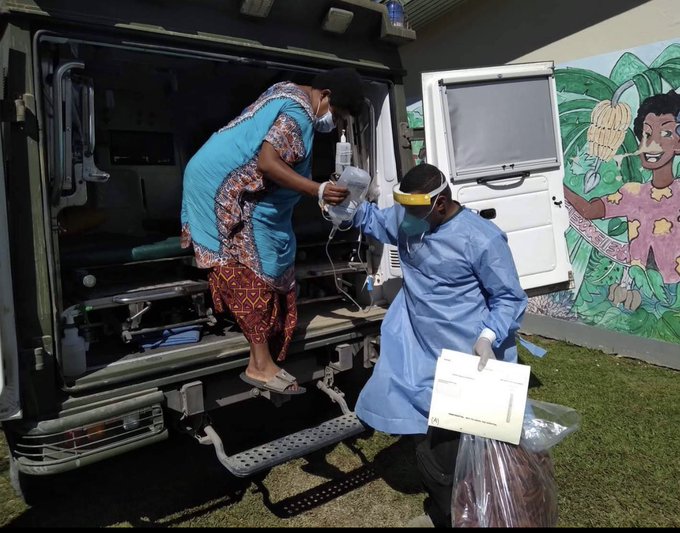
In the dense fog of Covid-19 misinformation in Papua New Guinea (PNG) lurk deeply embedded beliefs in witchcraft.

As Australia’s nearest neighbour battles with what experts say is an exponential surge in coronavirus cases, fears of unexplained deaths have had sinister consequences.

Sanguma – a local word that refers to the occult – is common across the Pacific. It is a mostly benign tradition, but with a darker side.

“A couple of weeks ago, one of the health workers in a rural facility died of Covid and his wife and daughter were tortured because of a belief in sorcery, and later they were confirmed with Covid as well,” explained Justine McMahon, PNG country director for Care International, a development charity. “Sorcery certainly plays into some of the attitudes that people have.”

Black magic is entangled in a swirl of conspiracies, suspicions and false rumours that are compounding one of PNG’s greatest public health emergencies.

“Misinformation is spreading faster than the virus. There is a huge degree of scepticism towards vaccinations,” warned Jonathan Pryke, the director of the Pacific Islands Programme at the Lowy Institute, a Sydney-based think-tank. “Social media is really fuelling the misinformation and the mistrust of the vaccine.

Supplies of the AstraZeneca drug delivered by the global Covax programme are expected to be administered within days.

There have been just under 11,000 Covid-19 infections and 107 deaths in PNG, according to Johns Hopkins University’s coronavirus resource centre. Seasoned observers, though, doubt this is an accurate reflection of the crisis because of low levels of testing, infected patients who aren’t seeking treatment, and fatalities not being identified with the virus.

“Covid has been growing exponentially since Christmas. It’s extremely bad,” Pryke told the BBC. “The health system is so stretched to breaking point that it really can’t handle the shock. The official statistics dramatically underestimate just how severe the challenge is.

“The only thing really insulating PNG from this crisis is that they have a very young population. So a lot of people are getting sick and recovering.”

Justine McMahon is based in Goroka, the capital of the Eastern Highlands Province. She sees worrying signs of complacency, even among teachers and medical workers.

“Many of those people are also propagating misinformation. People actually have to take this seriously,” she said. “Few people are following [public health] precautions. There is a lot of ambivalence. There is a lot of really doubting whether the virus affects the people, so that is a real struggle.”

When Professor William Pomat, director at the Institute for Medical Research in Papua New Guinea, developed chest pains, respiratory problems and rising panic, he recognised these as the signs of a Covid-19 infection.

“When you are feeling out of breath or your chest is tightening , you are thinking: am I going to be the next statistic? So all that is scary,” he told the BBC. “Mentally that affects you as well as not knowing what will happen next as you work through the different infection stages. I am quickly heading towards the 60th year of my life, so it does worry you.”

After 14 days in isolation, he is on the mend and back at work on the front line. But the fight against the pandemic hardly seems fair.

It is estimated there are 5,000 health workers in PNG for a population of 10 million people.

The South Pacific nation is wracked by other communicable diseases, and has disturbing rates of HIV, as well as infant and maternal mortality. Covid-19 is heaping more pressure on a fragile medical system.

“It is going to make other diseases worse if we continue the way we are going with health workers getting infected [with coronavirus] and staying away from work and allowing all the other infectious diseases like tuberculosis and malaria to continue to spiral out of control,” Prof Pomat warned.

Covid-19 has been diagnosed in each of PNG’s 22 provinces. It’s unclear why cases are now rising. New strains of the virus might have been imported across a porous land border with Indonesia, but perhaps there is a more simple explanation.

“We became complacent and we let go of wearing masks,” said Prof Pomat. “From the leadership level, many of us were just as guilty as the normal people.”

Member of Parliament Richard Mendani, who was 53, has died with the virus, along with at least two judges.

Saschveen Singh, a tropical infectious diseases adviser for Medecins Sans Frontieres, has recently arrived in Port Moresby, the capital of PNG.

“There is quite rampant community infection,” she told the BBC. “There’s been a slow rollout of testing capacity into the provinces. We are not sure what is going to happen in the coming weeks, but we just need to be vigilant and prepared for a potential surge.”

All of this is unfolding on Australia’s doorstep.

PNG’s Western Province is just 4km (2.5 miles) from Australian islands in the Torres Strait, and freedom of movement is allowed under treaty agreements.

“It is in Australia’s national interest to do everything possible to make sure than PNG has a health system and society that handles this crisis as best they can,” said Pryke.

SOURCE: BBC NEWS/PACNEWS

28 election petitions filed in the Samoa Supreme Court

A total of 28 election petitions have been filed in the Samoa Supreme Court following last month’s general elections.

The petitions are registered at the close of business, 30 April 2021 being the last day for filing allowed for under section 109 of the Electoral Act 2019.

The Chief Executive Officer of the Ministry of Justice and Courts Administration (MJCA) and Registrar of Courts, Moliei Simi Vaai said one petition was filed on 29th April and the rest were filed Friday.

“This means 28 candidates in the recent General Election have raised questions before the Court with regards to the election or the election result against a winning candidate, the Electoral Commissioner or both.”

Seven different law firms are involved in legal representation of petitioners and it is their responsibility to serve copy of the petition on each respondent named. Prompt service of proceedings is imperative to the timeliness and prompt progression of court procedures.

Chief Justice Satiu Simativa Perese issued a Practice Note earlier last week to the Samoa Law Society stating timetabling directions for filing of counter petitions and responses within 5 working days after receipt of service of the petition.

An administrative checklist was also dispatched for ease of preparation of petitions. The Court has scheduled all 28 matters for a First Mention Call on Tuesday, 04th May 2021 for further directions of the Court.

SOURCE: TALAMUA ONLINE

Tuilaepa should concede defeat, says FAST leader Fiamē Mata’afa

Samoa caretaker Prime Minister, Tuilaepa Sailele Malielegaoi should accept the result of the general elections and concede defeat.

This is according to the leader of the Fa’atuatua ile Atua Samoa ua Tasi – FAST party, Fiamē Naomi Mata’afa who has reiterated the result of the general elections that gave her party the lead with 26 seats against to the Human Rights Protection Party’s (HRPP) 25.

“He (Tuilaepa) has been defeated, and that is the truth,” Fiamē told a weekend press conference.

Mata’afa emphasised that the country’s decision voted FAST to form a new government “but this decision was usurped by an unelected government official’s unilateral decision that has created the current political stalemate.”

The stalemate has been caused by the Head of State, under the advice of the Electoral Commissioner to appoint former Member of Parliament Ali’imalemanu Alofa Tu’u’au who came second in her constituency’s election result, as the 6th woman MP and forcing a tie of 26 seats each to HRPP and FAST.

Since then, FAST took legal action and the matter will be heard in the Supreme Court on Wednesday this week.

Mata’afa is also questioning why the Electoral Commissioner is not answering her direct enquiry on why he kept on shifting his official public announcements on the election results.

Last week, the Electoral Commissioner issued a press release saying his integrity is intact but did not respond to the question on why he kept changing his official announcements on the final election results.

As an HRPP member for more than 30 years and worked alongside Tuilaepa, Mata’afa was asked about Tuilaepa’s growing impudence “whether he was always like that.”

Fiamē Mata’afa said being in power for too long has taken a toll on him.

“He thinks there are no limits to his authority and he can to do whatever he likes,” said Mata’afa.

“With all that power, he has forgotten that even a Prime Minister, a Judge or an MP’s authority is confined to policies and guidelines and the law all must follow,” she said.

One of Tuilaepa’s favourite lines towards the public servants is to use their “common sense.”

He often talked about situations where senior officials referred matters to him which he thought could simply be handled if they used their common sense.

With the current political situation, Mata’afa was asked if she had any ideas why Tuilaepa has not followed his own advice to use common sense.

“If there was any left, he would use it, but the situation is such that there is no sense left at all,” said Mata’afa…..PACNEWS

SOURCE: TALAMUA ONLINE/PACNEWS

1.5 future is still possible, despite Biden Summit shortfalls – Dame Meg Taylor

The Pacific Islands Forum Secretary General Dame Meg Taylor says a commitment to keeping global warming to the Paris Agreement limit of 1.5 degrees is still possible, if developed nations do their part.

Speaking to TVNZ journalist John Campbell on the ONE Breakfast show today, the SG said reducing carbon emissions and keeping to the 1.5 limit on global warming was important for the people of low lying atolls bearing the brunt of climate change- “ but also assisting them with the type of technology that’s going to be needed to strengthen their atolls, the way they live and innovative solutions as well. And I don’t think it’s beyond humankind to do that. We can put rockets into space, but we don’t seem to care much about what happens in small atolls.”

Dame Meg was speaking to Campbell on the Biden Climate Summit earlier this week, bringing 40 world leaders together to address climate change. The exclusion of most Pacific Islands Forum Leaders apart from a handful including the RMI President David Kabua, Australia’s Scott Morrison, and New Zealand PM Jacinda Ardern was considered a snub for former COP Chair, Fiji PM Bainimarama– who had been amongst the first to congratulate President Biden on his election win, and invited him to the Pacific.

Forum Leaders anticipating the US would return to the Paris Agreement under a Biden Presidency were not disappointed — but a statement from SG Taylor in the days following the Summit– made it clear that it did not live up to expectations for ambitious climate action towards achieving the promise of the Paris Agreement. In her statement Dame Meg Taylor had also welcomed climate targets announced by Japan, UK and Canada as well as South Korea’s commitment to end financing of coal-fired power plants overseas — but had said it was “disheartening that the urgency to act decisively to curb the global climate change emergency has not been taken favourably by other major emitters. It is also regrettable that no new climate finance commitments were made, despite developing countries being fully aware that the promised US $100 billion per year by 2020 has not been delivered”, her statement had said.

Noting the UNFCCs most recent report on National contributions to meet the 1.5 target had confirmed that the world is far from a pathway consistent with 1.5 degrees of global warming by the end of this century, the SG had called out the Outcomes of the Biden Summit, which “should have been a turning point noting the major economic powers that participated are responsible for 80% of the global emissions–the message on the ‘urgency to act’ is one that must now be taken up by all global leaders. For the Blue Pacific, and as set out in Forum Leaders’ Kainaki II Declaration for Urgent Climate Change Action Now, this is a matter of survival and cannot be downplayed”.

And Dame Meg had warned ‘the window to act to safeguard the future of our Blue planet and avoid a more catastrophic event than this current pandemic is closing fast. The COP26 meeting in Glasgow this November must deliver enhanced NDC targets and commitment to climate neutrality by 2050 to assure a resilient future for our Pacific people and all people”

Pacific Forum Leaders had made their mark with a Forum outcome in 2019, called the Kainaki Lua Declaration on Urgent Climate Change Action, Now. They had followed that up in late 2020, with a High Level Dialogue on Climate Action, inviting major global partners including many who attended the Biden Summit. Their statements from Forum troika leaders at that meeting, called for increased ambition, urgent action, climate financing for adaptation, and national actions that clearly target a net zero shift away from fossil fuels by 2050.

Keeping the focus on the Pacific this morning on the live broadcast session with the SG via Zoom Campbell said, “I want to talk about how you feel, when you watch the world’s big polluters talk about climate change, as if still, it was an abstraction, as if still, it was something a wee way off that we can address at some stage when it’s convenient, or expedient. Whereas in the South Pacific, it is a lived reality, right?”

In her response, Dame Meg said she was pleased that the US had returned to the Paris Agreement, and that the commitments by the US at the summit were “very important– but all the other bigger powers that were there, you know, all together, they produce about 80% of the carbon that goes into the atmosphere — their contributions were minimal, no change., ” she said. “Economic progress was much more important than the stability of our whole planet that we all share. ”

She said the real impact in terms of the temperatures of the planet, despite the messages of the Pacific over the years, the Paris Agreement in 2015, and the science proving threats to life at 1.5 degrees, are already at a trajectory showing the global temperature, at 1.3 degrees, will keep “going further, and then have devastating effects for the Pacific.”

Asked about the disparity between delivery and rhetoric of developed countries on climate change action, and the sense of rising frustration, SG Taylor was frank.

“I think in the Pacific, there’s been frustration for quite a while. I mean, during the previous president of the United States tenure and dismissive attitude towards the Paris Agreement– for the Pacific countries well, that was almost dismissing the issues that we’re facing me. You know, there’s a lot of discussion around mitigation, constantly. But for the Pacific, we need adaptation resources so that people can adapt to what is happening around us now. It’s not going to happen in 10 years’ time. It’s happening right now.”

Asked if anything had changed since UNSG Antonio Gutierrez visited Tuvalu and other Pacific nations, including the Time Magazine shot of him standing, suited up and knee deep in water, the Secretary General noted the efforts and advocacy from her United Nations counterpart.

“He’s just been pushing so hard for this crisis that we face, that it’s addressed,” she said, “And trying to drive the developed world to see that it’s not something that’s going to happen in the future but is happening right now, right now. “

She says the resources that are needed are bigger than throwing money at an issue.

“But it’s simply to make sure that we can adapt to what is happening around us. And there is also this notion that, well, Pacific people will just pack up and go and live somewhere else if things get so bad, and they are getting bad. But that’s not the narrative in our in the islands. Just look at the narrative that shifted in Kiribati for instance, there was once upon a time, this whole narrative about migration, and moving to other places. And yes, that’s good planning for the future if things get really, really bad. But the narrative in Kiribati is that we have been stewards of this part of the ocean for generations. And our work is to maintain our lives there and find solutions so that we can live on our atoll islands. And I think the world has an obligation to each other.”

There was no mention of the New Zealand positions and commitments during the interview.

SOURCE: PACNEWS

If it’s safe, dump it in Tokyo. We in the Pacific don’t want Japan’s nuclear wastewater

By Joey Tau and Talei Luscia Mangioni

Earlier this month, the Japanese government announced plans to discharge 1m tonnes of radioactive wastewater accruing since the Fukushima Daiichi nuclear disaster in 2011 into the Pacific Ocean.

To Pacific peoples, who have carried the disproportionate human cost of nuclearism in our region, this is yet another act of catastrophic and irreversible trans-boundary harm that our region has not consented to.

While Japan’s plan is for the water to be diluted first and discharged over the course of about 30 years, and the Japanese government has tried its hardest to convince the wider public of the treated water’s safety through the use of green mascots and backing from American scientists, Pacific peoples are once again calling it for what it is: an unjust act.

“We need to remind Japan and other nuclear states of our Nuclear Free and Independent Pacific movement slogan: if it is safe, dump it in Tokyo, test it in Paris, and store it in Washington, but keep our Pacific nuclear-free,” said Motarilavoa Hilda Lini, Vanuatu stateswoman and veteran activist of the Nuclear Free and Independent Pacific (NFIP) movement, after Japan’s announcement. “We are people of the ocean, we must stand up and protect it.”

Many in the Pacific have lived experience of nuclear harm with the continuing irradiation of our environments, while survivors and their descendants continue to experience harrowing maladies such as lymphatic cancers, thyroid and reproductive health issues.

Since the Hiroshima and Nagasaki detonations in 1945, 315 nuclear tests have been undertaken across the Marshall Islands, Australia, Kiribati and Maohi Nui. All of which were, at the time, described by nuclear nations to be scientifically sound and safe.

Indeed, both Japan and Pacific states share the trauma of nuclear testing. However, the Japanese government has since enthusiastically embraced the nuclear power industry.

One would think that Japan’s proposal to dump nuclear waste into the Pacific Ocean is something novel but there is a history of precedent. The shady practice was virtually a global norm in the past for the likes of nuclear nations like Japan, America and Europe. Things came to a head in 1979, when Japan’s clandestine proposal to dump nuclear waste in neighbouring Northern Marianas was exposed. Japan severely underestimated a united furore from political leaders, non-governmental groups and grassroots activists from the Northern Marianas, Micronesia and the Pacific.

On Hiroshima Day in Japan 1980 before the World Conference Against the Atomic and Hydrogen Bombs, an activist from the northern Pacific country of Palau memorably asked the Japanese audience: “Are the Japanese going to change from nuclear victims to nuclear assailants?”; “Are you going to dump your own garbage in other people’s back yards?”; “Are you really going to throw dangerous nuclear wastes in the Pacific which will harm not only us but our children and the following generations?”. These questions rocked the conscience of those from Japanese civil society and soon bonds of solidarity were formed.

But these questions are still relevant today, as Japan prepares once again to dump nuclear waste material into the Pacific Ocean.

Pacific peoples at all levels are protesting the move. Dame Meg Taylor made a statement on behalf of the Pacific Islands Forum, the key regional body, calling for Japan to hold off discharging the water until consultations and an independent review took place.

And we, as youth activists from the region, are concerned about the potential harm this will have on the health of our ocean, which is the economic, spiritual and cultural heart of Pacific countries.

The Japanese government intends to start dumping the nuclear wastewater in two years from now. We ask them to reflect on our joint nuclear legacy and listen to their Pacific neighbours. We are saying loudly and clearly: our ocean is not your dumping ground.

Joey Tau is a campaigner with the Pacific Network on Globalisation (PANG). He is a Pacific media and communications specialist.

Talei Luscia Mangioni is a Youngsolwara activist and a PhD candidate at the Australian National University.

Kacific and 3 Link roll out broadband satellite service to 118 health clinics across Vanuatu

The Government of Vanuatu through the Ministry of Health along with satellite operator Kacific Broadband Satellites Group and its service provider in Vanuatu, 3 Link Communications, have begun to roll out the Health Project, a programme to bring fast broadband to health clinics and communities across the Republic of Vanuatu.

Vanuatu’s Minister of Health, Silas Bule Melve said, “We are delighted to work with Kacific Broadband Satellites Group and 3 Link to achieve the goals of the country’s Universal Access Policy and to begin to implement the Council of Ministers decision to deploy 200 VSAT terminals to connect clinics.”

The Minister of Health said the Health Project will address key connectivity challenges in health facilities throughout the country through the implementation of 3 Link’s 118 Clinic Broadband Programme with the Ministry of Health. “The Ministry looks forward to seeing the real benefits to health workers and health facilities in Vanuatu, reducing communication challenges and, importantly, maternal mortality in isolated and rural Vanuatu.”

Women-and-children-at-untora-Health-Centre.jpg
Women-and-children-at-the-North-Abwatuntora-Health-Centre.jpg

He said Kacific and 3 Link will play a key role in providing this important and timely solution to ensure that all communication between health facilities improve, especially during this COVID-19 pandemic.

“Not only will we connect our health workers, but also the people of Vanuatu will have access to high-speed network during this time of COVID-19. It is a priority for my Ministry to ensure all are given access to clear and urgent information about COVID-19, which people need to know without delay,” reiterated Minister Bule.

“This is a milestone for the Government and the people of Vanuatu and will be a new chapter in the lives of all health workers and facilities in Vanuatu,” emphasised Minister Bule.

Launching of the 3 Link 118 Clinic Broadband Program.JPG

Kacific CEO, Christian Patouraux, praised the innovative approach adopted by the Ministry of Health: “It is clear that the Ministry recognises that by providing connectivity for an essential service like healthcare, they can, at the same time, establish internet infrastructure to enhance the overall well-being of entire communities. This creates economic opportunities, improves social cohesion, and links families with their loved ones.

“Kacific’s satellite internet service is designed to provide an affordable and accessible service to people in very remote areas,” he adds. “Vanuatu will provide a textbook example of how even a single point of connectivity, provisioned for a single application, can easily be extended to generate a rapid and lasting transformative effect across an entire community.”

In addition, 3 Link CEO, Millie Ogden, said the availability of reliable connectivity will also contribute to improving, upgrading, and strengthening communication between health workers in Port Vila and Santo and all health facilities around Vanuatu.

Ogden said this service will enable the Ministry of Health to enhance and up skill health workers in clinics, enable and provide access to online training, help roll out priority programmes, assist and support logistics around essential supplies, enable and identify remote diagnoses by experts and provide real-time advice for emergency procedures.

 Nurse Sarah Vanua at Aute Amapbobo Dispensary.jpg
Nurse Sarah Vanua at Aute Amapbobo Dispensary.jpg

“We want to assist and address key challenges faced by health workers and communities living around the health facilities, connecting them with those in remote areas. Until now health workers and members of the community have had to walk long distances, sometimes for many hours, to access communications networks,” said 3 Link CEO.

In support of the Health project, Chief Edward Rauh from Abwatuntora, North Pentecost praised the installation of the satellite dish installed at the Mauna Health Center in January 2021.
He said the Government of Vanuatu through the Ministry of Health have finally provided the service to connect health facilities, health workers and the local community at large. “Health workers, members of the community, students and particularly young people now have access. This is great for us as we can communicate out of our remote area that has been forgotten for many years.”

Local children at the Nokuku Health Centre in remote North West Coast Santo.jp

Rauh said in Pentecost, a registered nurse present at a childbirth was able to contact a midwife in another health dispensary urgently to assist him via satellite broadband when complications arose during the birth. The intervention by the hospital and between health workers saved both mother and child.

Kacific and 3 Link will provide the Ministry of Health equipment and broadband connection to support 118 nominated hospitals, clinics and dispensaries in Vanuatu. 3 Link has also been conducting demonstrations to familiarise healthcare workers with video conferencing.

To date, 38 satellite dishes have been installed: 18 in Espiritu Santo, 7 in Éfaté, 5 in Pentecost, and the remainder in Malo, Malekula, Tanna, Maewo, and Banks Islands.

The service also includes provision for communication assistance during natural disasters. Up to 50GB of additional data will be made available to each clinic in an affected area during the rapid response period.

In a remote part of Santo Island, 3 Link has installed community satellite WiFi stations in villages that, up until now, have been fully cut off from other forms of communication. Chairman of the Santo Sunset Environment Network, Allan Taman, confirmed that the 3 Link system provided life-saving early warning about the approach of massive ocean waves from an offshore cyclone in March 2021, that destroyed coastal buildings along the coast. “Thanks to 3 Link, we were able to evacuate low lying areas in time, and also save our boats and canoes that are the basis of our livelihoods.”

In addition to the direct benefits that the Health Project will provide to local communities, 3 Link will use the satellite dish as a platform to roll out its Community WiFi initiative in the vicinity of each clinic. This WiFi extension will function as a hotspot, allowing residents in surrounding communities to enjoy the advantages of satellite broadband connectivity through the simple purchase of a voucher.

Kacific Broadband Satellites Group (Kacific) is a next-generation broadband satellite operator that provides affordable, high-speed broadband access to Asia Pacific. Kacific uses the latest multi-beam space communications and ground technology to provide a quality service to businesses, governments and communities.

Kacific’s high-throughput Ka-band satellite, Kacific1, delivers to the Pacific and South-East Asia, with a focus on underserved rural and suburban areas. Kacific services foster greater internet usage, fuelling economic growth and improvements in service delivery across the regions covered.

3 Link Communications provides affordable high-speed satellite internet throughout Vanuatu in its mission to bridge the digital divide in Vanuatu with the use of next-generation satellite technology.

3Link Communications is committed to build a digital future for Vanuatu by empowering aspiring individuals and communities to participate in the digital economy, through e-governance, education, economic opportunity, rural community development, logistics, agricultural management, as well as disaster prevention and recovery.

SOURCE: KACIFIC

Regional solidarity way forward for the Pacific

In the true Pacific way, Fijian Prime Minister Josaia Voreqe Bainimarama has called on fellow Pacific Leaders to strengthen ties and have greater understanding and amicable solutions on critical issues of the region.

While delivering his official remarks at the virtual dialogue between the Forum Troika Plus and Micronesian Presidents Forum Monday, Prime Minister Bainimarama commended the Micronesian Leaders for assenting to the meeting and for their commitment to keep the Pacific spirit alive and regional solidarity intact.

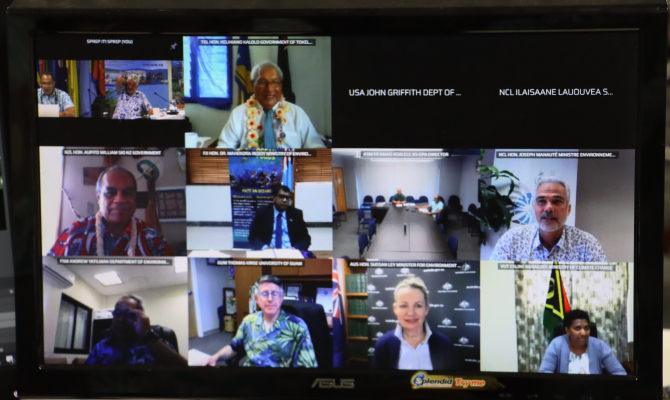
Virtual dialogue in progress between the Forum Troika Plus and Micronesian Presidents Forum

The Prime Minister also conveyed his sincere appreciation to the Leaders for their understanding following what transpired from the last Pacific Island Leaders Forum meeting, and this, he assured them of his full support “in our joint efforts to resolve the impasse through this dialogue mechanism.”

Discussions at the dialogue particularly, focused on the importance of a fair and frank political exchange with the Micronesian Presidents Summit (MPS) based on the characteristics of the Pacific way of open and respectful dialogues and understanding and appreciating the underlying concerns of the MPS in relation to its withdrawal from the PIF.

Prime Minister Bainimarama said at the dialogue that the concerns raised by the Micronesian Leaders may need to be looked at more closely with some careful attention and urgency and he is committed to looking at all these issues in this dialogue process in a comprehensive manner that meets all our expectations.

“I appreciate the situation that the Micronesians are in now and strongly believe that we should reflect on all their concerns and find ways to resolve them amicably.”

 Prime Minister Josaia Voreqe Bainimarama and his delegation participating in the dialogue
Prime Minister Josaia Voreqe Bainimarama and his delegation participating in the dialogue

At the dialogue, it was also discussed that there are a number of important regional review processes that are underway based on the Leaders’ decision and these include the review of the PIF meeting processes, review of the Secretary-General appointment procedures, formulation of the region’s 2050 Strategy and review of the regional architecture.

Prime Minister Bainimarama added; “Let us collectively reflect on the issues raised by our fellow Micronesian Leaders today and deliberate further in our next meeting. I ask that we take our dialogue a step at a time and be flexible in our approach that reflects our true Pacific Way.”

SOURCE: FIJI GOVERNMENT

Papua New Guinea’s Universal Periodic Review

This statement was originally published on hrw.org on 31 March 2021.

The Papua New Guinea government has failed to live up to commitments on women’s rights, children’s rights, and police accountability, Human Rights Watch said in a recent submission to the United Nations Human Rights Council. Papua New Guinea’s Universal Periodic Review (UPR) of its human rights situation before the council has been scheduled for November 2021.

“Papua New Guinea has made big promises to the UN, but failed to meet them,” said Elaine Pearson, Australia director at Human Rights Watch. “During the review, UN member countries should remind the Papua New Guinea government that it needs to do much better, especially to defend the basic rights of women and children, and to investigate and prosecute police brutality.”

Under the UPR system, the UN Human Rights Council in Geneva reviews each country’s human rights record every five years. During the previous cycle, in 2016, Papua New Guinea accepted numerous recommendations. It pledged to take steps to protect the rights of women and girls; to investigate gender-based violence, including accusations of sorcery; to increase access to education, and to ensure that police officers are held to account for abuses. However, the government has failed to show progress on these key issues.

The submission also covers the death penalty, disability rights, the rights of LGBT people, and refugee rights given that 130 refugees and asylum seekers remain in Papua New Guinea, transferred there by the Australian government since 2013.

SOURCE: HUMAN RIGHTS WATCH, IFEX

Bytes For All condemns social media suspension across Pakistan

This statement was originally published on bytesforall.pk on 16 April 2021.

Bytes For All strongly condemns the arbitrary suspension of various social media platforms in Pakistan on Friday. As per a notification by the Pakistan Telecommunication Authority (PTA), on the directions of the Ministry of Interior, Twitter, Facebook, YouTube, WhatsApp and Telegram are being blocked during 11am to 3pm to counter the protests from the members and allies of a religious group.

Bytes For All believes that blocking and filtering the internet is not a real solution ‘to maintain public order and safety’. Pakistan is a democracy and it is only the rule of law that enables a safe and secure environment for public life. We are also concerned that media censorship and internet blocking of the protests is setting a dangerous trend for the flourishing democratic principles in the country.

Internet shutdowns and denying citizens access to communication and information infrastructure is a serious violation of fundamental human rights. Suspension of mobile cellular services and/or internet services inevitably leads to the violation of some of the most important fundamental rights of the citizens of Pakistan, including the right to information, the right to freedom of speech and the right to freedom of assembly, guaranteed under Articles 19A, 19 and 16 of the Constitution of Pakistan, respectively. It is the constitutional responsibility of the federal government to uphold these fundamental rights and establish the writ by strengthening rule of law in the country. Suspension of social media platforms is also a violation of Pakistan’s international human rights commitments, which unnecessarily brings a bad name to the country.

We urge the authorities to refrain from such arbitrary actions of censorship and communication black-outs as they are against the norms of democracy and do not serve any purpose with regards to maintaining public order and safety at any level. Mass censorship is not a solution, it is a problem itself.

Stay connected

529FansLike
172FollowersFollow
156SubscribersSubscribe
- Advertisement -