Home Blog Page 1224

Fiji PM Bainimarama signs sale agreement of EFL shares

0

The Fijian Government’s vision to supply 100 per cent of energy in Fiji from renewable sources by 2036 is coming to fruition.

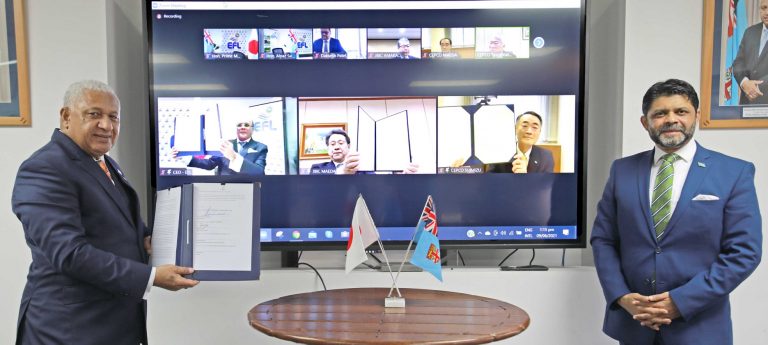
This follows Prime Minister Frank Bainimarama signing an agreement on the sale of 44 per cent shares of Energy Fiji Ltd (EFL) to Sevens Pacific Pte Limited Wednesday.

Sevens is a joint venture company established in Singapore comprising of a partnership between the Japanese company Chugoku Electric Power Company Limited (Chugoku) and the Japan Bank of International Cooperation (JBIC).

In signing the agreement, Prime Minister Bainimarama said the Fijian Government had always aimed to secure a strategic investor in EFL who would align Fiji’s energy sector to international best practices and ensure the long-term development of robust renewable energy programs.

“I am happy to say that Chugoku is that strategic investor through Sevens and as one of Japan’s largest utility companies, we are thrilled that Chugoku will be bringing their knowledge and technological expertise particularly in renewable energy to our shores,” PM Bainimarama said.

“EFL is already at the forefront in adopting renewable energy sources. In 2018 over 50 per cent of the country’s electricity was generated by EFL utilising renewable sources, and now with Chugoku, EFL will be further strengthening their operations and undertaking projects that will significantly expand their renewable energy sources to communities all over Fiji.”

“Sevens will assist the Fijian energy sector to transition away from its dependence on harmful fossil fuels towards clean energy sources and this transformation will be a shining beacon to the world showcasing our dedication and commitment in revolutionising our energy sector,” he added.

PM Bainimarama said the Government will remain as the majority shareholder owning 51 per cent while 44 per cent will be owned by Sevens and 5 per cent by Fijian Domestic Account Holders.

So far, around 40,000 Fijians are shareholders in EFL who have received 7,283,400 shares in EFL while a balance of 17,716,600 shares is currently held in the trust by Central Share Registry Limited for future EFL customers

SOURCE: FIJI GOVT/PACNEWS

Solomon Islands ICAC: how did it happen?

by Grant Walton

Over the past decade, around the world, the number of anti-corruption agencies (ACAs) – organisations specifically tasked with fighting corruption – has increased significantly. In turn, researchers and policymakers have sought to understand how ACAs are established and why they often fail to live up to expectations.

The international literature points to three institutions that determine how ACAs are established. First, the role of donors in pressuring governments to establish these agencies – if donors have significant leverage they can help force governments to establish and support new ACAs. Second, a strong and engaged civil society. Finally, political parties and the incentives driving politicians to support reform. In sum, it is often argued that if these institutions are robust it is more likely that countries will introduce ACAs that can address corruption.

In a recently published article (paywalled, email the author for a copy), I examine the role these institutions played in helping to establish (into law) the new Solomon Islands Independent Commission Against Corruption (SIICAC), the country’s first stand-alone ACA. The Solomon Islands parliament established the SIICAC after passing the Anti-Corruption Act 2018. My research, conducted just before the bill passed, involved interviews with 18 key stakeholders involved in this reform.

When I first examined their responses, it became clear that traditional explanations for why the SIICAC was established were inadequate. This is because when the SIICAC passed into law, the role of donors, supportive politicians, political parties and civil society in the country was on the wane, relatively weak or fractious.

The SIICAC was established when donor leverage was relatively weak; that is, the enabling legislation was passed after the international Regional Assistance Mission to Solomon Islands (RAMSI) intervention (2003-2017) formally wound up. While donors, like Australia, are still active in Solomon Islands, their presence has diminished. In 2010, at the height of RAMSI, total Official Development Assistance distributed to Solomon Islands from all donors was US$276 million in 2017 prices, by 2018 that figure had fallen to US$167 million.

Civil society – the second key institution some scholars believe shape ACAs – in Solomon Islands is also frail. While elements of civil society played an important role in petitioning the government to establish the SIICAC, as many have noted, the country’s civil society organisations are relatively weak compared to those in other developing countries.

Finally, politics in Solomon Islands revolves around individuals, rather than the more stable political parties that some consider important for establishing strong ACAs. Moreover, in 2017, before parliament passed legislation to establish the SIICAC, government MPs removed then Prime Minister Manasseh Sogavare, who championed the new ACA and broader anti-corruption reforms. While the reasons for Sogavare’s dismissal are numerous, for some commentators, and for Sogavare himself, it was due to his support of the SIICAC and associated anti-corruption legislation, and MPs’ concerns that the SIICAC would target their misdeeds.

Given this, it is little wonder that in August 2017, Ruth Liloqula, head of Transparency Solomon Islands, said it was unlikely SIICAC’s enabling legislation would ever pass.

So how was the SIICAC established?

Drawing on assemblage theory, my research suggests the bill passed because of the ability of national and international anti-corruption actors (bureaucrats, politicians, donors and activists) to work together at critical moments to shape anti-corruption policy. This group of disparate actors spanned the globe as Solomon Islands policymakers travelled to a number of countries to consult anti-corruption experts on the best model for their new ACA.

Anti-Corruption_Act_2018 Those involved were able to come together and help convince policymakers to pass the bill just when it looked like all was lost. For example, responding to politicians’ concerns that the SIICAC would target them, bureaucrats and international advisers came together to rewrite and reframe draft legislation, and worked to assure MPs that the bill would not threaten their interests. The SIICAC was established into law because at critical junctures key individuals reframed debates about this new institution.

My findings also provide some insights into why ACAs can fail to effectively address corruption. Respondents noted that the core group involved in legislative change marginalised those who believed the draft legislation was too weak. For example, in the lead up to parliament passing the legislation, those critical of the inclusion of a controversial clause to allow custom as a defence for bribery were excluded from key meetings they had previously been invited to. This clause controversially made its way into the final Anti-Corruption Act.

In addition, while the bill involved some public consultation, respondents were concerned that the public were mostly excluded from shaping the SIICAC’s mandate.

As a result, Solomon Islands’ new anti-corruption agency has been shaped by a disparate group of people that, at times, excluded critical and local voices. This cohort (or ‘assemblage’) succeeded in establishing the SIICAC into law; but there is a risk the compromises that accompanied this process will undermine the SIICAC’s ability to meaningfully address corruption in the years to come.

Disclosure: This research was undertaken with support from the Australian National University’s Asia-Pacific Innovation Program and the Pacific Research Program, funded by the Department of Foreign Affairs and Trade. The views are those of the author only.

This article appeared first on Devpolicy Blog (devpolicy.org), from the Development Policy Centre at The Australian National University.

Grant Walton is a Fellow at the Development Policy Centre and Chair of the Transnational Research Institute on Corruption. He is the author of Anti-Corruption and its Discontents: Local, National and International Perspectives on Corruption in Papua New Guinea.

The Trump of Samoa

0

By Oliver Hasenkamp

For decades, Samoa was seen as the most politically stable country in the Pacific. Tuila’epa Sa’ilele Malielegaoi served as prime minister for almost 23 years with little opposition. His Human Rights Protection Party (HRPP) had been in power for nearly 40 years and was the only party represented in the country’s parliament, the Fono, in the previous term. Yet there was little doubt about the democratic spirit of the government internationally.

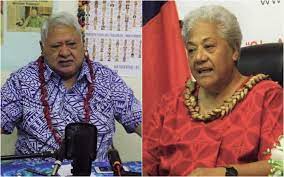
But that has changed significantly with the April 2021 election. The HRPP lost almost half its seats, and the newly-founded opposition party Faith in the One God of Samoa (Fa’atuatua i le Atua Samoa ua Tasi or FAST), led by Fiame Naomi Mata’afa, won the same number of seats as the HRPP. A political earthquake in itself, not to mention the election of a female head of government in a country where only about 10 per cent of MPs are female. But since the one remaining independent MP in parliament has sided with FAST, there has been a political and legal battle for power in Samoa, with the previous government trying to prevent the new government from taking office.

The HRPP nominated an additional member of parliament on its own accord, under the pretext of increasing the female quota. Samoan head of state, Va’aletoa Sualauvi II, who is politically aligned with the HRPP, called for new elections on 21 May to try to break the deadlock. But both moves were overturned by the country’s Supreme Court, ordering parliament to open on 24 May, which was boycotted by the HRPP and the head of state. With the parliament’s doors having been locked, Mataʻafa was ultimately appointed the new head of government by FAST MPs outside the Fono.

Trump’s political reach

Since then, there have been two rival governments: the new government led by Mataʻafa and backed by the Samoan courts, and the previous government led by Malielegaoi and backed by the head of state, which continues to refuse to transfer power peacefully. Many observers are talking of a coup by a government that was actually voted out. This is remarkable because, for many years, Malielegaoi had been a champion of democracy and was considered one of the greatest critics of Josaia Voreqe Bainimarama, prime minister of the neighbouring island state of Fiji, who himself came to power in a military coup in 2006.

The situation in Samoa is complicated even further by a controversial judicial reform last year, criticised as an attack on the separation of powers and triggering the creation of the new opposition party. Malielegaoi no longer sees the courts, but rather the Samoan head of state, as having supreme authority.

Many people in Samoa can’t help but be reminded of former US President Donald Trump – not least because of Malielegaoi’s fondness for the phrase ‘fake news’. And much like Trump, Malielegaoi talks about electoral fraud without presenting evidence of any kind. This refusal to accept reality is taking increasingly grotesque turns: he no longer talks about the will of the people, referring to himself instead as the leader of his country appointed by God.

War or Peace

Some Samoans fear things could turn violent – completely unthinkable in a country so dependent on tourism. Malielegaoi called for calm, while creating even more uncertainty by suggesting there was a threat to peace in the country, a page straight out of the Trump playbook. Residents of the head of state’s home village have put it under ‘their protection’, setting up roadblocks to check vehicles passing by.

But while these events are often a precursor to violence in other countries, there are legitimate hopes for peace in Samoa. Like most Pacific island states, Samoa does not have a military. So while there is no institution that can put an end to the deadlock, this also means there is no army to exacerbate the situation and encourage violence – as has happened several times in neighbouring Fiji.

In fact, something good could actually come out of this tense political situation. What has played a significant part in the country’s decades of stability is that Samoan society is based on a complex traditional system, placing huge importance on family cohesion and the authority of the family leaders, matai, or ‘chiefs’ – a system that makes it difficult to break out of traditional structures. This has been causing much frustration among young people for years. However, it could also prevent individuals from turning radical, since the use of violence could be sanctioned by the balanced family structures that pervade Samoan society.

What’s more, Mataʻafa and her party have so far remained cool, calm and collected in responding to the provocations thrown at them by Malielegaoi. Yet, Mataʻafa does face a difficult task: she seeks to reform the political structures that have crumbled over the years under Malielegaoi’s government, yet as a comparatively progressive voice in conservative society, she herself comes from the political establishment and doesn’t want to dissolve the traditional system.

The power struggle

Mataʻafa was deputy prime minister under Malielegaoi before resigning in protest over last year’s judicial reform. Her father was the first head of government after Samoa gained independence from New Zealand in 1962. And unlike Malielegaoi, she comes from one of the country’s most powerful families, one of the four holders of the Tama-a-Aiga title, usually bestowed upon the Samoan head of state. On paper, Mataʻafa could bring an even greater concentration of power in the long term than before.

Most recently, she has been backed by both the Catholic Archbishop of Samoa – a key voice in a very Christian but fragmented society – and some of the Micronesian states in the northern Pacific. However, other neighbours, in particular regional powers Australia and New Zealand, have so far been very reluctant to intervene – they still painfully remember the criticism received and influence lost in the region after taking a stand against the Fijian military government more than ten years ago. Since the split of the Pacific Islands Forum, there is also a lack of a united body to step in and mediate.

While the United Nations has called for a dialogue between the two sides in Samoa at an international level, the European Union has not yet expressed its views. Unlike with Australia and New Zealand, this is likely just a general lack of interest rather than polite restraint.

Germany, in particular, has been penalising Samoa and the Pacific island states for years – beyond sporadic cooperation in areas such as climate change. Hardly anyone in Germany is aware that Samoa, like many other Pacific islands, was under German colonial rule until the First World War. Today, Germany still does not have an ambassador in the region.

This political disinterest and the lack of attention paid to the crimes committed under German colonialism are particularly acrid, given what’s going on in Samoa. The system for regulating land ownership and the associated matai titles, as well as the documentation underlying it – now the subject of the controversial judicial reform – largely date back to the German colonial era.

SOURCE: IPS JOURNAL/PACNEWS
Small island nations are struggling to recover from the pandemic, UN says

0

Small island developing states (SIDS) are facing an uphill struggle to recover from the impact of the pandemic, which has deepened their financial and economic vulnerabilities, according to the United Nations Conference on Trade and Development (Unctad)

Last year was an exceptionally challenging year for SIDS, which are at least 35 per cent more susceptible to external economic shocks than other developing nations, Unctad said in its Development and Globalisation: Facts and Figures report on Thursday.

While these countries are a diverse group, they share a number of socio-economic and environmental challenges and witnessed an estimated 9 per cent decline in their gross domestic product in 2020, compared with a 3.3 per cent drop in other developing countries, the report said, citing figures from the International Monetary Fund.

The economies of the 38 SIDS recognised by Unctad are largely dependent on travel and tourism. Spread across the Caribbean, the Pacific Ocean, the Atlantic, the Indian Ocean and the Mediterranean, these countries includes some of the most popular tourism destinations in the world. They also include island nations with more developed economies, such as Singapore.

Their reliance on the travel and tourism sector to earn foreign exchange revenue made them more vulnerable to the Covid-19 pandemic, which tipped the global economy into its worst recession since the 1930s, forced border closures and severely disrupted the travel and tourism sector.

The world economy is bouncing back and is expected to expand by six per cent this year, according to the IMF. However, the tourism sector faces a more uncertain outlook amid second and third waves of the virus in parts of the world.

Revenue in the global tourism industry fell 74 per cent year-on-year in 2020, leading to US$1.3 trillion in lost export revenue. The sector is unlikely to recover to pre-pandemic levels until 2023, according to the UN World Tourism Organisation.

The economies of tourism-dependent island nations suffered an estimated 70 per cent drop in travel receipts in 2020, which are “an essential source of jobs and livelihoods”, according to the UNCTAD report.

“Many SIDS have built strong service economies [and] the service sector accounted for over 70 per cent of SIDS’ GDP in 2019,” the report said. “On average, two in three people work in services in the island economies, half of men and three in four women, often in jobs related to tourism.”

On average, exports of services contribute 25 per cent of SIDS’ GDP. These countries generally have an import surplus and almost half of their exports are from the travel sector. As a result, 24 of the 38 nations had a negative trade balance comprising more than 55 per cent of imports in 2020.

Their remoteness poses a significant challenge to their recovery, especially the most isolated Pacific island nations.

The countries’ often weak, financially vulnerable institutions are also a stumbling block to a return to growth.

“SIDS are among the most indebted developing countries in the world,” UNCTAD said. “In 2019, external debt accounted for 62 per cent of their GDP – a record high, mostly driven by increases in short-term debt and private debt, said Unctad.

SOURCE: THE NATIONAL NEWS/PACNEWS

Samoa’s FAST party seeks clarification of court ruling

Samoa’s FAST party is seeking clarification of an Appeal Court decision about extra parliamentary seats for women.

An Appeal Court decision last week upheld the Supreme Court’s earlier voiding of an extra women’s seat in the aftermath of April’s national election.

The ruling meant the FAST party maintained its majority of 26 seats in the 51-seat Parliament.

But the court also ruled that six rather than five women MPs was the correct number under Samoa’s system providing for 10 percent of parliamentary seats to be reserved for women.

The FAST Party deputy leader Laauli Leuatea Polataivao said the caucus was awaiting the court’s clarification.

However, caretaker Prime Minister Tuilaepa Sa’ilele Malielegaoi and his HRPP party – which had been in power for decades – continues to refuse to concede defeat.

He said no government would be formed until all 28 election petitions are heard – with a possible by-election to decide the sixth woman seat.

Earlier this week, talks between the two political parties failed to resolve the impasse, according to FAST party leader Fiame Naomi Mata’afa.

She said last week’s Court of Appeal decision was not retrospective and could only apply to future elections as the writ of appointment of the elected members was given by the Head of State on 16 April 2021.

Mata’afa said she was also seeking the continuing support and prayers of the churches and the nation as the political leaders look to amicably resolve the current impasse.

Two weeks ago Samoa’s constitutional crisis deepened when the caretaker HRPP government locked the doors to parliament in an attempt to stop Mata’afa, the prime minister-elect, from being sworn into office following her patry’s one-seat election win. That was despite the Supreme Court ordering parliament to sit, overruling the Head of State’s earlier decision to cancel the new parliament sitting.

Unable to be sworn in within parliament, FAST decided to hold its own swearing-in ceremony under a marquee tent erected on parliament grounds.

Mata’afa was sworn in that afternoon, as was her Cabinet, but a constitutional question lingers over the legality of that swearing in: none of the judiciary, the speaker, the head of state nor the elected HRPP members had been present.

Meanwhile, Tuilaepa said his government was preparing a minimal budget to allow government to function when the current financial year ends on 31 June.

He said the government would operate on 25 percent of the current budget which he estimated would be around 200 million tālā.

Tuilaepa did not elaborate on details but he says that Cabinet met on Tuesday with all Chief Executives of government ministries and organisations and advised them to prepare budgets based on the 25 percent spending allowed under the constitution.

Tuilaepa said he will be speaking on the issue again this week.

A case due to be heard in the Supreme Court on Monday is likely to indicate if such a budgetary move is necessary.

The Court has been asked to rule on the Constitutionality of the swearing-in ceremony held by the FAST Party last month.

SOURCE: RNZ PACIFIC/PACNEWS

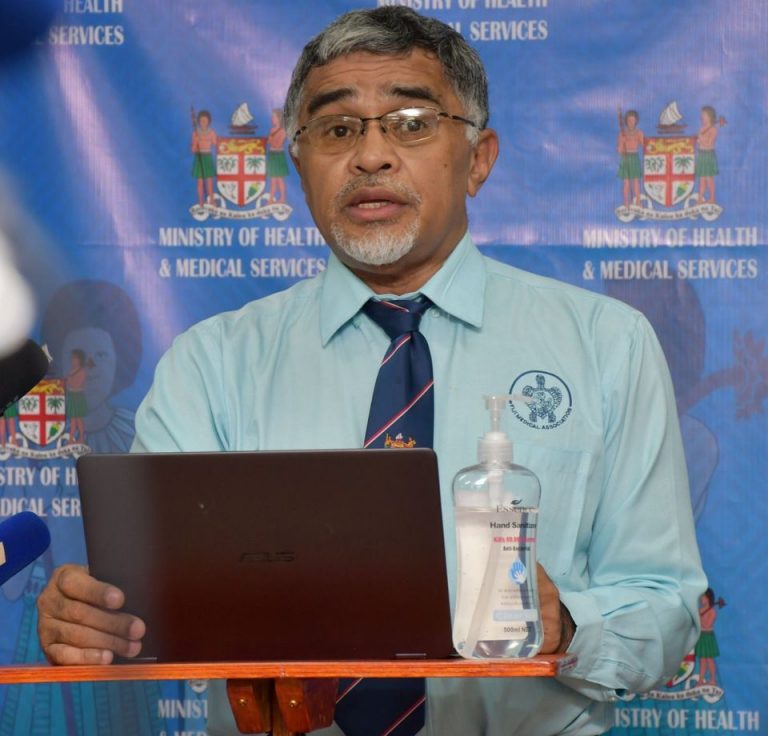
39 new COVID-19 cases in Fiji, health professionals losing their morale: Dr Fong

Five police officers are among 39 new cases of Covid-19 in Fiji Thursday.

The government announced late last night that 32 of the latest cases are from existing clusters.

Another 11 cases were reported from the country’s main hospital in the capital Suva.

Health permanent secretary Dr James Fong said the ministry’s mitigation strategy is to isolate cases, treat seriously-ill patients and ensure the success of its vaccination rollout programme.

But he said they were concerned that Lami and the police barracks in Nasinu, both clusters outside Suva, may see increasing numbers of cases.

Teams are tracing and testing known contacts and are isolating positive patients to prevent further spread of the virus, Dr Fong said.

“In the near-term, we are concerned that Lami may see increasing numbers of cases.

“We also anticipate more cases from the cluster at the Police Barracks in Nasinu.

“Our stationary and mobile screening teams are tracing and testing known contacts and are isolating positive patients to prevent further spread of the virus,” said Dr Fong.

Acting Police Commissioner Rusiate Tudravu told local media the force had tried their best to prevent the spread of the virus amongst its officers.

Initially three officers from the Nasinu Police Station had tested positive for the virus and another 15 were swabbed earlier in the day.

Neither Tudravu nor Fong provided information on how the officers were infected.

“I’m not surprised because we are classified as high mobile risk because of our job, it requests us to be on the front line,” Tudravu said.

“Having said that, we have tried our best not to have anyone in the force to have the virus.

“We are there in the front-line and we are vulnerable to that.”

The infected police officers are on home isolation and monitored by the Ministry of Health and guarded by police officers, Tudravu added.

The other latest cases included six from Nawaka, Nadi; three from the warehouses of the Fiji Independent Commission Against Corruption-FICAC, two from the Republic of Fiji Military Forces Naval Division, two from Waila in Nausori, one from Naitasiri, one from Caubati outside Suva and another case from the Covid-19 Incident Management Team (IMT)at the Health Ministry’s headquarters in Suva.

The ministry is yet to determine the source of infection for seven other cases – four from Lami Town, one from Toorak a suburb adjacent to the central business district of Suva, one from Nasinu Town and one from Reservoir Road near the city.

Meanwhile, the government’s vaccination rollout programme continues with 228,030 people having already received at least one dose of the AstraZeneca vaccine.

50,000 doses of the vaccine arrived in the country from Australia this week.

“The vaccine administration in Nadi had been temporarily halted due to a case among the administration teams,” Dr Fong said.

“Relevant personnel have since been cleared and vaccine administration in Nadi has resumed.”

Seven patients had recovered and there were now 656 active cases in Fiji.

There have been 849 cases since this outbreak began two months ago and 919 cases since March 2020.

Health professionals in Fiji are losing their morale as they are facing challenges due to non-compliant Fijians.

Dr Fong said health officials are trying their level best to safeguard Fijians, however, breach of protocols such as social gathering puts added pressure on them.

He said officials are getting tired, however, the Ministry has put itself in a good space and has relooked at its containment and quarantine strategies.

“From the health care workers they are getting tired, some of them are beginning to get a little bit low on the morale as every time they thought they are getting ahead of it then somebody will shift the goal post again.”

Chief Medical Advisor, Dr Jemesa Tudravu said the Ministry is keeping a close watch and is making sure that their numbers are not severely compromised.

“Our team has been able to respond to the situation when a health facility is compromised or when a staff develops COVID-19 symptoms or is exposed.”

Head of Health Protection Doctor, Aalisha Sahukhan said frontline workers play a critical role in the war against the virus.

Dr Sahukhan said the frontline healthcare workers are swabbed twice a week because of the nature of the work they do.

SOURCE: RNZ PACIFIC/PACNEWS

We don’t get involved says NZ foreign minister Mahuta

0

The New Zealand government will not get involved in the state of affairs of any nation and this applies to Fiji which is fighting the second wave of COVID-19.

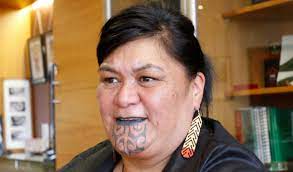
New Zealand Foreign Affairs Minister, Nanaia Mahuta, made these comments when asked by the media on Fiji’s effort in containing the virus.

Mahuta said New Zealand role is to assist and not infringe on any sovereign rights.

“New Zealand isn’t in a position to tell other countries how to respond in a COVID circumstance. All countries are facing similar challenges, we are sharing much information as we can to draw on each other’s experiences. New Zealand has been leaned on also and also in terms of the approach we have taken. But by enlarge, every country needs the willingness of its whole population to support a countrywide response.”

New Zealand says it has assisted in providing vaccines and also budgetary support so far.

SOURCE: FBC NEWS/PACNEWS

Prominent lawyer arrested and charged in PNG over involvement in alleged misappropriation and stealing of K268 million

1

Members of the Papua New Guinea Special Police Forensic Criminal Investigation Team (SPFCIT), arrested prominent lawyer Gregory James Sheppard of Young & Williams Lawyers on Tuesday in Port Moresby.

He was taken to the Boroko Police Station, interviewed and subsequently charged with two counts of misappropriation and another two counts of money laundering in relation to his alleged direct involvement in the transfer of funds amounting to K52 million (US$14.8 million)

These funds were part of the K268 million (US$76.2 million) that were unlawfully withdrawn from the Western Province People’s Dividends Trust Account (WPPD TA) also known as Western Province People’s Dividends Community Mine Continuation Agreement Trust Funds (WPPD CMCA) held with the Australia and New Zealand Banking Group (PNG) Limited (ANZ Bank).

The 65-year-old defendant from Perth, Western Australia, was previously brought in by Police in relation to the same criminal investigation and charged with two counts of conspiracy and another two counts of false pretense in January of this year. So far, the defendant has been charged with a total of eight offences.

It is alleged that on 15 February 2018, the defendant and his law firm were engaged by the Ok Tedi Fly River Development Foundation Limited (OFRDFL) as its legal representation regarding numerous civil proceedings that it instituted against the Independent State of Papua New Guinea (the State).

The defendant proceeded with the civil proceedings against the State and obtained Orders from the Court for its clients to become Trustee replacing the State’s Board of Trustees (BOT) to the WPPD CMCA TA held with the ANZ Bank.

It is alleged that after OTFRDFL became the Trustee to WPPD CMCA TA, the defendant actively assisted directors of OTFRDFL using the Court Order and liaised with officers of ANZ Bank and changed the signatories to the WPPD CMCA TA.

It is further alleged that as soon as the signatories to WPPD CMCA TA were successfully changed, two separate payments of K15 million and K37 million were paid out as legal fees on 17 August 2018, and 23 December 2019, respectively to the defendants, Young & Williams Lawyers Trust Account held with Bank of South Pacific Limited (BSP). The defendant is the sole signatory to the BSP trust account.

It is also alleged that the defendant with assistance from other lawyers from within his law firm (Young & Williams) communicated with the officers of the ANZ Bank and successfully facilitated the two separate payments amounting to K52 million into Young and Williams Trust Account held with BSP.

It is alleged that as soon as the defendant’s law firm was paid K52 million, the funds were then expended for other unrelated purposes than the original intended purpose of the WPPD CMCA TA Funds, which is to fund and implement development projects and programmes in the CMCA region in the Western Province.

It is alleged that Gregory James Sheppard released numerous unrelated transactions as sole signatory of his law firm’s trust account held with BSP to a number of unrelated companies and individuals. It is also alleged that the defendant transferred approximately K10.6 million (US$3 million) out of the K52 million (US14.8 million) to a company, namely, Mundi No.1 Limited which is solely owned by the Secretary for OTFRDFL, Samson Jubi.

It is alleged that Mundi No.1 Limited then made payments via online transfers to other directors and chairman of OTFRDFL from the monies that it received. Samson Jubi as the sole signatory for Mundi No.1 Limited facilitated the payments via online transfers whilst he was based in Cairns, Australia.

This is in breach of Section 7 (1) (c) of the Criminal Code Act 1974, in which the defendant aided the Secretary of the OTFRDFL by paying approximately K10.6 million (US$3 million) and in return the Secretary paid monies to the other directors and other parties.

Further, it is alleged that the defendant transferred K30 million (US$8.5 million) from the proceeds of K52 million into Young & Williams Lawyers’ other Trust Account held with Westpac Bank PNG Limited (Westpac Bank).

Police obtained a Court Order to search the law firm’s trust account held with Westpac Bank. The defendant successfully obtained a Court Stay Order and Police have not been able to establish how the defendant exhausted the K30 million (US$8.5 million) which is a significant portion of the K52 million (US$14.8 million). Police strongly believe that the monies contained in the Westpac Bank trust account have been depleted.

The money within WPPD CMCA TA held with ANZ Bank is only intended to be used to fund and implement development projects and programmes in the CMCA Communities in Western Province. CMCA Region is made up of 158 villages located along the Fly River Corridor.

It is alleged that when the sum of K52 million (US$14.8 million) was under the possession of the defendant’s trust account held with BSP, he exhausted the funds with transactions that had no direct correlation with the implementation of developments projects and programs in the CMCA Communities in Western Province, thus that amounts to misappropriation of those funds.

Members of SPFCIT travelled to Daru, Western Province a week ago to apprehend Steven Bagari who is the Chairman of OTFRDFL. However, Steven Bagari managed to evade the police net and is currently not able to be located. The SPFCIT team has appealed to the directors of OTFRDFL to make themselves available to Police to allow the matter to be fully investigated.

Commissioner Manning has directed Provincial Police Commander for Western Province and Police Station Commanders for North Fly District, Middle Fly District and South Fly District to assist with the Police Investigation currently undertaken by SPFCIT and apprehend the remaining directors of OTFRDF Ltd and turn them in to the Police.

The Special Police Forensic Criminal Investigation Team is headed by Police Commissioner David Manning and comprises RPNGC Detectives, a Forensic Accounting Specialist and Legal Counsel engaged through the Department of Justice & Attorney General.

SOURCE: PNG GOVT/PACNEWS

Samoa’s longest serving Prime Minister faces citation for contempt of court

Samoa caretaker Prime Minister Tuilaepa Dr Sailele Malielegaoi was Tuesday served to appear in Court next week, to face a motion that he and others be cited with contempt of Court for boycotting the convening of Parliament on Monday 14 May 2021.

The Court action is a response to a motion by FAST – Faatuatua i Le Atua Samoa ua Tasi party – to also have Leaupepe Toleafoa Faafisi, the Clerk of the Legislative Assembly and the Attorney General, cited for contempt of Court.

In a symbolic demonstration to uphold the rule of Law Chief Justice Satiu Simativa Perese, together with all members of Samoa’s Judiciary walked up to the doors of Parliament House expecting the XVIIth Parliament of Samoa to convene on Monday 24th May – the 45th day since Samoa’s 9th April general election.

Samoa’s Head of State Tuimalealiifano Vaaletoa Sualauvi II had issued a Proclamation for the XVIIth Parliament of Samoa to convene at 9:30am on Monday 24 May 2021. However after over 500 invitations had gone out and the programme distributed, the head of State then issued a second Proclamation to suspend the opening of Parliament “until such time as to be announced and for reasons that I will make known in due course”.

A special in Chambers sitting of the Court resulted in Court Orders that declared the Proclamation to suspend the opening of Parliament as unlawful. The same Orders upheld the first Proclamation of the Head of State for Parliament to convene as required by Samoa’s Constitution within 45 days of an election.

The Supreme Court also specifically directed that copies of the judgment be immediately delivered to the Clerk of the Legislative Assembly, together with the Attorney General and the Head of State.

There was a stand-off at Mulinuu that Monday morning when the doors of Parliament House remained locked, and Clerk of the Legislative Assembly Tiatia Graeme Tualaulelei made to follow a Public Notice issued the Sunday night before from the desk of “The Speaker of the Legislative Assembly” signed by Samoa’s former Speaker, Leaupepe Toleafoa Faafisi.

Tiatia Graeme Tualaulelei apologised to the FAST party leader that morning , and conveyed that their position is based on the latest Proclamation issued by the Head of State – referring to the Proclamation declared unlawful by the Supreme Court of Samoa.
On Sunday evening after the Court orders were made known, Tuilaepa Sailele spoke from the TV1 studio to publicly condone the Court decision and stated that he and members of the Human Rights Protection Party refuse to attend a swearing in.

At the time of the 09 April general elections, Tuilaepa was the second longest serving incumbent Prime Minister in the world, behind Cambodia’s Hun Sen. He has been Samoa’s Prime Minister since Tofilau Eti Alesana stepped down in November 1998 and a Member of Parliament for Lepa since 1980.

SOURCE: SAMOA GLOBAL NEWS/PACNEWS

Oceania Olympians leading the vaccination charge towards Tokyo

There’s been a strong uptake from Pacific Island athletes getting vaccinated against Covid-19 in the lead-up to the Tokyo Olympics.

The Summer Games are scheduled to begin on 23 July, after being delayed by 12 months because of the Covid-19 pandemic.

The International Olympic Committee said vaccination was “encouraged” but not compulsory for athletes.

Leaders at the Pacific Islands Forum meeting in February agreed to give consideration to Olympic athletes where possible after the primary targets in each country had been vaccinated.

Oceania National Olympic Committees (ONOC) President, Dr Robin Mitchell, said the local response has been very good.

“The Northern Pacific finished theirs in January. February was the latest for FSM, Palau, Guam, the Marshalls and American Samoa,” he said.

“The last group starting, Vanuatu and Kiribati started (last) week, so essentially all of our athletes, officials we’ve asked them to cover, international federations – media as well – going into Tokyo.”

The IOC struck a deal with Pzifer last month to make vaccines available to Olympians in countries that were not prioritising jabs for those travelling to Japan.

Mitchell said more than 80 percent of Olympic athletes around the world had been vaccinated a month ago and the hope is to get the number “closer to 100 percent or even better by the time we get to Tokyo”.

A number of Olympic qualifying tournaments have been disrupted by the ongoing border restrictions around the world.

Robin Mitchell is on a committee assessing the qualifying criteria for Tokyo and said the final list of athletes will be confirmed at the end of the month.

“We’re getting quite a few changes in the last couple of weeks where they have to make decisions on previous competitions.

“Hopefully that will sort itself out for sports like beach volleyball, for Vanuatu in particular, and I think boxing and weightlifting is also pending and then athletics and swimming have until the end of the month, or quite late in the piece, before the final numbers are determined.”

Opinion polls have consistently shown a majority of the Japanese public want the Olympics to be cancelled or further postponed.

Tokyo remains under a state of emergency but Robin Mitchell said the situation on the ground for athletes and officials is safe.

“The terminology they used is ‘cautious not concern’. What’s happening in Tokyo is no different to what is happening in Fiji (where Mitchell is based) – basically it’s containment zones – defined and targeted lockdowns within the confinement zone.

“By the time we get to Tokyo we’ll probably have minimum contact with the local population, except those that are servicing the Games Village, transport staff etc.”

The biggest question from athletes has not been about whether they should go to Tokyo, Mitchell said, but a desire for clarification about what they can do when they get there.

From the feedback the athletes are not so much asking about Tokyo but what to have confirmation about participation, for those that are still undergoing qualifying tournaments, and also dates on the playbook.”

A playbook with the Covid guidelines for athletes in Tokyo will be released in the coming days.

Once people have fulfilled their quarantine requirements they will be able to move around freely within venues such as Games Village, so long as they adhere to Covid-19 protocols, Mitchell said.

SOURCE: RNZ PACIFIC/PACNEWS

Stay connected

529FansLike
172FollowersFollow
156SubscribersSubscribe
- Advertisement -