Home Blog Page 1143

Tuvalu communities face climate drought disaster

The small Pacific Island nation of Tuvalu, has been experiencing low rainfall conditions, with mounting concerns of extreme water shortages for people across the tropical islands.

Tuvalu has been facing drought conditions for the past three months and rainfall levels have been some of the lowest ever recorded.

There are fears communities may face water shortages in the coming months if rainfall continues to be below normal, especially as the Red Cross Red Crescent Early Action Rainfall Watch places Tuvalu at ‘dry warning’ level, with high risk of severe dry conditions getting worse.

Tuvalu Red Cross Secretary General Tagifoe Taomia said:

“Record low rainfall levels leave our drinking water tanks empty and our crops withered. Climate extremes are hitting our country hard. Our communities rely on rainfall as the main source of fresh water as there are no rivers on the island.”

“Water harvesting systems are completely dependent on rainfall. No rain, no water to harvest and when it does rain, the amount we are able to collect is dependent on the intensity of the rainfall.”

“Early action is being ramped up to assist people in remote communities across the country, to take proactive steps to analyse these impacts and build their knowledge and capacity to prepare for periods of drought.”

To support Tuvalu Red Cross with their drought early action, the International Federation of Red Cross and Red Crescent Societies (IFRC) has released emergency relief funds of around 30,000 Swiss Francs (US$33,000).

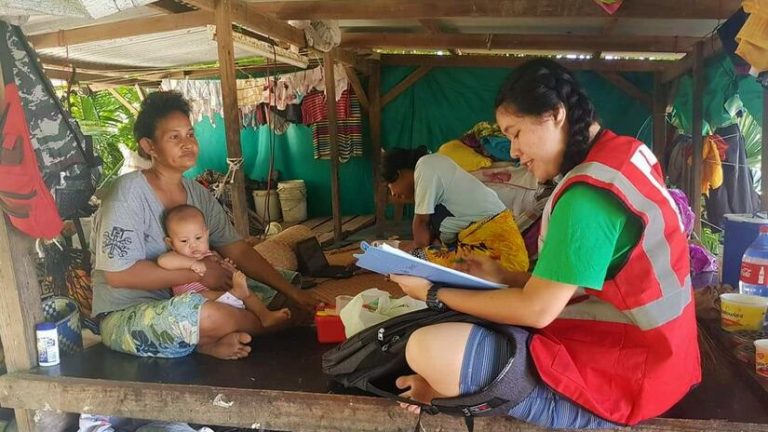
Tuvalu Red Cross will assist people with their household water tank monitoring and deliver drought awareness activities to help communities cope with the current dry period with rainfall levels at some of the lowest recorded and to be better prepared for periods of droughts.

Disaster management teams from Tuvalu Red Cross are working alongside authorities to help Island Disasters Committees prepare their communities to survive these dry months. Katie Greenwood, IFRC’s Pacific Head of Delegation, said:

“These seriously dry drought levels and forecasts of worse to come in a Pacific Island tropical country reveal how exposed we are to the ravages of extreme weather events which are being fuelled by a changing climate and warming oceans.”

“This IFRC funding is the first ever Disaster Relief Emergency Funds released at the early onset of a drought in the Pacific.”

“It’s critical to invest more in preparing early to enable Red Cross in the Pacific to support their communities to be safe ahead of disasters so they can reduce impacts and build resilience,” said Greenwood.

SOURCE: IFRC/PACNEWS

Fiji records 240 new cases of COVID-19, Baby among three deaths reported

Fiji has recorded 240 new cases of COVID-19 and three new deaths Wednesday, increasing the total number of cases in the island nation to 48,323 and 526 deaths since the outbreak in April.

Permanent secretary for Health, Dr James Fong said 49 cases are from the Western division, 32 cases are from the Central division in Vitilevu, Fiji’s main island and 159 cases are from the Eastern division on the island of Kadavu.

“There are 159 new COVID-19 positive cases in Kadavu and four new cases in Malolo Island. All these individuals have been isolated.

“There have been 747 new recoveries to report since the last update, which means that there are now 13,597 active cases. 2,516 active cases are in the Central Division, 10,793 active cases in the Western Division, 4 active cases in the Northern Division (Macuata) and 284 active cases in the Eastern Division (all in Kadavu).

“There have been 48,323 cases during the outbreak that started in April 2021. We have recorded a total of 48,393 cases in Fiji since the first case was reported in March 2020, with 33,915 recoveries,” said Dr Fong.

He said there are three new COVID-19 deaths reported for the period of 30 August – 07 September 2021. All three deaths were reported from the Central division, including a four month old infant in Suva.

“There have been 8 more deaths of COVID-19 positive patients. However, these deaths have been classified as non-COVID deaths by their doctors. The doctors have determined that these deaths were caused by a serious pre-existing medical condition and not COVID-19.

“There have now been 528 deaths due to COVID-19 in Fiji, with 526 of these deaths during the outbreak that started in April this year. As of 03 September, the national seven day rolling average of COVID-19 deaths per day is four. The seven-day rolling average for COVID-19 deaths per day in the Central division is one and in the Western Division is three.

“We also have recorded 353 COVID-19 positive patients who died from the serious medical conditions that they had before they contracted COVID-19; these are not classified as COVID-19 deaths,” said Dr Fong.

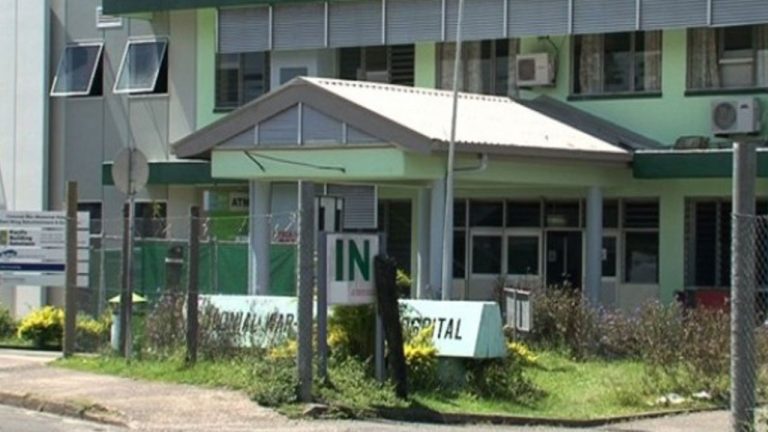
He said there are currently 169 COVID-19 patients admitted to hospitals in Fiji.

“80 patients are admitted at the Lautoka Hospital, 12 patients are admitted at the FEMAT field hospital, and 77 are admitted at CWM hospital, St Giles, and Makoi.

“20 patients are considered to be in severe condition, and 7 are in critical condition,” Dr Fong said.

“The national 7-day average daily test positivity is 17.2 percent, which is on a downward trend but still indicating a high level of community transmission,” Dr Fong said.

As of 07 September 568,676 adults in Fiji have received their first dose of the vaccine and 308,258 have received their second doses.

“This means that 96.9 percent of the target population have received at least one dose and 52.9 percent are now fully vaccinated nationwide,” said Dr Fong.

SOURCE: PACNEWS

Australia under pressure to allow commercial kava import

0

The Solomon Islands and Vanuatu have upped the pressure on Australia, urging it to follow through on its promise to allow commercial kava imports.

That issue, along with how Australia could better support the Pacific’s agriculture industries more broadly, and also labour Mobility – were the top issues discussed by some of the region’s leading diplomats.

High Commissioners from Samoa, Solomon Islands and Vanuatu spoke on a panel, along with the Australian Minister for the Pacific Zed Seslja, as part of this week’s ANU Crawford Leadership Forum.

Vanuatu High Commissioner Samson Fare said that he would like to see Australia invest in Vanuatu’s priority commodities, such as kava.

“We would definitely be looking forward to working closely with Australia in speeding up the process of this commercial pilot to come into realisation,” he said.

SOURCE: ABC/PACNEWS

Micronesia Presidents join Pacific Forum SG in call for urgent climate action

It was a rare moment given the upheaval and controversy the Pacific Islands Forum has faced in the last year or so.

Palau President Surangel Whipps Jnr and his fellow MPS leader, President David Kabua of the Marshall Islands, were on the same page this week with Pacific Islands Forum Secretary General Henry Puna.

Despite some earlier apparent hiccups with connecting, Whipps and his fellow MPS leader acknowledged the presence of the Forum’s controversial appointment, putting aside talk of denunciation and leaving the Forum family, to stand as one on the region’s climate change crisis.

The three were part of a high level panel lighting up the path to the COP 26 later this year, when countries of the world will gather – or some of them will gather—to negotiate whether or not this climate crisis will end well, or be the end of humanity. With science now backing the Pacific’s ongoing 1.5 to stay alive call from more than a decade ago, Tuesday’s plenary which was joined by New Zealand and the UK’s Ministers for Climate change, was another virtual hurdle for the Virtual Islands Innovation summit, organised by its founder James Ellsmoor and with a global following that has attracted world leaders, thinkers and major backers to the event.

For Tuesdays Pacific opening (another was help for the Caribbean islands, and more sessions are continuing this week), former U.S President Bill Clinton provided the welcoming remarks and support for the Pacific nations.

But it was the leadership of the Micronesia Presidents, speaking to the issues they know so well because they live them daily, which drew strong positive support in the virtual platforms chat columns.
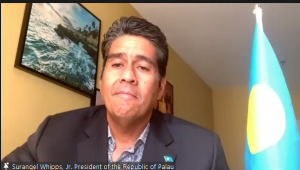
Palau, like all small island developing states has been faced with an exhilarating pace of global challenges. We have had to adapt to these environmental health and economic shocks, and are barely staying afloat,” Whipps told the online plenary, noting Palau’s enviable record of reaching herd immunity in July, and rolling out a pandemic certification programme. Even two cases detected at the border in August were isolated and vaccinated.

“We have truly opened with care,” Whipps said, announcing the nation will open up in February next year to host the global “Our Oceans Conference”.

But being home to globally renowned waters is also feeling the impact of climate change, and Whipps noted Palau, like other vulnerable islands of the Pacific, faces the harsh reality of climate.

“There is an obvious unequal distribution of benefits and burdens, as well as an uneven field of global policymaking on sustainable oceans. We must encourage and facilitate the fair sharing of the benefits of the ocean use and align our concerns for social equity with concerns of environmental sustainability,” he said.

“The growing negative impacts of sea level rise, displacement of communities destruction of infrastructure, and the loss of historical and cultural resources and the threats to food security require action. We must all work towards net zero in 2050. It’s time climate financing is made accessible to local communities so that we can all develop and implement climate mitigation and climate adaptation strategies.”

The strong call from Whipps took up where the focus from Puna summed up the bottom line: “For us in the Pacific, climate change is not a debate. It is a matter of survival and every day of inaction brings us one step closer to a perilous future which could well see many of our homes disappear.”
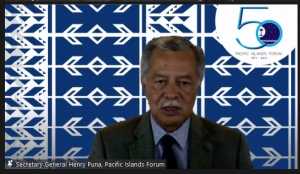
Recalling his own experiences as a pearl farmer, the Forum secretary general highlighted three key message, setting the stage for climate change reality in the Pacific; summing up regional action to combat the climate change crisis and implement Sustainable Development Goals; and sharing what the Pacific people must see “from governments and the global community within this decade. if humanity is to secure our collective future.”

“So what do we want to see from governments and the global community? In short, Urgent action, and ambitious action,” SG Puna said.

With the latest IPCC report pointing to the need for urgent action to avoid catastrophic impacts, Puna joined the opening call from RMI President David Kabua for the Kainaki Lua Declaration of the 2019 Forum Leaders to see traction at the upcoming COP26 this November.

In Glasgow, Puna, said, “we want to see real and tangible commitment to upholding the goals of the Paris Agreement. The Paris Agreement is not just a political tool – it is a roadmap for our very survival. The Rulebook must be finalised at COP 26.”

Describing the global talks and commitments of recent months as ‘insufficient’, Puna reminded the Virtual summit “we can have all the commitment and talk in the world, but without real, actual action, particularly by the wealthy and global major emitters, the world will surpass the 1.5-degree threshold within the next decade. This is not the future we want for our children.”

Like other Pacific nations experiencing stronger typhoons and cyclones as the years go by, RMI has been hit by the decimating shocks of a climate crisis it didn’t create. Focussing on the work of advocacy and unmet promises, Kabua called for a focus on the actual implementation of the Paris Agreement calling for financing of the US$100 billion commitment for climate adaptation.

“It is also important that the global community has a closer focus on the relationship between oceans and climate change. We are big ocean states. Oceans must be integrated into the UNFCCC practice process. The recognition of the ocean climate, biodiversity nexus entails that the production of one cannot be the expense of the other.

Kabua described the kind of bold ambition for oceans he is looking for. RMI is partnering with other nations to push for stronger emissions action at the IMO, with a carbon levy to fund research and help the most vulnerable islands of the world.

The Marshall Islands has also joined a new maritime boundaries declaration which sets the maritime borders under the law of the sea, to exist in perpetuity, despite sea level rise.

“We are committed to our collective efforts to ensure that as maritime zones are delineated in accordance with UNCLOS, they cannot be challenged or reduced as a result of sea level rise and climate change,” he explained.

“Rising sea level is a natural phenomenon threatening all island nations worldwide. This is a threat more catastrophe than this current pandemic,” he said.

“The RMI will not be idle, we will continue to take decisive actions—and we will join all efforts for a greenhouse gas transition to zero emissions by at least 2050,” he said.

SOURCE: PACNEWS

For more information on the Virtual Islands Innovation summit you can log on https://islandinnovation.co/


Samoa PM issues climate warning ahead of crunch UN talks

The world must take urgent action on climate change at upcoming UN talks in Glasgow or low-lying Pacific nations will face a “dire” future, Samoa’s new leader has told AFP in an interview.

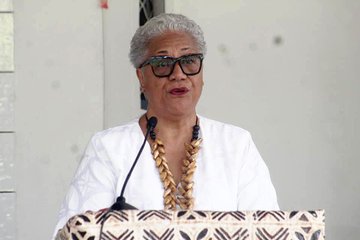
Fiame Naomi Mata’afa, who took office as Samoa’s first female prime minister in late July, gave a stark assessment of the Pacific’s prospects if efforts to tackle global warming continue to stall.

Mata’afa said rising seas were already swamping the region’s tiny atoll states — which include nations such as Tokelau, Tuvalu and Kiribati.

“With them, it’s a real and present circumstance — the water is gaining ground on them,” she said Monday, adding that violent cyclones were becoming more common across the South Pacific.

Major storms “used to be every 50 to 60 years, now it’s becoming every two to three years,” she said.

“For us, we’ve noticed the impact on our coastal areas, and about 70 percent of our country is settled on the coast.”

In a wide-ranging interview, Mata’afa also discussed the geopolitical rivalry between China and the United States in the Pacific, her disappointment at neighbouring Australia’s climate stance and the implications of her ground-breaking election victory.

But front of mind was the 26th edition of the UN Climate Change Conference of the Parties — COP26 — scheduled to start in the Scottish city of Glasgow in November.

The summit will involve negotiators from 196 countries in the biggest climate conference since landmark talks in Paris in 2015.

Mata’afa said it was crucial that participants honour the ambitious goal set in Paris to limit global warming to 1.5 degrees Celsius compared with pre-industrial levels.

To do that, she said carbon-emitting countries needed to prioritise saving the planet over economic growth, adding: “It’s not rocket science.”

“The Pacific was sort of a lone voice in the debate for a very long time, but I think the science advisers have now brought the world’s thinking towards that.”

The 64-year-old admitted her frustration at regional heavyweight Australia, which refuses to adopt a net-zero emissions target while remaining one of the world’s largest fossil fuel exporters.

“When you’re working as a collective as we do in the Pacific, Australia is a part of that,” she said.

“It is a frustrating element but that’s the reality of our lives, you can’t always agree.”

She also bristled at suggestions by some in Australia that Samoa did not understand the risks posed by forging close relations with China, which is seeking to expand its influence in the Pacific.

“What they were saying was we weren’t as well nuanced about how you have relationships with these big countries,” she said.

“We’ve been independent since 1962, so we’ve been around the block. I think we understand quite well what our relationships are, just as Australia has its own relationships.”

Mata’afa said the new government had no intention of changing its diplomatic recognition of Beijing and recognised the “One China” policy, although she remained open to trade with Taiwan.

She played down the impact of cancelling a Beijing-bankrolled port project agreed to by her predecessor, saying it was only at the feasibility stage when canned and would have no bearing on Samoa’s “mature” relationship with China.

Quizzed on rivalries between China and the United States in the region, Mata’afa said she was comfortable dealing with both superpowers to pursue Samoa’s best interests.

“In the geopolitical context, the reality of small countries is that we have to navigate our way through these larger countries and the issues they prioritise,” she said.

Mata’afa has been a long-time advocate for women’s rights and expressed hope her ground-breaking election win would signal a change of attitudes in the Pacific, which has one of the lowest rates of female parliamentary representation in the world.

“For gender role modelling, I’ve always believed that any women who achieved in whatever sector, once that happens other girls and women see that it can be done,” she said.

“It’s significant in that sense,” she said.

SOURCE:AFP/PACNEWS

People’s Alliance political party registered in Fiji

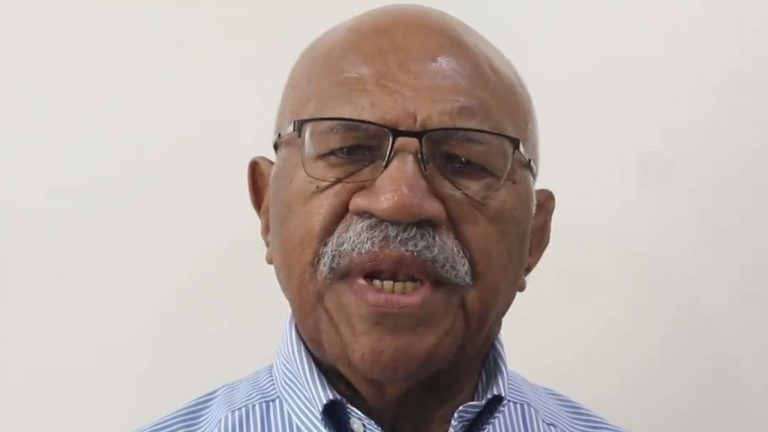
Sitiveni Rabuka’s People’s Alliance has been registered as Fiji’s latest political party.

Registrar of Political Parties, Mohammed Saneem said today that the one objection received has been dealt with and “the applicant has successfully furnished all the particulars required under the law and hence the party has been duly registered.”

The total number of registered parties in Fiji currently stands at eight.

Rabuka was Leader of the Opposition until he resigned from the Social Democratic Liberal Party (SODELPA) in December last year.

Meanwhile, the leader of the newly registered People’s Alliance Party, Sitiveni Rabuka says he is ready to contest the next General Election.

Rabuka said he was aware of the financial challenges that come with administering a political party.

Rabuka has admitted to FBC News that the People’s Alliance does not have the money to mount a successful election campaign but adds there are plans to get funding in time to prepare for the campaign period.

Following the successful registration of his party earlier today, Rabuka says some former Social Democratic Liberal Party youth worked behind the scenes to the Peoples’ Alliance to this point.

He said he has proven his critics wrong, especially in light of the immense pressure he was under.

“Many people say negative things about the party and our chances of getting registered, but we have now come through and proved everyone wrong. We have confidence in his office.”

Rabuka says he is aware of SODELPA members who are not interested in running for the Opposition party in the 2022 General Election.

However, the Leader of the Peoples’ Alliance said for now, he has no intention of poaching any SODELPA members.

“They are free agents, they have their own voter blocs that have supported them to get them to contention for the seat in parliament and they have been asked whether they are interested in running again under the SODELPA banner and they had not shown that interest.”

A number of key SODELPA MPs are known to have allegiances to Rabuka and there is speculation that some of them are ready to jump ship for a Rabuka ticket in the next election.

Fiji’s next General Election is scheduled to take place between 26 May 2022 – 09 January 2023.

In another development, Unity Fiji Party leader Savenaca Narube wants to challenge the amendments being made to the Political Parties Act as he believes it’s being done to weaken the opposition.

Narube said the opposition parties must not accept these gagging tactics lying down, they must unite to challenge these amendments in court.

He said the amendment to the Political Parties Act which demands actions by parties not in government had nothing to do with financial management.

“There is no doubt in my mind that this was meant to hide the amendment from public scrutiny. We must unite to challenge these amendments in court,” he said.

“The amendment was tucked away with the amendment to the Public Financial Management Act which deals with how the Government of the day should manage the country’s finance.

“Therefore, the amendment to the Political Parties Act which demands actions by parties not in government had nothing to do with financial management.

“There is no doubt in my mind that this was meant to hide the amendment from public scrutiny. This tactic worked as the opposition missed the amendment altogether,” he said.

Narube said to demand political parties to calculate their impact on the budget deficit is totally impracticable.

“Some may argue that it is reasonable to demand political parties to assess the cost of the promises that they make,” he said.

“To enable them to do this, the political parties will have to know the total projected expenditure and revenue, which are impossible.

“The screws are being tightened slowly to gag and weaken the opposition in 2022. Bill 50 in March this year amended the Electoral Act to make it unlawful to criticise the elections.

“Bill 52 also in March this year amended the Political Parties Act to remove the rights of the Opposition to appeal the decisions of the Supervisor of Elections to the High Court.

“Instead, the law was amended so the appeal can only be made to the Electoral Commission of which the Supervisor of Elections is the secretary, and whose decision is final,” Narube said.

SOURCE: ISLANDS BUSINESS/FBC NEWS/FIJI LIVE/PACNEWS

K500million for PNG election: PM Marape

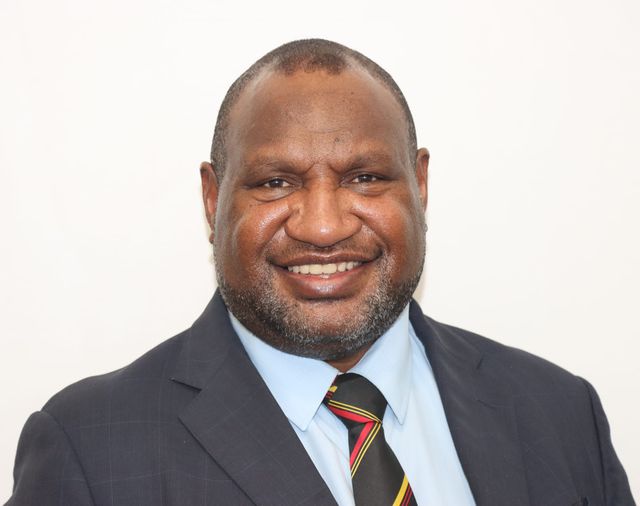
Papua New Guinea Prime Minister James Marape says the 2022 general election will cost Papua New Guineans about K500 million(US$142 million) with a huge portion going to the common roll update, pre-election planning and security operations.

“This is why we have asked for the police and the Electoral Commission to submit a budget within the limit of the estimates,” he said.

Police Minister William Onglo also said Police Commissioner David Manning had signed off on the budget for the election security on Friday.

Onglo said the budget would be taken to the National Executive Council.

Police are seeking K194.1 million (US$55.2 million) for security operations throughout the election.

Comm Manning told The National that the breakup of the security budget was K48 million (US$13.6 million) for transport, K47.6 million (US$13.5 million) for allowances and K43.9 million (US$12.5 million) for travel, including air support.

The National understands that the remaining balance includes:

*Planning, coordination, training and welfare – K17.1 million(US$4.8 million);
*Equipment – K16 million(US$4.5 million);
*Communications – K10.6 million (US$3 million);
*Threat mitigation and awareness – K9.7 million (US$2.7 million); and,
*K1.2 million(US$341,000) for the formation of a new Government.

“K500 million(US$142 million) is a huge chunk of the national budget, so we are also having a closer look to ensure that we minimise unnecessary spending on areas that (the money) can be absorbed elsewhere,” Marape said.

“That is why the inter-department election steering committee is now in full swing, working on what the essential cost is and what other associated costs could be spent elsewhere.

“We have pushed beyond K500 million in 2017, and in 2012, it also pushed beyond K500 million.

Marape said much of the spending was associated with security, transportation, logistics and the counting period.

“To the best of our ability, we want to minimise the cost,” he said.

“I appeal to Papua New Guineans to support the election, support the police, and ensure law and order prevails,” said Marape.

SOURCE: THE NATIONAL.PACNEWS

ADB, Vanuatu sign $5 million grant to boost transport projects

0

The Asian Development Bank (ADB) and the Government of Vanuatu today signed a US$5 million grant to help fund the preparation of ADB-supported land, maritime, and aviation projects in Vanuatu.

Vanuatu’s Minister of Finance and Economic Management Johnny Koanapo and ADB Pacific Department Director General Leah Gutierrez signed the agreement, which will fund assessments, planning, and capacity building for implementing transport sector projects.

“Vanuatu is vulnerable to natural hazards, and we must protect our transport sector assets to ensure they do not deteriorate,” said Koanapo. “This ADB support will enhance the readiness of Vanuatu’s transport projects and allow us to be prepared in times of extreme weather and disasters.”

The Vanuatu transport network, which comprises predominantly government-owned infrastructure and services, includes 4 international seaports of entry; 3 international airports; a road network comprising an estimated 2,000 kilometers of sealed, gravel, and earth roads; 28 domestic airstrips; and 36 domestic wharves, jetties, and landings critical for interisland connectivity. The islands in Vanuatu are mostly mountainous or steeply undulating. This physical geography and the dispersed population of the island group make it difficult to build and maintain transport infrastructure in Vanuatu.

“ADB-supported projects need robust preparation of engineering designs, strengthened procurement to select quality contractors, and institutional strengthening of government agencies,” said Gutierrez. “ADB will use its project readiness financing (PRF) to expedite transport project delivery in Vanuatu by reducing start-up delays, ensuring quality design, and providing a high level of project readiness preparation which will ultimately help project implementation down the line.”

ADB’s PRF will help to identify the investment potential for transport projects, complete project designs, and support the procurement of civil works materials. The facility will also help prepare a transport sector road map and investment plan to prioritize bankable projects in air, maritime, and roads in the short to medium term, and provide capacity and institutional strengthening for the Ministry of Infrastructure and Public Utilities.

SOURCE: ADB/PACNEWS

Securing climate financing to build resilience to climate change in the Pacific region

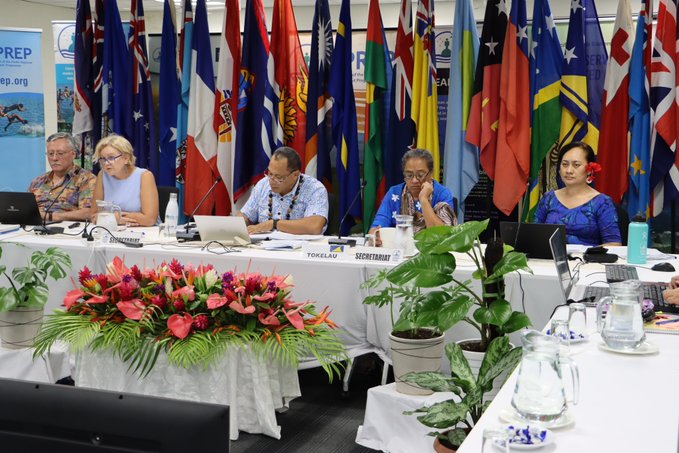
Emerging opportunities and challenges in accessing climate finance to build resilience to climate change in the Pacific were identified during the second day of the 30th SPREP Meeting of Officials.

According to a report released in 2017, titled ‘Climate Finance in the Pacific: An overview of flows to the region’s Small Island Developing States, a total of US$748 million in finance, principally targeting climate change, was committed to Pacific island countries between 2010 and 2014.

With the establishment of the Green Climate Fund (GCF) in 2015, there has been a shift in countries’ approaches to accessing financing to meet their Nationally Determined Contributions ambitions towards low-emission, climate-resilient pathways.

Since the establishment of the GCF, approximately US$362 million has been approved for grants in the Pacific from funding mechanisms which include the Adaptation Fund and the Global Environment Facility, which is the largest funder of climate-related financing in the Pacific.

Manager of SPREP’s Project Coordination Unit, Dr Melanie King, presented to the 30th SPREP Meeting of Officials on how Pacific island countries can capitalise on emerging strategic opportunities in securing climate financing for Pacific island countries to meet their climate change goals, and also highlighted some of the challenges that prevent them from doing so.

Dr King stated that Pacific island countries can capitalise on opportunities to access climate finance by exploring access to all funding options and opportunities, building synergies across all modalities and funds, developing financial assistance funds to enable access to technical support in order to develop effective concept notes, and developing solid platforms for projects at country levels through Readiness and National Adaptation Plans.

Aligning country programmes with key priorities and clear project ideas which meet funder investment criteria and scaling-up investments were also ways in which countries can fully capitalise on emerging strategic opportunities to access climate finance.

While a number of opportunities are emerging through interactions with the funding agencies, accessing finance also has a number of challenges for Small Island Developing States which need to be mitigated against before effective access can be achieved.

These challenges include the countries priorities not always meeting funding investment criteria. This therefore leads to project concepts which do not meet the criteria being submitted to funders and subsequently declined.

Another challenge to Pacific island countries in accessing climate financing is the limited capacity to absorb increasing amounts of development assistance, which leads to a hesitancy to take on large scale development projects.

“We need to challenge our Pacific island countries to think big. In order to make a difference or to bring about change, we need to think large-scale. A way this can be achieved is by looking at blending and scaling-up across funds, and utilising third-parties to implement these projects, relieving internal pressure on resources, whilst still working closely with governments,” Dr King said.

In addition, the lack of clear articulation and mapping of key priorities, as well as capacity constraints and high transactional and operational costs are also challenges which exist for SPREP’s Pacific island member countries

SPREP was recently re-accredited to the Green Climate Fund as a regional Accredited Entity. This means that Pacific island Members can apply for GCF funding for climate change adaptation and mitigation projects through SPREP. The organisation had to meet strict and extensive fiduciary, governance, project management and other organisational performance standards in order to be re-accredited.

A multi-country Readiness Project aimed at building capacity within SPREP, across the region and across Direct Access Entities to better support the development of country project pipelines has also been supported by the GCF.

For more information, please contact Dr Melanie King, Manager Project Coordination Unit, at melaniek@sprep.org

SOURCE: SPREP/PACNEWS

PNG logging industry ‘a major money laundering risk’ – report

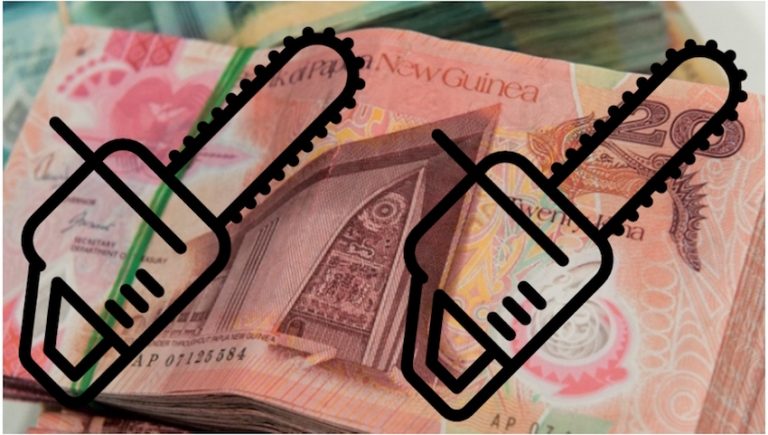
Illegal logging in Papua New Guinea represents a major money laundering threat as it generates very large illegal profits and it has a very high detrimental impact on the economy as well as the natural environment.

This is according to a money laundering and financing of terrorism risk assessment published by the Bank of Papua New Guinea.

The risk assessment says the strong indicators of large scale corruption and illegal logging in the forestry sector in PNG are well known, well documented and widely accepted. It says those risks have already led one commercial bank to ‘institute a policy of not dealing with companies involved in the logging industry’.

The PNG Forest Authority though remains apparently unconvinced, believing ‘the extent of illegal logging is seriously overstated’. This is despite the risk assessment finding the PNGFA’s own records showing ‘extensive over logging’ which delivers ‘additional profits’ to the logging companies.

Because of the PNGFA’s intransigence, the risk assessment says there has never been any investigation into breaches of forestry laws that has resulted in a successful prosecution of a timber operator or an individual associated with the industry. This is despite many reports of high levels of corruption in the sector and concerns that have been voiced over a long period. The PNGFA’s approach is ‘counterproductive’ says the assessment, ‘as it provides little disincentive for unauthorised activities’.

The risk assessment says the scale of illegal logging in PNG not only dramatically reduces the financial benefits of the industry to the country but is also diminishing a limited natural resource. The loss of forest areas is ‘a major problem’ as almost a third of all logging involves land clearances for agriculture leading to permanent deforestation. This is increasing the loss of wildlife habitats and increases the risk of loss of endangered species, says the assessment.

In 2013, the UN Office on Drugs and Crime estimated that that the value of illegal logging in PNG and the Solomon Islands was in the order of US$800 million per annum, this, says the assessment is double the value of legally exported forest products reported to the Bank of PNG. It is also equivalent to around 10 percent of the value of all legitimate exports from PNG and represents about four percent of national GDP. In addition, the lost benefit to income tax revenue, GST and licence fees is ‘very significant’.

In addition to the illegal profits for logging companies and financial losses to the country, the assessment also notes the forestry industry is linked to a range of other criminal activity. It says the network of forty private logging ports around the country are outside effective Customs control and are known to be used for criminal activity including people smuggling, the export of flora and fauna and money laundering.

It is also ‘considered likely’ that that there is a significant level of prostitution associated with forestry camps and cases where foreign women engaged in prostitution have been brought in involuntarily or under duress are also ‘likely’.

The laundering of the proceeds from illegal logging is not just a domestic problem. The assessment says that most of the laundering of funds derived from illegal logging in PNG probably happens offshore, although some of the money does find its way back to PNG to support the continuation of logging activities. This means that some foreign countries are facing a domestic money laundering problem created by criminal offences committed within PNG. While addressing the problem at its source (in PNG) is described as ‘critical’, there is also the opportunity for PNG to work with other countries to trace, locate, freeze and recover criminal proceeds overseas.

The risk assessment says that illegal logging is a complex problem that requires ‘coordinated and concerted action by PNGFA, revenue agencies and the Office of the Public Prosecutor’ and ‘a different approach to compliance, involving criminal prosecutions and imprisonment, as provided for in the legislation’.

The assessment says although there are capacity and skills shortages within government agencies and weaknesses in the regulatory and legislative framework, most importantly, there is currently a lack of will in the PNG Forest Authority to investigate and prosecute illegal logging.

The assessment also calls for a joint task force to be created with FASU, Customs, PNGFA, police, Internal Revenue Commission and Department of Justice to trace, locate, freeze and recover the criminal proceeds of illegal logging, including those banked overseas. It also notes that technical assistance being provided by INTERPOL to address the illegal logging and money laundering is an important development.

The assessment says the joint task force should conduct ‘a specific money laundering risk analysis for the logging industry’ that will ‘address criminal activity in the industry’ and ‘provide the basis to reduce criminal behaviour [and] increase public confidence in the integrity of the industry’.

The findings of the risk assessment should serve as a warning to all the commercial banks in PNG of the potential risks they could face from doing business with the logging industry and providing financial services to the sector.

SOURCE: ACT NOW PNG/PACNEWS

Stay connected

529FansLike
172FollowersFollow
156SubscribersSubscribe
- Advertisement -