Home Blog Page 1109

Three cyclones forecast to hit Fiji

0

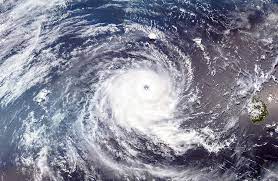
Fiji is likely to be hit by one to three tropical cyclones from November 2021 to April 2022, one of which will be a severe system, stated the Fiji Meteorological Service in its 2021/22 Tropical Cyclone outlook released this week.

And the Western Division will face an “elevated risk”.

“Average tropical cyclone activity for Fiji is likely this season, with one to three tropical cyclones likely to pass through Fiji’s exclusive economic zone.

“Out of the one to three tropical cyclones, one severe tropical cyclone is likely to affect Fiji.”

Fiji Met stated an analysis of past cyclone tracks showed that a greater number of tropical cyclones which affected Fiji in seasons similar to present, passed through the Western division.

“Hence, there is an elevated risk of tropical cyclone activity in the Western division.

“Similarly, TCs also affected other parts of Fiji in seasons similar to present in the past. Therefore, all parts of Fiji should be equally prepared for the coming tropical cyclone season.”

In total, four to six named tropical cyclones are expected between November 2021 to April 2022 in the region.

SOURCE: FIJI TIMES/PACNEWS

Atoll nation of Tuvalu adopts ‘cubes’ to step up nutritious food production

Tuvalu, a small atoll island nation in the Central Pacific Ocean, is one of few countries in the world to have so far evaded the pandemic. But, while it has achieved a milestone with no recorded cases of COVID-19, its population of about 11,931 continues to battle food uncertainties and poor nutrition. These challenges, present long before the pandemic emerged, have been exacerbated by lockdown restrictions and economic hardships during the past year and a half.

In the low-lying island country, people have strived to grow food with “lack of access to land, lack of compost for growing food and, more so, with high tides and cyclones flooding the land with seawater,” Teuleala Manuella-Morris, Country Manager for the environmental and development organisation, Live & Learn, in the capital, Funafuti, told IPS.

For years the islanders have watched their food gardens destroyed by extreme tropical weather and disasters, such as cyclones and tidal surges. These factors have contributed to their increasing consumption of imported foods. But now, the future is looking more certain with the introduction of an innovative farming system on Funafala, an islet situated close to the main Funafuti Island.

The new farming method is based on a modular structure of specially designed boxes, known as ‘food cubes’, which give local food growers greater control over their harvests.

“Tuvalu, as an atoll nation, has a range of agricultural production challenges and also relies on imported food. The pandemic has also affected food supply chains. So, considering such challenges, there was a shift in policy in trying to strengthen food security programmes. In the meantime, we were already piloting the food cube system in Tuvalu. It fits perfectly well with the shift in policy focus for food security for the country,” Gibson Susumu, Head of Sustainable Agriculture in the Land Resources Division of the regional development organisation, Pacific Community, which is guiding the project’s implementation, told IPS.

Issues of declining agricultural production and persistent malnutrition have existed across the Pacific Islands for decades. Before the pandemic in 2019, 49.6 percent of Oceania’s population of an estimated 11.9 million endured moderate to severe food insecurity, reports the United Nations Food and Agriculture Organisation (FAO). Although stunting afflicts 10 percent of children under five years in Tuvalu, which is well below the regional average, the country carries a heavy burden of Non-Communicable Diseases (NCDs). Eighty percent of men and 83.8 percent of women were classified as overweight in Tuvalu in 2016, cites the Global Nutrition Report, while diabetes afflicts 23.1 percent of adults, according to the World Health Organisation.

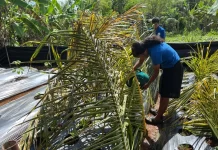
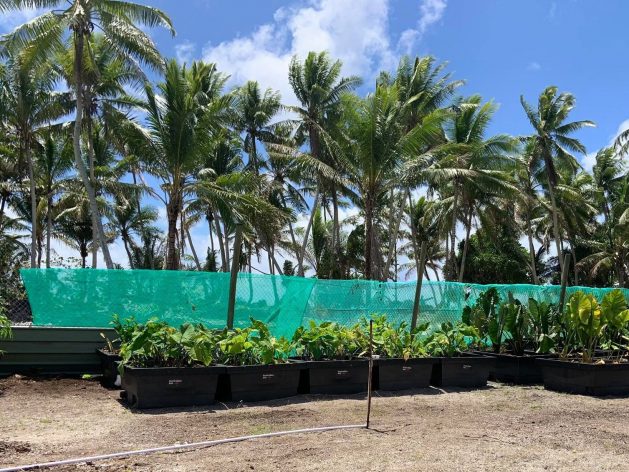
On Funafala, a vast interlocking array of boxes, raised above the ground, creates a patchwork field of green abundance. The ‘field’ contains 80-100 cubes spread over an area of 1.2 acres in which fruit and vegetables are being grown for more than 16 local households. Each ‘food cube’, which is one-metre square and 30 centimetres deep, is manufactured from 80 percent recycled food-grade plastic and designed with features that expose the plants grown within to oxygen and controlled irrigation.

“The Funafala garden has showcased the growing of local foods, like pulaka (giant swamp taro), taro, local figs, cassava, dwarf bananas and dwarf pawpaw trees…It is not only providing more food for the community but has also proven that the food cubes are another way of growing food in areas being flooded with seawater while maintaining soil fertility for more planting. At the same time, it saves water,” Manuella-Morris told IPS.

The ‘food cube’ was designed and produced by Biofilta, an Australian company developing modular urban farming systems six years ago. In 2017, the business won a worldwide competition called LAUNCH Food, commissioned by the Australian Department of Foreign Affairs and Trade to reward new solutions to the global issue of poor nutrition.

“To put it into a food security context, I think those food cubes will be able to produce up to 150 kilogrammes of vegetables and greens for a year, and that is sufficient to meet the green vegetable requirements for the member households,” Susumu said.

Biofilta claims that the system is “raised, so there is no risk of saltwater inundation, and our wicking technology is extremely water-efficient, using only a fraction of the water needed in conventional agriculture.” These are important features, as Tuvalu possesses no renewable water resources and its point of highest elevation above sea level is only five metres. Further, the farm uses compost, specifically tailored to the country’s soil needs by the Australian Centre for International Agricultural Research (ACIAR), which also draws on ingredients from the island’s green waste treatment facility.

Another key partner, Live & Learn, has expanded trials of the farming system on other islands in Tuvalu. The long-term goal is better health outcomes and longer productive lives for islanders. “Because of agricultural challenges, the diet diversity is very low…So, with the diversification of the production systems, it means that the households have more access to healthy diets, and if the surpluses can be marketed, it also supports the income side of the households,” Susumu explained.

The Pacific Community also plans to consult with the government, local communities, and farmers to determine appropriate prices for the commercial sale of surplus fresh produce from the farms so that healthy food remains affordable to everyone.

More widely, the initiative is responding to calls from organisations, such as the FAO, to rethink food systems around the world so that smarter production leads to increased supplies of quality food, reduced pressures on finite natural resources, such as land and water, and the lower impact of agricultural practices on global warming.
The success of the ‘food cubes’ in Tuvalu has sparked enthusiasm by other Pacific Island countries, such as the Cook Islands and Fiji, where it’s also being trialled.

SOURCE: IPS/PACNEWS

Depleting fishing grounds and the need to practice sustainable fishing at Titiana

By Ronald Toito’ona

The dual impacts of over-fishing and climate change appear to have resulted in the depletion of fish stocks on various common fishing grounds used by local fishermen from Titiana village, in the Western province of Solomon Islands.

Titiana is a coastal community of Micronesian decent, situated at the southern shore about 2 miles west of Gizo, the province’s capital town.

In response to poor catches, villagers are now looking more at revisiting their old fishing methods to ensure that their fish and marine resources are sustainably managed.

As populations have grown, fishing in nearshore and coastal waters has, in some areas, lead to depleted resources and changes in fishing practices.

Common fishing grounds are no longer as rich in fish stocks, and fishing communities find it more difficult to cope with reduced catches that take more time and effort. This is increasingly an everyday challenge for many communities in the Solomon Islands.

With the daily challenges of trying to meet their demands for fish to eat, the local fishers of Titiana have now started to take sustainable fishing practices seriously as they begin to respond to concerns that their community’s main food source is on the brink of collapse.

Wesley Misu, 27, is a fisherman from the Titiana Community. In a recent interview, Misu said sustainable fishing was not a question of concern for many years. But now, communities are seeing the importance of fishing to their livelihood as they respond to declining catches despite their increased efforts.

With the complications surrounding the increase in over-fishing at the Titiana community, the fishermen are now eager to understand how sustainable fishing works.

The experience: depleting fishing grounds and over-harvesting

For the past 20 years, Misu joined his relatives and friends on fishing trips, and has seen and experienced the changes brought about by over-harvesting of fish stocks.

During an interview at the Gizo Fish Market, Misu said it is much more difficult than 20 years ago as people have to go out very far to fish and sometimes come back home with only few fish. At times, their catches are not enough to feed their families or to be sold for little income at the market.

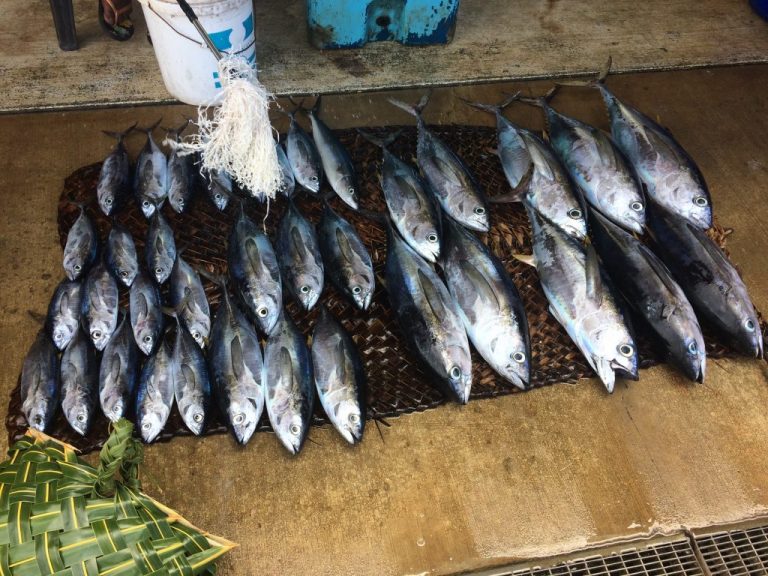
“In recent years, fishers would return home with less than 20 fish. This is different from the experience of the early 2000s, where we usually travel out fishing and return with a boatload of fish or tuna.

“I believe that, before, good catches were a result of careful harvesting of fish stocks in our common fishing grounds, using the traditional fishing techniques and also with the use of right fishing gear which also contributes to sustainable fishing,” said Misu.

Another challenge that the young fisher said he is experiencing now is the impact of climate change on the movements of fish stocks from their common fishing grounds.

Misu said sometimes when he goes out to fish, he returns with nothing at all.

“Maybe this is caused by the rising tides or how the tides are changing each day.”

In spite of all the challenges Misu and the fishermen from Titiana are facing today, they never give up exploring the reefs and deep seas to fish.

They said they see a lot of potential in fishing because it benefits their families over the passing years.

“Fishing has always benefited us in all aspects of life. I would be unemployed or broke it wasn’t for fishing—or if there is no ocean, we wouldn’t fish.

“Therefore, we have to keep our ocean and fish in sustainable ways so that our future generations can enjoy eating from our sea resources like now,” Misu and the group of fishermen explained.

Another issue raised by the fishers as a contributing factor to the depleting fishing grounds was the use of small gillnets to fish in the reefs and near Fish Aggregating Devices (FADs). With the small sized gillnets, it is common knowledge there is a possibility that most unwanted fish species and other marine lives will be caught as bycatch.

“That said, people need to have a clear understanding of the fish population and the extinctions of other fish and marine species, and also choose carefully which type of fishing method they can use,” the fishers stated.

Apart from the accounts of the Titiana fishers, the fishing community of Gizo also reported that people are using all kind of fishing methods, especially in the technological age. In doing so, they are contributing to the over-harvesting of some endangered fish and marine species.

This does not only affect the fish, but also the reef’s ecosystem.

Besides, almost every day people went out to the sea to fish, so they are well versed with the behavior of the fish and the locations of the fishing grounds. This makes it difficult for them to fish at the same spot because of the repetition of harvesting on the same fishing ground every day.

Finding the solution to create a local, sustainable fishery

In various coastal villages around Solomon Islands, traditional ways of fishing using throwing or shooting devices (spears, bow and arrow, throw nets, spear-guns) or passive devices (fish-traps, gillnets, fish-pens) were used in the past.

For the Titiana fishing community, the Kura fishing method began long ago, especially since the mid-1950s when the first settlers of the community migrated from Kiribati, between the 1950s and the early 70s while Solomon Islands was a British protectorate.

Others have also stated that Kura is a local name for deep-sea fishing, with lure hooks and a white plastic shank, that has been done for several years. This method is said to have been introduced by Filipino (Philippines) fishers.

The Kura fishing technique is an old-fashioned way of fishing which Misu and other fishermen from his village have been recently trialing to see if it can contribute to sustainable fishing.

Misu explains how the Kura fishing works.

“I first went on a Kura fishing trip two decades ago when I was a kid. Back then, I used to go out on fishing trips with my uncle or sometimes with my friends.

“This method (Kura) is a very easy way to fish because you use coconut leaves attached to a rock and drop your bait to the bottom of the ocean to attract the fish.

“After dropping the fishing line, you will just wait to pull the tuna or fish when you feel that it bites the bait,” Misu explains.

Kura is a simple fishing technique, but the size of the fishing line and hook determines one’s catch.

Another old fishing method is toe-line fishing. According to Misu, this type of method is less dangerous for juvenile fish because one can only catch normal sized fish.

Interestingly, both the Kura and toe-line fishing can also be used in offshore and inshore fishing. These methods are also used to catch tuna near deep-sea FADs.

Realising the importance of FADs for a sustainable fishery

As fishing is the only means of income generating activity for the Titiana coastal community, the use of FADs is seen as a crucial way to manage fish population.

“The people here are heavily dependent on our sea resources. This is due to our ocean fishing skills, and our lack of land and expertise for gardening – the other main food and livelihood option in rural Solomon Islands,” Misu said.

It was also reported that offshore fishing can be dangerous for Titiana fishers, due to the fact that the industrial FADs are located in oceanic waters to the south of Gizo, with fishers operating small outboard motor-powered canoes to access these FADs between 20 km and 70 km offshore. If the weather gets rough it can be dangerous, and it is also very expensive for the fuel to travel so far offshore.

“We used to travel far to fish for tuna at the industrial FADs.

“But it can be costly, especially if we went out on a trip and the catch was limited. This means making a loss, as we need to cover the cost of fuel and other expenses incurred on that single trip,” the fishermen explained.

However, the fishers are also aware that fishing FADs offshore is one way to manage fish population and to protect the reefs and its ecosystem from over-harvesting.

This is essential for reefs to avoid over exploitation. This way, fisherman and communities will preserve the reefs to fish for a longer time.

“The idea is basically to have more coastal and nearshore locally made FADs to attract fish after a period of time. After the FADs are launched, no one is allowed to fish at the FADs until it open for community harvest.

“That way, fish stocks in the common fishing areas will be healthy and sustainable in the long run,” the Titiana fishers said.

They also encourage local fishermen around Solomon Islands and the Pacific region to practice sustainable fishing. The group of fishers stated that every fisher needs to understand how to fish properly in their respective fishing grounds. Only in this way will they have a sustainable population of fish in the ocean, from the deep to the seashores.

SOURCE: TUNA PACIFIC/PACNEWS

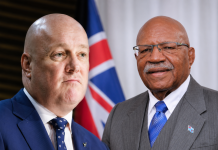
More ambitious actions needed from the biggest emitting countries – Fiji PM Bainimarama

The Small Island Developing States (SIDS)are on a mission to demand more ambitious actions from major emitters and the restoration of the health of the global ocean and more importantly, an increase in climate financing for those affected by climate change.

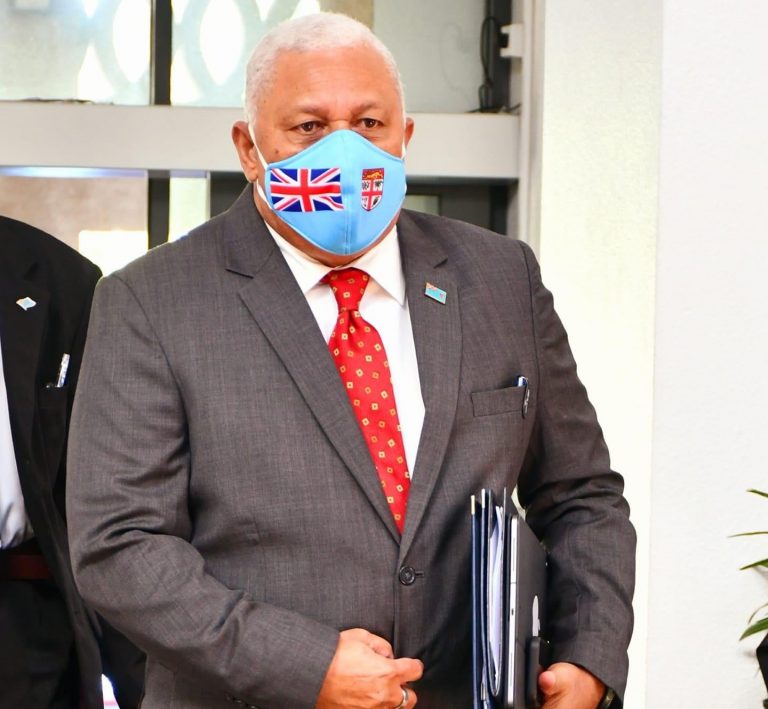
With about three weeks away from the 26th Session of the United Nations Climate Change Conference scheduled to be held in Glasgow, Scotland, Prime Minister and Pacific Islands Forum Chair, Voreqe Bainimarama said there must be strong realistic commitments to ramp up climate actions from the larger greenhouse gas emitters.

While delivering his statement virtually at the EU-Indo-Pacific High-Level Conference on Climate Change, Prime Minister Bainimarama said success is guaranteed if Governments, businesses and ordinary people summon the courage to seize the future we want for ourselves by making strong commitments and acting upon them.

“Fiji is not only asking for ambition, we are acting on it. Our recently passed Climate Change Act commits us to achieve net-zero emissions by mid-century,” he said.

“It mandates the 100 percent sustainable management of our ocean by 2030, with 30 percent as marine protected areas and it calls for resilience through nature-based solutions. It requires the private sector to disclose information on climate change risks and establishes national carbon budgets.”

“COP26 must be the place for the finalisation of the outstanding elements of the Paris Rulebook.”

“Fiji and our Pacific Island neighbours are embracing the goal of region-wide green and blue economies to create a sustainable future in the midst of a healthy Blue Pacific. With the right ambition and corresponding actions, the same ocean that threatens to swallow low-lying islands can become our most sustainable source of prosperity.”

“The ocean-climate nexus should be as clear to anyone as it is to us. In fact, it is more than a nexus; it is an unbreakable bond. We are becoming a part of that bond by investing in sustainable “blue” economies that create generational benefit to our people.”

On the subject of climate financing, Bainimarama said in order to build a truly resilient Fiji and the Pacific, we need access to fast-deploying targeted grants, long-term concessionary financing, and financial tools and instruments established through public-private collaboration and partnership.

“Right now, Small Island Developing States are only able to access a mere two per cent of the climate finance currently available and with that, we are expected to protect ourselves from an existential crisis we did not cause. It is not just an unjust expectation, it is an impossible expectation,” he said.

“Our share of climate finance must be increased to at least 10 per cent of the total funds to protect against future impacts and a clear commitment must be locked in with regards to loss and damage to address the damage already done.”

“For our sake and all of humanity’s, SIDS will wield the full measure of our moral authority against major emitters who refuse to arrive in Glasgow with strong commitments. Our case will be made on the basis of moral principles and global security.”

Meanwhile, the virtual conference showcased a commonality of views between the EU and key partners in the Indo-Pacific on matters of adaptation, including finance and also the need for a number of key countries, notably the G20, to step up their efforts in significantly reducing greenhouse gases in this decade.

SOURCE: FIJI GOVT/PACNEWS

International stats agencies concerned over Fiji’s chief statistician Naiqama dismissal

0

Two international statistics organisations have written to Fiji’s Prime Minister Voreqe Bainimarama to express their concern over the dismissal of the Fiji statistician, Kemueli Naiqama, as CEO of the Fiji Bureau of Statistics from office.

Naiqama’s contract was terminated over the release of data desegregated by ethnicity and religious belief in the Fiji Household and Income Survey (HIES) last month.

At that time the Ministry of Economy said the decision for “failure to comply with Section 5 of the Statistics Act 1961…and that the data on ethnicity and religion was “extrapolated from erroneous sources and which exceeded the established scope of the survey’s data collection.”

However the International Statistical Institute (ISI) and the International Association for Official Statistics (IAOS) are concerned that in sacking Naiqama, “the government’s action is a breach of the UN Fundamental Principles of Official Statistics and would in many countries be seen as unconstitutional.”

In a letter sent to Prime Minister Bainimarama on Monday, ISI President Stephen Penneck and IAOS President Misha Belkindas write that Fiji’s Minister for Economy “took a view on the methodology of the [HIES] survey, and used this as a reason for the dismissal, without apparently seeking professional statistical advice.”

They call on the government to:

*Have the Household and Income Expenditure Survey report independently reviewed by professional experts to determine “the degree of confidence that can be placed in their findings”

*Establish a proper administrative process to determine the context in which the stated conflict with the actions of the Government statistician has occurred

*Appoint any new government statistician by a process that prevents politicisation of the role

* Clarify and reinforce the extent of independence of the Fiji Bureau of Statistics.

Naiqama has stood by the HIES, writing: “This is an honest, clear and realistic snapshot of the poverty situation in Fiji according to internationally accepted standards and categories, and nothing else.”

Penneck and Belkindas write that under Principle 2 of the United Nations Fundamental Principles of Statistics: “To retain trust in official statistics, the statistical agencies need to decide according to strictly professional considerations, including scientific principles and professional ethics, on the methods and procedures for the collection, processing, storage and presentation of statistical data.”

Penneck and Belkindas contend that the termination of Naiqama’s employment, “by political direction without due process would be a breach of this principle and would in many countries be seen as unconstitutional. It is the Government Statistician who guarantees to those outside the country that their trust in official statistics is well founded. The Government of Fiji needs to act urgently to provide vindication of its actions independent of political process so it can rebuild trust in Fiji statistics.”

Noting that official statistics are used by “investors, international rating agencies and others who trade and engage with Fiji”, they write “when such persons are removed from office for what appear to be political reasons, then the practice of science in other fields is more likely to come under political pressure. If the issues we have raised are not resolved, there will be many who have heightened concerns about the integrity and independence of any persons involved in producing trustworthy evidence about the conditions and progress of Fiji in the future.”.

SOURCE: ISLANDS BUSINESS/PACNEWS

‘Precedent set’ State House welcomes Vanuatu Court decision

0

The office of the President of Vanuatu has welcomed the decision of the Supreme Court on the Constitutional application of Ombudsman, Hamlison Bulu, over President Obed Moses Tallis’ recent pardoning of three former Prime Ministers.

Principal Private Secretary of the State Office, Peter Bong, said they applauded the court decision which dismissed the application at the conference level. This, he said, clearly shows the President has the Constitutional power to pardon the conviction of a convicted citizen.

This is in accordance with Article 38 of the Constitution: “The President of the Republic may pardon, commute or reduce a sentence imposed on a person convicted of an offence. Parliament may provide for a committee to advise the President in the exercise of this function.”

Bong said the verdict now sets the precedent for any future challenge of the President’s constitutional power.

SOURCE: VANUATU DAILY POST/PACNEWS

Samoa by-elections set for 12 November, Speaker rules on corrupt arrangement issue

The Office of the Electoral Commissioner(OEC) has announced Friday 12 November as the official polling day for Samoa’s seven pending by-elections.

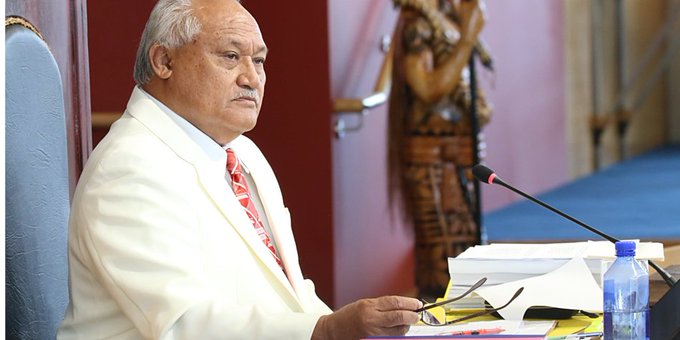
In a public statement the OEC confirmed Speaker Papalii Li’o Oloipola Ta’eu Masipa’u has issued the official warrant instructing the Electoral Commissioner to proceed with issuing of the Writs for the seven by-elections to return the seats of electoral constituencies that were declared void after electoral petitions.

“The Office of the Electoral Commission wishes to inform the public of these key dates of the by election process:

1. Issuing of Writ for by elections – Friday 15 October 2021

2. Nomination of Candidates 18 October 2021 to 22nd October 2021.

3. Withdrawal of Nomination: 29 October 2021

4. Campaigning period opens 25 October and closes 09 November

5. Pre-Polling: 10 November 2021

6: Polling Day: 12 November 2021

In an interview with the Samoa Global News Electoral Commissioner Faimalomatumua Mathew Lemisio said there are more than 16,800 registered voters in the seven districts with 1,103 eligible to pre-vote.

He added at the time, that preparations were already well underway.
Meanwhile, the Samoa Speaker of the House has announced he has no power to prevent a candidate guilty of a corrupt arrangement or attempting to circumvent the process by resigning or withdrawing petitions already filed before the Court relating to charges of bribery and treating.

As election petitions and counter-petitions filed before the Courts were being withdrawn, the Supreme Court noted its disapproval of “corrupt arrangements” being entered into by candidates; where resignations were being declared to circumvent the process and avoid court hearings on charges of bribery.

Candidates were feigning resignations so Court petitions against them could be withdrawn, with intentions to just swing around again and run in the by-election created by their resignations.

In a statement issued this week, the Speaker Papalii Li’o Oloipola Ta’eu Masipa’u says the Electoral Act is “flawed and technically deficient” by not linking a corrupt arrangement (under s133) or an attempt to circumvent the process, to any form of sanction.

According to the Speaker there is nothing neither he nor the Electoral Commissioner can do because there is no provision that disqualifies a candidate from standing in a by-election, even if they have been found by the Supreme Court to have breached s133 of the Electoral Act by purposely entering into a “corrupt arrangement” and thereby circumvent the process of bribery and treating petitions against them.

The result is that the April 9th winner of the Sagaga 4 seat Tuisa Tasi Patea, a lawyer by profession who resigned to ensure the petition against him by FAST candidate Tagaloatele Poloa was withdrawn – is able to run again in the upcoming by-election.

Despite a comprehensive Supreme Court report to the Speaker outlining attempts by candidates to circumvent the petition process, the Speaker has announced that his hands are tied by deficiencies in legislation, and Tuimasealii Tasi Patea of HRPP and Tagaloatele Poloa of FAST can both register as candidates in the upcoming by-election. Tuisa had also prepared a counter-petition against Tagaloatele.

The decision by the Speaker essentially allows the candidates, accused of bribery in the 09 April general election, to call a truce and return to the polls for a rematch.

There is no guarantee that the by-election would not bring about further bribery allegations and more election petitions filed before the Court. There is also no guarantee that candidates will not “circle back” by resigning once more, and return to by-elections, yet again.

In his statement the Speaker has also announced Safata 2 candidates Nonu Teo Lomialagi Lose Niumata who won the seat in April, and FAST candidate Laumatiamanu Ringo Purcell, also eligible to compete in the upcoming by-elections.

The Supreme Court did not report Nonu Lose Niumata’s resignation and petition withdrawal as a corrupt arrangement or an attempt to circumvent the petition process, because the former General Manager of Accident Compensation Corporation (ACC) indicated he did not intend to compete in the resulting by-election.

In a recent sitting of Parliament, amendments to the Electoral Act were made ahead of the by-elections now scheduled for 12 November 2021. No amendments were brought before Parliament to fix the flaws referred to by the Speaker.

SOURCE: SAMOA GLOBAL NEWS/PACNEWS

UN isolation fund launched to support COP26 delegates who contract Covid-19

UN Climate Change will cover the extra accommodation costs of developing country delegates who test positive for Covid-19 during the Cop26 climate talks and need to self-isolate.

COP26 president designate Alok Sharma announced the latest solidarity measures in a speech in Paris on Tuesday, setting out his priorities and expectations for COP26.

“It will be an extraordinary Cop in extraordinary times. But collectively, we must pull together to make it work,” Sharma said.

The fund, he said, will be available to accredited party delegates, civil society observers and journalists from developing countries. Participants who contract Covid-19 will be required to isolate for 10 full days in their accommodation, which could extend their stay in Glasgow.

The isolation rules have been laid out in a Covid-19 code of conduct, which all participants are requested to sign and agree to respect in order to attend the summit.

A COP26 spokesperson told Climate Home News the code of conduct will apply to all participants, including ministers, who are exempt from quarantine requirements when entering the UK.

COP26 organisers are expecting up to 25,000 people to attend the conference while 120 heads of state have confirmed they will participate in a two-day leaders’ summit on 1-2 November.

The UK has among the highest levels of reported Covid infection in the world, averaging 55 daily cases for every 100,000 people.

For all the efforts to Covid-proof the event, Robert West, professor of behavioural science and health at University College London, told Climate Home that it is “highly likely that there will be some transmission among delegates and that this will spread to the local population”.

The UK host strongly recommends all participants get vaccinated but it is not mandatory and some people are relying on jabs that have not been approved by the World Health Organisation.

Under the code of conduct, all COP26 participants need to wear a face covering unless they are eating, drinking, sitting in an office or meeting space or negotiating and ensure one meter of physical distancing.

They will be asked to self-administer a Covid-19 lateral flow test every day in their accommodation before travelling to the Scottish Event Campus, where the conference is taking place. A negative result will be required to enter the conference centre.

Anyone who reports Covid-19 symptoms or tests positive will need to isolate immediately and undertake a PCR test to confirm the result.

A positive PCR test will require delegates to isolate for 10 full days and prevent them from using public transport. The UK government said it will find suitable accommodation for those who need it.

Diplomats who have travelled to Glasgow but are unable to access negotiations in-person because they are isolating or due to limited room capacity as a result of social distancing, will be able to follow discussions online.

Breaching the rules could lead to a suspension of the summit and possible criminal prosecution.

Lia Nicholson, a climate advisor for the Alliance of the Small Island States(AOSIS), told Climate Home that concerns over contracting Covid-19 were outweighed by the urgency of stepping up climate action.

She said Aosis was “impressed” with the UK’s “above and beyond” response to the challenges of holding an in-person Cop.

“We cannot afford these decisions to be delayed another year. And we expect that parties will of rise to the challenge. We don’t want to be putting ourselves and our communities at risk, and then come away with nothing,” she said.

Nicholson added that delegations will need to show flexibility if some of their negotiators become sick and are out of action for part of the talks – a possibility which she said required greater preparation of the entire delegation on critical issues.

The announcement of the self-isolation fund brought relief among campaigners which face prohibitively expensive costs to attend the summit.

Adrian Martinez, of the Costa-Rican based organisation La Ruta del Clima, told Climate Home that the risk of contracting Covid-19 at the conference was “a great worry”.

He and his team have been able to purchase health insurance to cover medical attention in a UK hospital but the policy doesn’t cover the cost of extending their stay beyond the end of the conference, which they cannot afford.

The urgency justifies the risk, Martinez said. “If climate change did not involve our survival and the ability of our communities to exist, we would pick another Cop to attend,” he said.

The number of people who will be required to quarantine upon arrival in the UK, a cost which the government said it will pay, has been dramatically reduced.

Only seven Latin American countries remain on the UK red list after it was updated on Monday.

Alejandro Aleman, Latin America coordinator for the Climate Action Network, told Climate Home that the repeated changes to the rules and the cost of health insurance was preventing campaigners on the continent from attending the conference.

“The general feeling is that action is being taken to prevent participation from civil society in Latin America,” he said. CAN Latin America’s participation at COP26 will be reduced by two thirds compared with previous years, he estimated.

SOURCE: CLIMATE HOME/PACNEWS

Fiji is on a promising recovery path

COVID-19 cannot be removed completely from society.

Local and international health experts say discipline is needed to ensure people’s safety.

Fiji Medical Association President, Dr Basharat Munshi said the Covid-19 is here to stay and vaccination will guarantee high levels of immunity.

“This disease will be downgraded to like a common cold or flu. It will no longer be as deadly as it is now. This is something that we will live with just like common cold or flu.”

Permanent Secretary for Health, Dr James Fong has confidence in Fiji’s current COVID safe measures.

He said these strict measures have successfully controlled COVID transmission during this second wave.

“Because it moves slower, we have the ability to contain it faster. That means we won’t have over-burdened health systems trying to struggle with a huge load of people at one point in time.”

Fiji is on a promising recovery path that reflects the World Health Organisation’s guidelines of a high level of herd immunity be accompanied by lower transmission, hospital admissions and death rates.

Meanwhile, the Pfizer vaccine will be administered to children aged between 12 and 14 years from 18 October.

Prime Minister Voreqe Bainimarama said although the vaccination is not compulsory, students are encouraged to get vaccinated to help the number of people contracting Covid-19 to be low.

The Prime Minister of Fiji has reiterated again on the importance of vaccination.

The vaccine is being brought in from New Zealand.

25,457 children in Fiji have received their first dose of the vaccine as of 09 October.

SOURCE: FBC NEWS/PACNEWS

17 doctors still refuse covid-19 vaccine, Solomon Islands lack capacity to treat covid-19 outbreak

Seventeen doctors at the Solomon Islands National Referral Hospital (NRH) continue to avoid being vaccinated.

This is according to the chief executive officer of the NRH, Dr George Malefoasi.

He confirmed this during a press conference with local journalists at the Prime Minister’s Office.

He said there are 95 doctors from key departments at the NRH; of this total number, 17 doctor still refuse to get vaccinated with the covid-19 vaccines.

“Of the 95 doctors at NRH key departments 17 refused to take the vaccine. So, at the moment we are still talking with them but they still stand not to receive the jab.

“Out the 17 doctors three are from a very high positions and key decision maker clinicians in one of our key department at the NRH,” Malefoasi said.

He stressed they are looking at having another dialogue with them and also to engage international doctors to get the doctors to receive their jab.

“As a CEO I am very much concerned on three senior doctors from one of our key department, all the rest are junior registrars. These junior ones need to decide,” Malefoasi said.

Dr Jones Ghabu, senior consultant physician at NRH and head of internal medicine department, in a recent radio talkback show had appealed to all doctors and nurses who have not yet had their jab to do so.

“I again asked all doctors and nurses who are unvaccinated in the country to please go get your jab because if there should be an outbreak of covid-19 in the country all of us will be affected,” Ghabu said.

He said all individuals have the risk to get infected with the covid-19 virus. The only way to minimise it is to get vaccinated.

Ghabu also called on all citizens in the country to no get manipulated by theories about the covid-19; “theories are not truthful,” he said.

He uttered, “the truth is that people are dying everyday with the COVID-19 virus. The vaccine that we are trying to rolling-out works and saves a lot people.”

Meanwhile, Solomon Islands does not have the capacity to handle a covid-19 outbreak in the country if there should be any, says Dr Jones Ghabu, a senior consultant physician at the National Referral Hospital and head of internal medicine department.

“As someone working in the hospital and is treating people daily we do not have the capacity to treat outbreak in the country.

“This is the very reason why I appeal to you all to please; we must prevent COVID-19 entering the country and prevent community transmission to happen,” he said.

“If we cannot prevent it and COVID-19 came into the country either I watch you dead or you watch me dead that is the truth about our current situation.”

He on the same note calls for all to continue following strategies put in place by the Ministry of Health Medical Services.

SOURCE: ISLAND SUN/PACNEWS

Stay connected

529FansLike
172FollowersFollow
156SubscribersSubscribe
- Advertisement -