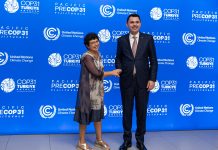


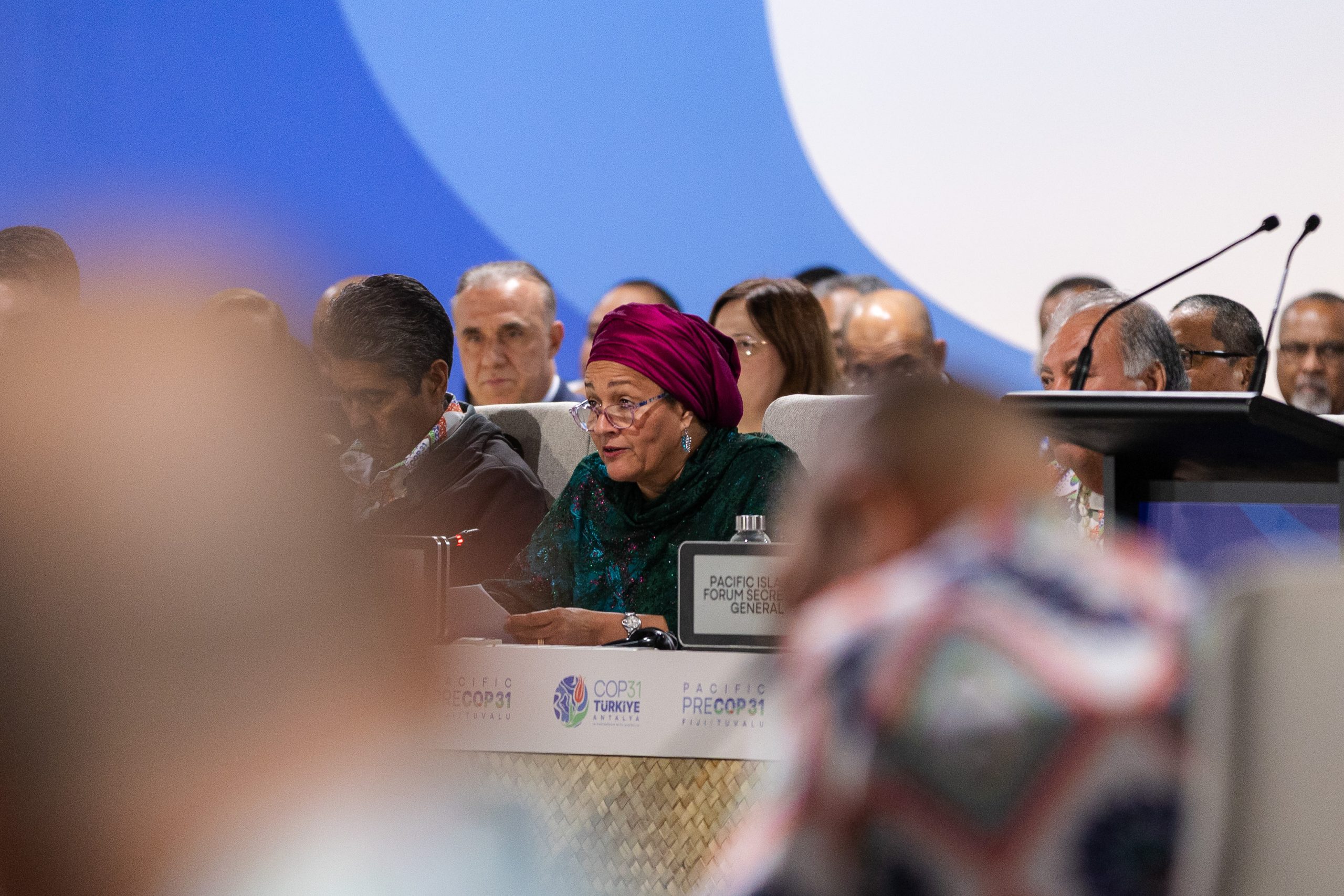
United Nations Deputy Secretary-General Amina Mohammed has called on the world to match Pacific leadership on climate change with urgent action on emissions, adaptation and finance, warning that communities least responsible for the crisis cannot continue carrying its greatest costs.
Mohammed told Pacific leaders at the Pacific Pre-COP31 plenary in Nadi that the future Pacific nations had warned about for decades had arrived.
“For decades the Pacific has warned the world about the future of nations if we cross the planetary boundaries. And that future has arrived,” she said.
She said rising seas, retreating coastlines, saltwater intrusion, extreme heat, destructive storms and warming oceans were already threatening Pacific infrastructure, health, livelihoods, reefs, fisheries and food security.
Mohammed said the world was approaching an overshoot of the 1.5-degree Celsius temperature goal under the Paris Agreement, but stressed that the target must not be abandoned.
“For the Pacific, we believe this is not an abstract number, nor is it a polite conversation.
“It goes to the heart of a question that we put to the Pacific leaders in Palau last month: Can Pacific peoples continue to build good lives here, on their own islands, on their own terms, while protecting the land and the ocean that sustains them?”
“Our answer must be yes,” she said.
Mohammed said every year temperatures remained above 1.5C threatened development gains and the future of Pacific generations.
“Those who contributed least to this crisis cannot be expected to continue to carry its greatest costs.
“Responsibility, capability, justice and solidarity must shape the world’s collective response,” she said.
Mohammed also rejected the notion that Pacific countries were waiting for the rest of the world to rescue them, saying the region had already demonstrated leadership on climate action.
“You are not waiting to be saved, and that you are leading,” she said.
She highlighted Pacific efforts to keep the 1.5C target at the centre of global climate negotiations, advance ocean and climate justice, and bring the issue of sea-level rise before international institutions.
Mohammed also highlighted the recent adoption by the UN General Assembly of a political declaration on sea-level rise, which affirmed the continuity of statehood and preservation of maritime zones in the face of rising seas.
She said this record gave the Pacific “unique moral and political authority” to set the standard for COP31.
Mohammed welcomed the Taku Pakasoa Declaration, which Pacific leaders are expected to sign following their plenary, saying it reflected Pacific solidarity and called for collective action on 1.5C, the ocean and climate finance.
As leaders prepare for COP31 in Türkiye, Mohammed called for three immediate priorities.
First, she said countries must keep the 1.5C goal alive.
“Overshoot is not a reason to surrender. It’s a call to accelerate, make the overshoot as short and small as possible, bringing temperatures back down as quickly as possible,” Mohammed said.
Second, she said vulnerable countries needed urgent investment in adaptation, including resilient infrastructure, secure water supplies and healthy ecosystems.
“Adaptation is not optional.
“Warnings alone cannot hold back the sea,” Mohammed said.
Third, she called for climate finance commitments to be delivered, saying developed countries must lead.
She said the US$300 billion annual climate finance goal should be central to efforts to mobilise US$1.3 trillion a year for developing countries by 2035.
“Finance still has to be predictable, accessible, and at a scale, especially for the most vulnerable,” she said.
Mohammed also called for a fully resourced Green Climate Fund(GCF) and Loss and Damage Fund, noting that requests to the Loss and Damage Fund stood at US$2.8 billion, while pledges received so far amounted to just over US$800 million.
She welcomed Pacific-led initiatives such as the Pacific Resilience Facility and called for it to be fully funded.
Mohammed said delivering a 100 percent renewable Pacific by 2030 would require US$10 billion in resources leveraged with another US$15 billion in co-financing.
“Resources do exist,” she said, arguing that the challenge was political choice.
“What is needed is a political choice to invest in resilience and mitigate that risk,” Mohammed said.
Mohammed said the UN would continue to stand alongside Pacific island countries.
“The Pacific has shown what solidarity can achieve.
“Now the world must stand together with the most vulnerable of its family members, lest they become the collateral damage,” she said.