
Samoa has called for a major overhaul of the international financial system, warning that small island states are being forced to finance both development and survival as climate disasters increase pressure on already constrained economies.
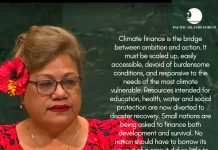
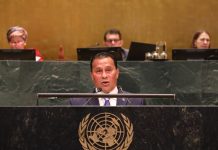
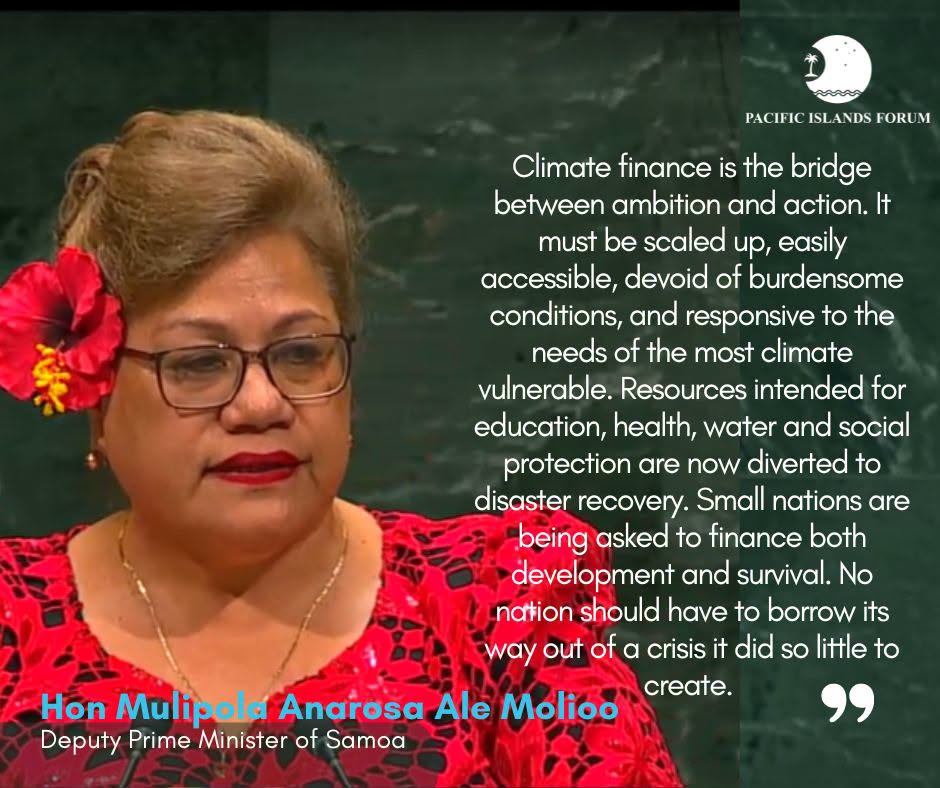
Samoa Deputy Prime Minister and Minister of Finance Mulipola Anarosa Ale Molioo told the UN General Assembly that climate finance must be scaled up, made easier to access and tailored to the needs of countries most vulnerable to climate change.
“Climate change remains the single greatest threat to Samoa and the global community.
“Climate finance is the bridge between ambition and action. It must be scaled up, easily accessible, devoid of burdensome conditions and responsive to the needs of the most climate vulnerable,” she said.
Molioo said resources intended for education, health, water and social protection were increasingly being diverted to disaster recovery.
“Small nations are being asked to finance both development and survival. No nation should have to borrow its way out of a crisis it did so little to create.”
She said the widening gap between international commitments and delivery was contributing to a growing development financing crisis.
“The current international financial architecture was designed for a different era. It struggles to adequately recognise vulnerability and fails to fully account for the realities faced by SIDS.”
Molioo called for the Multidimensional Vulnerability Index to be incorporated into financing decisions, saying it was essential to better reflect the circumstances of developing countries.
She also called for a fairer debt regime, including a robust mechanism for debt restructuring.
“Debt forgiveness must be linked to measurable progress on resilience.
“Building and investing in resilience today will reduce the cost of disasters tomorrow,” she said.
Samoa also supports the inclusion of state-contingent clauses in debt instruments, allowing debt payments to be suspended during crises.
Molioo said the world was being shaped by uncertainty, disruption and rapid change, but also by “hope, innovation and opportunity”.
For Samoa, she said, the global challenge was whether trust could be restored and whether transformation could protect vulnerable people.
“The answer lies in the first words of our UN Charter — ‘We the peoples’.
“We must always put people at the centre of our decisions,” she said.
She said Samoa’s approach was underpinned by Samoan values including respect, dignity, love, protection and service.
“Every decision in this hall shapes the world that every child inherits,” she said.
Molioo said profound changes to the international system were necessary and inevitable, as people increasingly questioned whether global institutions were delivering on their promises.
Samoa remained committed to multilateralism and the United Nations as the central forum for addressing global crises, she said.
On UN reform, she said changes should improve delivery, eliminate duplication, strengthen coherence and accelerate impact.
She cautioned against reforms that could weaken UN Multi-Country Offices or the Resident Coordinator system, and said decisions should not be taken prematurely without the full consideration and endorsement of member states.
Molioo said energy security had become a defining issue for many small island nations.
While Samoa has one of the highest shares of renewable electricity in the Pacific, it remains heavily dependent on imported fuel.
She said successive energy crises and the 2026 fuel crisis had exposed the economic cost of that dependence.
Samoa was working towards a more reliable and affordable energy system that would reduce imported fuel dependence, strengthen resilience and support sustainable development.
Digital transformation, including artificial intelligence and data analytics, could help accelerate that transition, particularly through off-grid solutions and smarter energy planning, she said.
Molioo said the ocean remained central to Pacific identity, livelihoods and development but was under growing pressure from pollution, biodiversity loss, over-exploitation and climate change.
“Pursuing economic growth has come at a great cost to our marine ecosystem,” she said.
She also warned about the risks associated with deep seabed mineral exploitation.
“Our oceans face a crisis of limitless proportion,” she said.
“Weak governance frameworks threaten what remains. Without urgent action, small island states face a future without land and no usable ocean.”
Molioo called for a shift in how the world values the ocean — “from a resource we exploit to one we protect and cherish”.
She said Samoa had ratified the BBNJ Agreement and remained engaged in negotiations towards a global treaty on plastic pollution.
Samoa also remains committed to implementing the Apia Commonwealth Ocean Declaration, the 2026 Pacific Islands Forum Ocean Statement and its own Samoa Ocean Strategy, which she said were important to achieving Sustainable Development Goal 14 on life below water.
Molioo also warned that Samoa’s maritime domain was increasingly being exploited by transnational criminal networks involved in illegal trafficking, including illicit drugs moving through the Pacific.
“Illicit drugs enter homes, harm young people, fuel violence and place increasing pressure on communities and essential services,” she said.
She identified non-communicable diseases as one of Samoa’s most serious development and public health challenges.
Samoa was responding through stronger health literacy, reforms to school nutrition and food environments, and early intervention programmes.
Water security was another priority, with Molioo saying Pacific water systems remained highly vulnerable to disruption.
She called for urgent investment in climate-resilient water systems, improved access to finance, stronger capacity and partnerships, and a transnational water governance regime informed by outcomes from global water conferences.
Molioo said Samoa remained committed to peace, human rights and justice and expressed concern over ongoing conflicts and the loss of civilian lives, displacement and destruction of infrastructure and the environment.
“The continued supply of weapons to fuel conflicts must end,” she said.
She also reiterated Samoa’s call for meaningful reform of the UN Security Council to make it more effective, credible and representative of current global realities.
“At its heart, Samoa’s development journey is about investing in people,” she said.
Samoa was strengthening social protection, investing in youth, supporting women and persons with disabilities and building a resilient economy through its District Development Programme across all 51 districts.
“Our greatest source of resilience will not be our infrastructure or our institution alone. It will be our people — healthy, skilled, educated and empowered.”
Molioo said the ‘āiga’, or family, remained at the heart of Samoa’s development pathway.
“Before I am a leader, I am first and foremost a mother.
“History may record our titles, but our children will inherit our choices,” she said.
She said this was why the United Nations mattered and called for countries to continue working together as “one United Nations family.