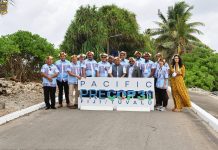


By Pita Ligaiula in Koror, Palau
Pacific Islands Forum leaders have strengthened their regional position on ocean sovereignty, fisheries, deep sea minerals and marine pollution, warning that sea-level rise, illegal fishing and growing pressure on ocean resources require coordinated Pacific action.
In their 2026 Forum Leaders’ Communiqué, leaders reaffirmed that the ocean remains central to the sovereignty, security, prosperity, culture and identity of Pacific peoples and endorsed the 2026 Pacific Islands Forum Leaders’ Ocean Statement to guide regional advocacy and action.
“The ocean remains central to the sovereignty, security, prosperity, culture and identity of Pacific peoples,” the leaders said.
They called for stronger and more coordinated Pacific engagement across international negotiations and processes dealing with oceans, climate change, biodiversity, fisheries, pollution and sustainable development.
Leaders also tasked the Office of the Pacific Ocean Commissioner to coordinate regional preparations for the first Conference of the Parties to the Agreement on Marine Biological Diversity of Areas beyond National Jurisdiction, known as the BBNJ Agreement, in January 2027.
They encouraged continued mobilisation of resources to support Pacific countries to ratify and implement the agreement.
The leaders again put maritime sovereignty at the centre of the Pacific’s response to climate change, reaffirming earlier Forum declarations aimed at protecting maritime zones and statehood in the face of climate change-related sea-level rise.
They said the sovereign rights and jurisdictions of Forum members must be safeguarded as sea levels continue to rise.
Leaders committed to urgently conclude outstanding maritime boundary treaties, bring existing agreements into force and deposit relevant coordinates and charts with the United Nations in line with international law.
The position builds on the Forum’s 2021 Declaration on Preserving Maritime Zones and its 2023 Declaration on the Continuity of Statehood and Protection of Persons Affected by Sea-Level Rise.
Forum leaders also endorsed the Vakamanu Regional Pacific Fisheries Strategy 2026-2035 as the region’s overarching framework for fisheries and aquaculture.
They said fisheries and aquaculture remain critical to Pacific prosperity, food security, livelihoods, culture and national economies.
The strategy will focus on sustainable management, protecting members’ sovereign rights, strengthening climate resilience and securing greater economic and social benefits from fisheries resources for Pacific peoples.
The leaders also reaffirmed support for the East New Britain Initiative, describing it as a key regional hub for tuna processing and services.
They said greater participation by Small Island Developing States was needed across the entire tuna value chain.
At the same time, leaders called for urgent strengthening of high seas management measures to eliminate illegal, unreported and unregulated fishing.
However, they warned that new conservation and management measures must not shift a disproportionate administrative or conservation burden onto Small Island Developing States.
On deep sea mining, leaders endorsed recommendations under the Implementation Plan for a Member-Led Regional Approach to Deep Sea Minerals and a proposal for a regional repository for deep sea mineral data and knowledge.
The communiqué makes clear that the Forum will continue regional cooperation while preserving the sovereign rights of individual members.
“Regional cooperation on deep sea minerals should continue to be guided by Member leadership,” the leaders said.
They stressed that the regional approach must be “without prejudice to the sovereign rights of Members over natural resources within their national jurisdiction.”
Leaders also called for equitable access to science, data and knowledge and adherence to international law, including the United Nations Convention on the Law of the Sea.
They noted Vanuatu’s offer of its Global Scientific Assessment of Deep Sea Ecosystems as an independent scientific contribution to support the Pacific Deep Sea Knowledge Partnership.
The language reflects the continuing diversity of positions among Forum members on deep sea mining while keeping regional cooperation focused on science, information and member-led decision-making.
The leaders also renewed their call for an ambitious, comprehensive and legally binding global agreement covering the full life cycle of plastics, from production through to waste.
They said the agreement must also address existing plastic pollution in the marine environment.
The Forum reaffirmed its commitment to preventing marine litter and plastic pollution and protecting the health of the Pacific Ocean and its peoples.
Leaders also called for collaboration on a Regional Extended Producer Responsibility Framework designed specifically for Pacific economies that rely heavily on imported goods.
Leaders acknowledged progress under the Pacific Blue Shipping Partnership(PBSP) following the signing of its charter in June by Fiji, the Marshall Islands, the Federated States of Micronesia, Kiribati, Nauru, Tuvalu and Vanuatu, followed by Tonga.
They said the partnership and its inaugural ministerial council meeting had committed Pacific countries to a coordinated approach to shipping decarbonisation through the Green Climate Fund.
The Forum also acknowledged Tonga’s concerns over the protection of migratory humpback whales and their ecological links between the Pacific and Southern Ocean.
Leaders said greater attention was needed along migratory corridors, including the impacts of climate change, and called for further action to protect Antarctic krill and the wider marine ecosystem.
Leaders welcomed the Melanesian Ocean Summit hosted by Papua New Guinea in May and noted the Polynesian Leaders Group’s intention to convene a Polynesian Ocean Summit in 2027.
They said the planned summit would provide another Pacific-led platform to strengthen ocean governance and protection, elevate the region’s collective voice on ocean rights and marine conservation and advance the blue economy.
The leaders also recognised the role of traditional knowledge, voyaging societies, fishers and coastal communities as custodians of the Pacific Ocean.
They further welcomed the Declaration on Traditional Navigation as a Cultural Heritage of the Blue Pacific Continent, endorsed on 02 September 2026 and presented by Palau’s Great Council of Chiefs and the Micronesian Voyaging Society.
“Traditional navigation and voyaging” were recognised as “an enduring expression of Pacific culture, identity and traditional knowledge, connecting Pacific peoples across the Blue Pacific Continent,” the leaders said.