
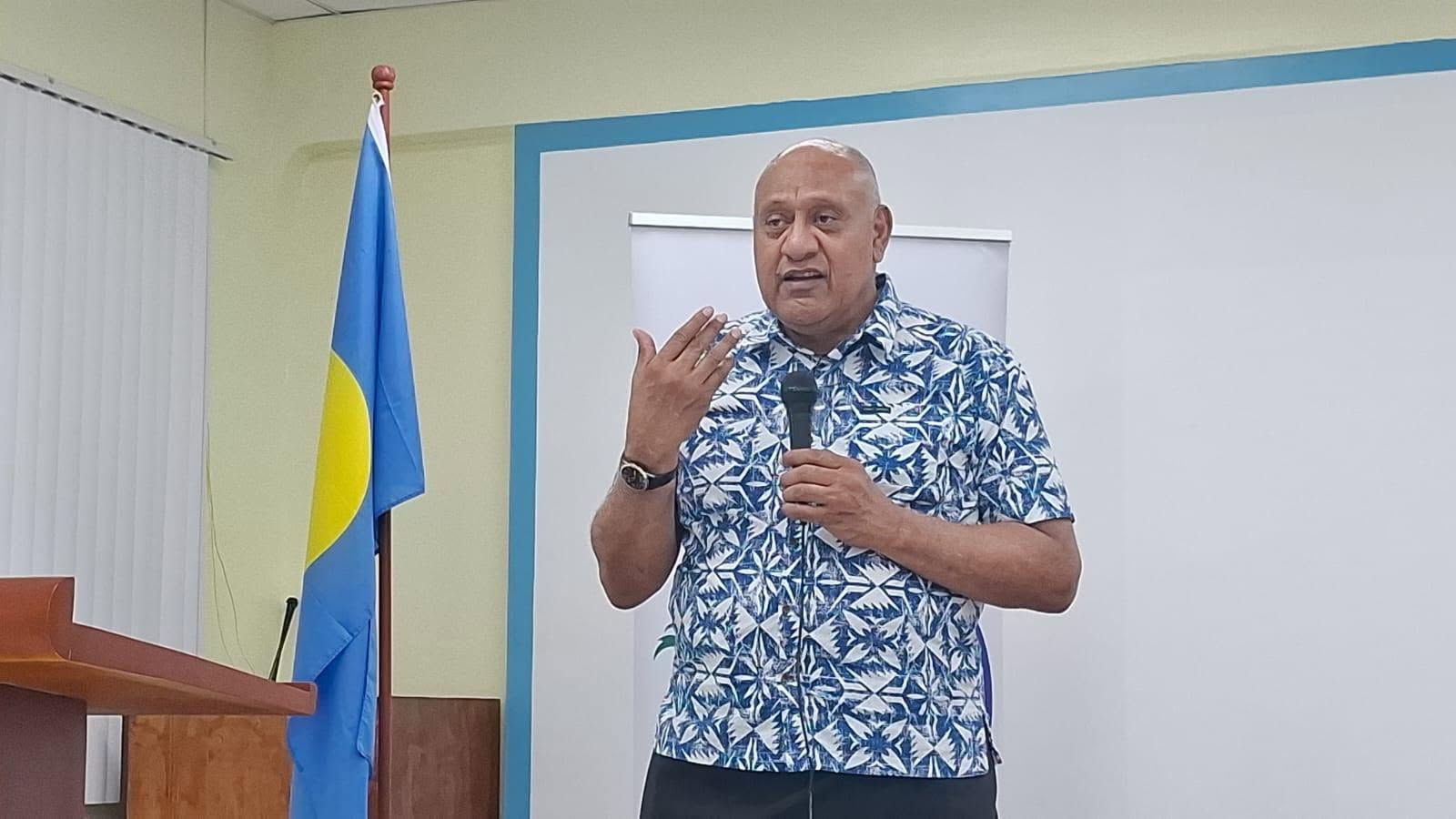
By Pita Ligaiula in Koror, Palau
Pacific Ocean Commissioner Dr Filimon Manoni has called on Pacific journalists to strengthen ocean reporting, saying the future of the region’s ocean depends not only on policies and negotiations but also on the stories told to Pacific communities.
Addressing regional journalists at the Pacific Islands Forum Secretariat and Pacific Islands News Association (PINA) Regional Media Workshop in Palau ahead of the 55th Pacific Islands Forum Leaders’ Meeting, Manoni said the media was a vital partner in advancing the Pacific’s ocean agenda.
“The future of our ocean depends not only on policies and negotiations, but also on the stories we tell,” Dr Manoni said.
He said journalists, editors, broadcasters, content creators and other media practitioners had an important role in advancing ocean literacy, amplifying Pacific voices and connecting communities with major decisions on ocean governance.
Dr Manoni said ocean literacy was not limited to scientific knowledge or formal qualifications.
“Literacy is not about marine science and getting a certificate or a degree, but it is about understanding your relationship with the ocean, recognising what the ocean means in our daily lives, how we depend on the ocean, and embracing the fact that we are one with the ocean,” he said.
He said better public understanding of the ocean would support sustainable fisheries, conservation, climate resilience and informed decision-making.
The Office of the Pacific Ocean Commissioner, established by Forum Leaders in 2011, was created to provide regional leadership, advocacy, coordination and implementation support for the Pacific’s shared approach to ocean management.
Dr Manoni said the office existed because Pacific leaders recognised that the ocean was central to the region’s livelihoods and identity.
“The ocean is not just a resource, but our very livelihoods are intertwined with the ocean.
“Our lives depend on the resilience and the health of our ocean, which is increasingly coming under enormous pressure from many different activities.,” he said.
Dr Manoni said Pacific countries had taken an active role in international ocean negotiations rather than remaining on the sidelines.
“We have made a conscious decision not to stand to the side, but to be in the middle of this discussion, to help shape and influence the global discourse and policy decisions on how we should govern our ocean,” he said.
He highlighted the Biodiversity Beyond National Jurisdiction (BBNJ) Agreement as an example of Pacific efforts to secure principles that promote fair and equitable benefits.
Manoni said Pacific countries had worked to ensure that the benefits from international ocean agreements were not limited to powerful economies.
Forum Leaders are also expected to consider a new ocean statement renewing calls for urgent action to protect ocean health.
Dr Manoni said the statement would reaffirm existing Pacific positions, promote practical and implementable regional initiatives and reflect consultations across the region.
It is also expected to help set the Pacific’s direction ahead of COP31 and guide collective regional action on ocean issues.
Dr Manoni said Pacific fisheries management was an example of the region’s contribution to the global community.
The Western and Central Pacific supplies an estimated 50 to 60 percent of the world’s tuna.
“Our work in managing our fisheries has allowed millions of communities across the globe food security.
“Our work in fisheries has allowed millions across the globe to get the nutrition that they need. So it is a global good.,” Dr Manoni said.
He said Pacific countries carried a disproportionate burden in managing fisheries and protecting ocean resources.
When Pacific governments seek support from development partners, Dr Manoni said, it should not be seen as a request for handouts.
“When we ask partners to team up together with us to do this work together, it is in this context that we ask for the support,” he said.
Dr Manoni urged Pacific journalists to produce more reporting that strengthened advocacy, encouraged accountability and highlighted Pacific leadership.
“The ocean needs stronger advocacy, more storytellers, and reporting that drives action, strengthens accountability and celebrates Pacific leadership,” he said.
He said journalists should also report positive developments and show communities that collective action could produce results.
“Above all, tell positive stories that show progress is possible and that collective action delivers results,” he said.
Dr Manoni encouraged journalists covering next week’s Forum Leaders’ Meeting to use the workshop to strengthen their understanding of ocean governance and to help communities participate in regional decision-making.
“Use this training to deepen your understanding of ocean governance and continue the vital role of educating, informing and inspiring our people,” he said.
He said the media could give a voice to Pacific people who might otherwise have little opportunity to contribute to decisions taken at the political level.
Dr Manoni urged visiting journalists to spend time in Palau listening to local people and gathering stories that reflected the Pacific’s connection with the ocean.
“Take the time to enjoy this beautiful country, speak with people to gather their stories, capture powerful images and record compelling pieces to camera,” he said.
“And in doing all that, remember that our ocean story is the Pacific story. Help us tell it well, help us tell it often to our own Pacific people.”
Dr Manoni also thanked regional media representatives for their commitment to journalism and their partnership in telling Pacific ocean stories as Forum Leaders prepare to meet in Palau next week.