

Despite the capacity and resource constraints Pacific Small Island Developing States face in accessing global climate finance, communities across the region are already developing practical, locally led climate solutions. From restoring coastal ecosystems through nature-based solutions to adapting farming practices and combining Indigenous knowledge with scientific expertise, locally led adaptation is taking shape in villages, on farms and along coastlines.
The challenge is not simply generating new ideas. It is creating the conditions that allow promising local solutions to grow.
With climate finance still largely directed towards large-scale, proven interventions, many community-led adaptation initiatives struggle to access the early-stage funding, technical support and partnerships needed to test, strengthen and demonstrate their potential. Without this support, promising ideas often stall at the pilot stage or fail to attract larger sources of climate finance. This can be especially challenging for women-led initiatives, youth innovators and community organisations, whose locally developed solutions are often overlooked despite their strong potential to strengthen climate resilience.
Creating Pathways for Climate Adaptation
Recognising this challenge, the Pacific Community (SPC) established the Climate Innovation Programme Co:Lab. Backed by a US$5 million investment through the Adaptation Fund Climate Innovation Accelerator (AFCIA), Co:Lab is designed to help address the gap between promising locally led adaptation initiatives and larger climate finance opportunities.
More than a grant programme, Co:Lab is a regional climate adaptation innovation accelerator that combines catalytic funding with technical expertise, mentoring and strategic partnerships, helping locally led initiatives progress towards investment and wider impact.
From FiT Learning to Co:Lab Design
Co:Lab builds on six years of learning through SPC’s Funding with Intent (FiT) programme. Established as an internal innovation platform, FiT used small, flexible grants to encourage experimentation, test new approaches and strengthen organisational learning.
Between 2020 and 2026, FiT supported 48 incubation projects and 10 amplification projects across areas including climate adaptation, sustainable agriculture, fisheries, digital innovation and geospatial technologies. Collectively, these projects helped SPC understand not only what worked, but why—and what promising initiatives needed to move beyond the pilot stage.
The FiT Sensemaking Exercise found consistently strong results during incubation, confirming that relatively modest investments, when combined with the right support, can unlock significant innovation. It also identified a persistent gap: many promising initiatives struggled to secure the technical assistance, partnerships and follow-on investment needed to progress beyond successful pilots and achieve wider impact.
Innovation in Practice: atoll farming in Palau
The swamp taro restoration project in Palau illustrates how early-stage support can help communities investigate a locally identified challenge and test a practical response.
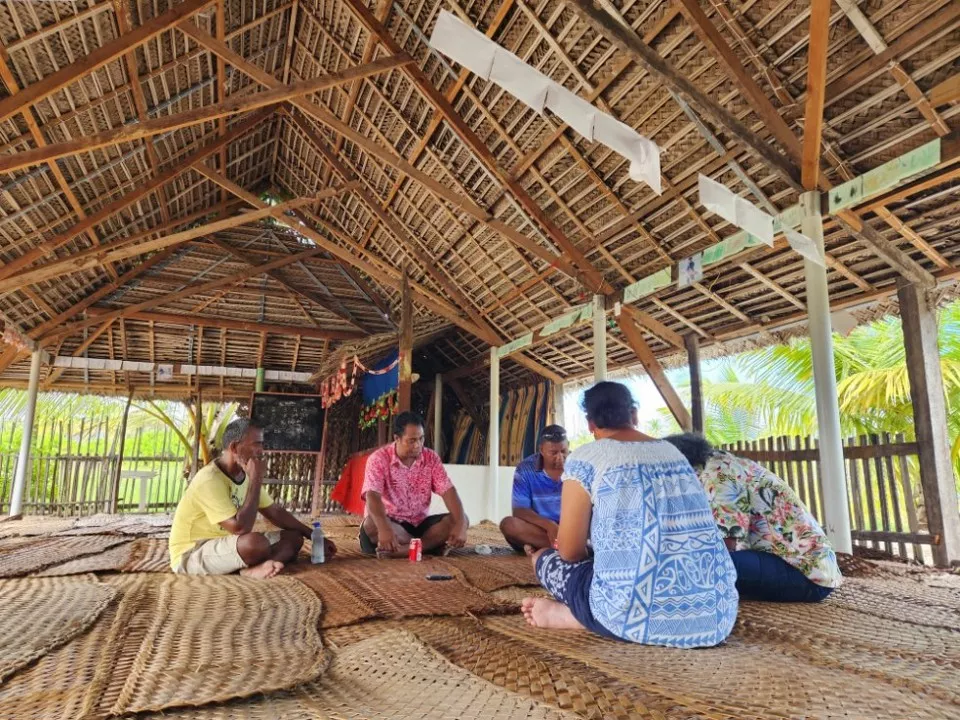
While working with communities in Kayangel Atoll through SPC’s Managing Coastal Aquifers Project (MCAP), SPC technical teams heard repeated concerns about the declining health of giant swamp taro (Cyrtosperma merkusii). More than a staple food crop, giant swamp taro is deeply woven into Palauan culture and plays an important role in food security and livelihoods. These community concerns became the starting point for a FiT-supported pilot project to better understand the problem and identify practical responses.
The project brought together women growers, groundwater specialists, soil scientists and agriculture experts. Scientific investigations into groundwater conditions, soil characteristics and water quality were considered alongside generations of Indigenous knowledge about traditional cultivation practices and environmental change.
Together, they revealed a more complex picture than first anticipated. Rather than a single cause, the decline was associated with high sodium levels, low potassium, compacted soils and prolonged waterlogging, while saltwater intrusion linked to climate change placed further pressure on the traditional taro pits.
The response reflected the same collaborative approach. Working with women growers, the project refined traditional basket-planting techniques by combining scientific evidence with local knowledge. Women advised against using pandanus because it is an important source of household income and recommended coconut leaves instead.
Filled with organic material and raised above the waterline, the baskets created healthier growing conditions for young taro plants while remaining practical, locally appropriate and grounded in traditional practice.
After six months, the results were clear. Raised basket planting achieved survival rates of approximately 75 percent in one taro pit and more than 80 percent in the other—at sites where previous planting had recorded no survival. The approach outperformed both conventional planting and raised coconut-husk beds, demonstrating how a practical solution using locally available materials could improve drainage, lift taro roots above saline groundwater and support plant survival under increasingly difficult conditions.
The project showed what relatively modest, strategic investment can make possible. By bringing women growers and technical specialists together, it transformed scientific evidence and local knowledge into a practical adaptation response with measurable results.
From Pilot to Impact
The wider FiT findings show what early-stage support could achieve and what promising initiatives still needed beyond a successful pilot. Those lessons informed Co:Lab’s three-stage pathway, which provides different forms of support as innovations develop.
1. Incubation provides grants from USD$25,000 up to USD$ 75,000 alongside hands-on co-design support to help communities, organisations and innovators pilot and de-risk early-stage climate adaptation innovations.
2. Acceleration provides technical assistance and funding of up to USD$200,000 to help scale high-potential solutions and strengthen their readiness for investment.
3. Amplification extends the reach of successful innovations through knowledge sharing, peer learning, policy uptake and investment matchmaking, enabling replication and helping attract additional finance.
Through Co:Lab, SPC is helping build stronger pathways so more locally led ideas can move beyond proof of concept, inform policy, attract climate finance and deliver wider impact.
The challenge is not finding innovation in the Pacific. It is creating the pathways that allow it to grow.