A senior Australian diplomat has warned that Western democracies are losing ground in the strategic contest across the Indo-Pacific.
The warning comes as Papua New Guinea moves to close Taiwan or Republic of China’s representative office in Port Moresby. The mission has been in PNG since 1990.
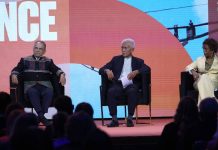
Speaking at an international conference in Tokyo, Australia’s Ambassador to Japan and former head of the Office of National Intelligence, Andrew Shearer, said China is steadily reshaping the regional balance of power.
“We’re seeing increasingly concerted efforts to unpick the regional order, to strip it away, strip away its more liberal characteristics, and over time unpick the U.S alliance system … and replace it with a more illiberal, more hierarchical, and inherently more coercive order.”
Shearer said China’s growing military reach and expanding influence across Southeast Asia and the Pacific have created a difficult challenge for Western countries.
“I think that’s a very difficult problem set for us to respond to as Western liberal democracies,” he said. “I think, if you’re objective, you would say we are sort of gradually losing some of that contest.”
He also pointed to China’s expanding military activities including a recent submarine-launched intercontinental ballistic missile test into the Pacific, warning the region faces greater uncertainty and a higher risk of miscalculation.
“We’re also, of course, seeing the increasing overuse of both conventional and, in a coercive sense, nuclear capability in the region.”
Shearer said those developments are increasing tensions across the Indo-Pacific.
“The threshold for conflict has come down in recent years, and that is something that should worry us all.”
His comments came as Papua New Guinea announced last week it would close the Taipei Economic Office in Port Moresby, ending Taiwan’s diplomatic presence in the country.
PNG Foreign Minister Justin Tkatchenko confirmed the decision in a statement, telling China’s Ambassador Yang Xiaoguang that the “physical presence of Chinese Taipei will no longer be recognised or required within the jurisdiction of Papua New Guinea”.
The move was welcomed by Beijing, which said it “highly appreciated” the decision and described it as strengthening relations between China and Papua New Guinea.
Yang told EMTV the decision reflected PNG’s support for the One China principle and said China was ready to continue strengthening its relationship with Papua New Guinea.
The comments come as China and PNG mark 50 years of diplomatic relations with both countries highlighting closer cooperation in recent years.
Taiwan has rejected Papua New Guinea’s decision, saying the Taipei Economic Office in Port Moresby remains open and that it will reassess its relationship with PNG.
Taiwan’s Ministry of Foreign Affairs announced the decision was made without prior negotiations and described it as a unilateral move.
In a statement, the ministry said Taiwan would reassess cooperative projects and economic exchanges with Papua New Guinea and consider further steps in response.
Taiwan’s representative office in PNG was established in 1990 following a trade agreement between the two sides despite the lack of formal diplomatic relations.
The United States has also raised concerns over Papua New Guinea’s decision, saying it supports Taiwan’s meaningful participation in the international community.
A U.S State Department spokesperson told a White House briefing that Washington remained concerned about actions that limit Taiwan’s international engagement.
If the closure goes ahead, Palau, Tuvalu and the Marshall Islands would remain the only Pacific island nations that maintain formal diplomatic relations with Taiwan.
The developments come amid growing strategic competition across the Pacific where regional nations continue to balance relationships with traditional partners, China and other international powers while maintaining that Pacific priorities including climate change, development and sovereignty remain at the centre of regional decision-making.