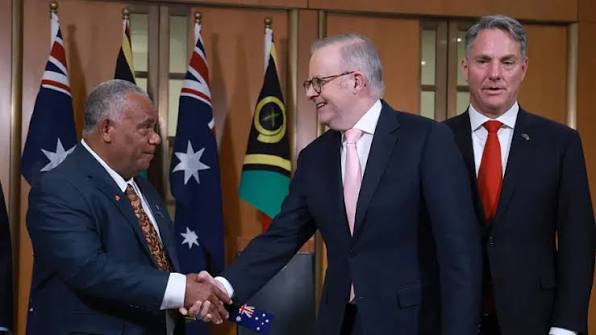
The Australian federal government has notched a potentially significant strategic win in the Pacific, with Vanuatu saying China’s police presence there was “expected to reduce over time” following its signing of the Nakamal Agreement with Australia.
China has expanded policing ties with several Pacific nations in recent years, but this is only the second time a Pacific nation has made an on-the-record commitment, albeit with a caveat, to wind back Beijing’s police presence on the ground.
Fiji’s prime minister, Sitiveni Rabuka, said in 2024 that Chinese officers in his country’s police force had been “repatriated” because the two countries had different legal systems.
China has maintained a small police training team in Vanuatu since 2023, and its internal affairs minister, Andrew Napuat, travelled to Beijing last month to renew its policing cooperation pact with Beijing.
The Chinese embassy in Vanuatu has also made substantial donations to Vanuatu’s police force, including multiple surveillance drones, dozens of motorcycles, patrol boats, uniforms, minibuses, riot gear and forensics laboratory equipment.
That is a source of anxiety for Australia, which believes Beijing is intent on establishing a military foothold in the region and that it is using police training teams to embed itself as a legitimate security partner for Pacific nations.
Last week Vanuatu’s deputy prime minister and finance minister, Johnny Koanapo, met Foreign Minister Penny Wong and Pacific Minister Pat Conroy in Canberra to discuss implementation of the high-profile Nakamal Agreement, which was finally signed in June after months of sometimes tough negotiations.
The two governments said in a joint statement that the agreement recognised Australia as “Vanuatu’s longstanding primary policing partner” and “reaffirmed its commitment in the Nakamal Agreement that it would prioritise any policing requests to Pacific Islands Forum members”.
“Vanuatu said its police arrangement with China had been in place for some time, is time-limited and expected to reduce over time, whereas the Vanuatu-Australia Nakamal Agreement is legally binding and has no expiry date,” they said.
The joint statement was quietly uploaded to DFAT’s website early this afternoon, but has not been heavily publicised by either government.
Vanuatu’s government did not respond immediately to a request for comment. The ABC has also sought comment from the Chinese embassies in Port Vila and Canberra.
Issues around police cooperation remain highly sensitive in Vanuatu, and disagreements over China’s role in the sector have sparked up before.
Last week Vanuatu’s prime minister, Jotham Napat, pushed back when a senior Australian Federal Police officer, David McLean, told a parliamentary committee that the eight-strong AFP team in Vanuatu would soon increase due to growing cooperation under the Nakamal Agreement.
“I expect that number could nearly double in size over the coming years as we increase the frequency and intensity of programme delivery and advisory support,” he said.
He said the cooperation would cover “everything from the fundamentals of modern organisational design and administration through to professional standards, investigative policing, community policing, general duties policing, forensics and the centre of excellence we’re delivering”.
But Napat cautioned last week that his country had yet to give any approval for an increase in Australian police officers, and that any request would need to be signed off by his government.
“Anything where we allow them to come, that’s a matter where our government with the government of Australia sits down and agrees to that,” he said.
“But I’m not aware of any arrangement.”
The two countries also provided some basic details about the early implementation of the Nakamal Agreement, which is expected to funnel about $500 million (US$348 million) into Vanuatu’s key priorities over a decade.
In their joint statement, the two countries said the early priorities would include “strengthened policing cooperation, budget support, climate cooperation and assistance for ni-Vanuatu communities affected by El Niño and volcanic ash”.
They also said Australia had committed to “early delivery of two renewable energy and water projects”, including providing “renewable electricity, lighting and clean water to schools and community facilities in remote communities, and solar-powered water supply systems to improve access to water”.
Vanuatu also flagged investment in key infrastructure priorities, including maritime and aviation infrastructure and rebuilding efforts in Port Vila, Santo and Tanna, in meetings with representatives of the Australian Infrastructure Financing Facility for the Pacific.