By Nic Maclellan
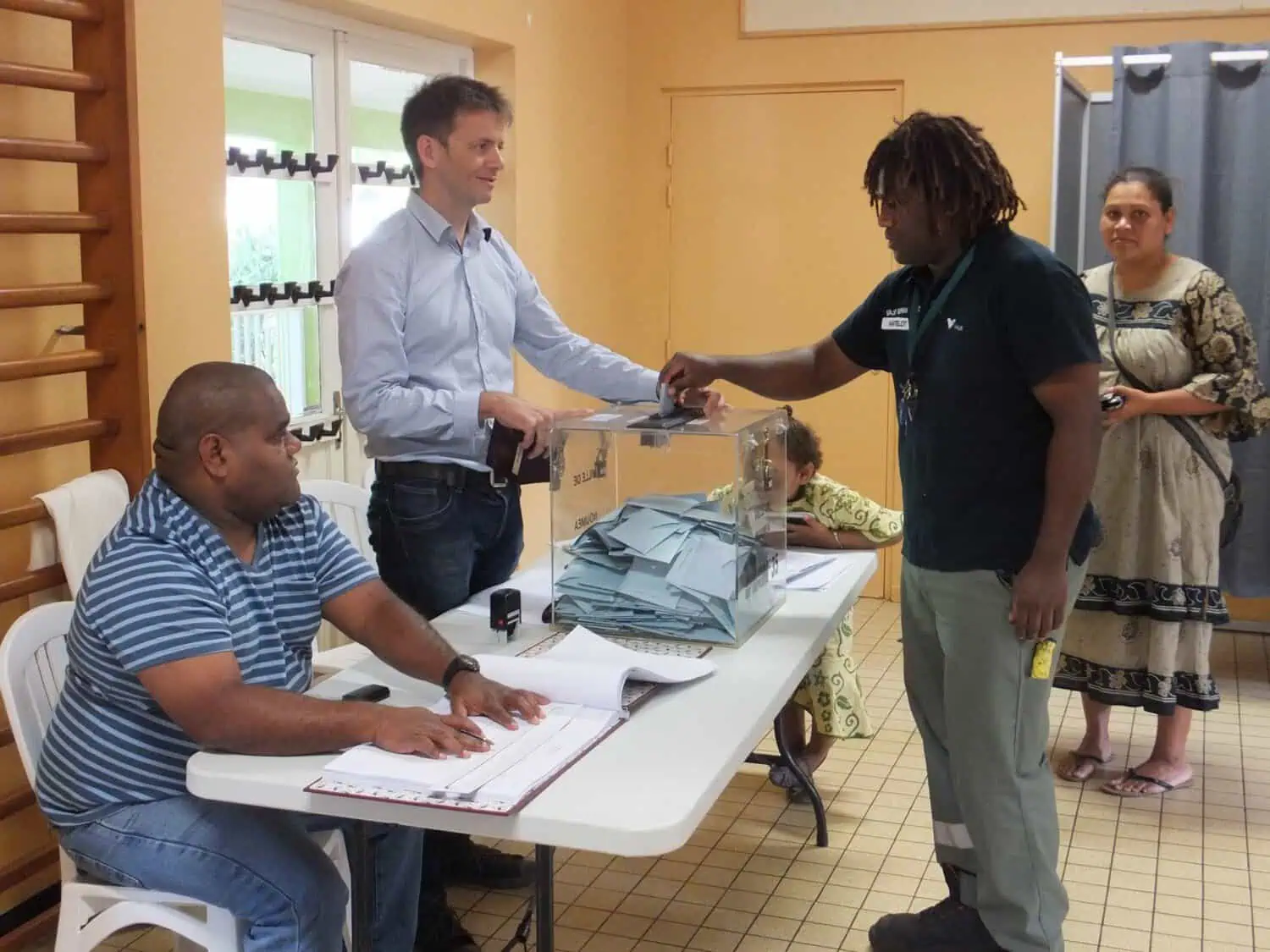
Voters in New Caledonia go to the polls on 28 June, to elect representatives for the islands’ three provincial assemblies – in the South, North and Loyalty Islands – and the national Congress of New Caledonia.
For most voters, a key concern is the drastic state of the economy, after six months of conflict in 2024 left 14 dead, hundreds arrested and a shattered economy. With reduced revenue from key sectors like tourism and the mining and smelting of nickel, the Government of New Caledonia and the three provincial administrations face a fiscal crisis. Many voters will seek candidates who can address job losses in the private sector and cutbacks to public services like health and public transport.
Beyond these immediate economic and social concerns, there is also uncertainty over proposals for a new political statute to replace the 1998 Noumea Accord, the framework agreement that has governed the islands for more than a quarter of a century. In April, the French National Assembly rejected the French government’s proposal for a new statute, known as the Bougival Accord. The collapse of the Bougival process has complicated these elections – even though the outcome will determine which parties can influence ongoing talks with the French State about a new political status for the Pacific dependency.
Lots of candidates
By 08 June, political parties and coalitions had lodged their final lists of candidates with the French High Commission in Noumea. This year, 12 electoral lists will compete for seats in the Southern Province, five in the Northern Province and seven in the Loyalty islands.
To gain a seat, an electoral list must win enough votes to reach a threshold of five per cent of registered voters in the province. It’s a system designed to encourages parties to form coalitions, but ensures that many smaller groups will not gain representation in the Congress. The multiplicity of candidates in the Southern Province means many people voting for smaller lists may be wasting their vote, as the list will not reach the 5 per cent required to win a seat.
Voters must choose 76 members for three provincial assemblies, which have different sizes: 40 seats for the Southern Province, 22 for the North and 14 in the Loyalty Islands. Each assembly elects its own president and executive, but a proportion of the assembly members also make up the 54-member Congress of New Caledonia in Noumea: 32 (out of 40) members from the Southern assembly, 15 (out of 22) from the Northern assembly and 7 (out of 14) from the Loyalty Islands assembly.
Under French legislation known as the parity law, women must make up 50 per cent of any electoral list, alternating male and female candidates. This ensures that nearly half the elected members will be women – a unique outcome amongst independent nations in Melanesia, where there are few women in the national legislature.
New Generation
Both Northern and Loyalty Islands provinces have majority Kanak populations, ensuring that most seats will be won by candidates from two pro-independence parliamentary groups: the Front de Libération Nationale Kanak et Socialiste (FLNKS) and the Union Nationale pour l’Indépendance (UNI).
UNI incudes the Parti de Libération Kanak (Palika) and Union Progréssiste en Mélanésie (UPM), two parties that were founding members of the FLNKS in 1984. However both have now left the coalition, critical of the dominance of the Union Calédonienne (UC) party and angered by the creation of the Cellule de coordination des actions de terrain (CCAT) network and its role in the May 2024 uprising in New Caledonia. Their subsequent decision to endorse a new political statute for New Caledonia, dubbed the Bougival Accord, led to internal debate: longstanding Palika leader Paul Néaoutyine denounced the agreement, even though his lieutenant Jean-Pierre Djaïwé was a key negotiator.
Néaoutyine, a veteran of the independence movement, has been president of the Northern Province assembly since 1999, and has served as mayor of the east coast town of Poindimié for 36 years. This week, as the UNI list for the Northern Province was published, Néaoutyine leads the charge, but Djaïwé is not included. Another Palika veteran, former President of New Caledonia Louis Mapou will head the UNI electoral list Unis pour le pays (United for the country) in the Southern Province, while Wali Wahetra heads the list “PALIKA Îles” in the Loyalty Islands.
In contrast to the choice of historic leaders by UNI, the FLNKS lists across the provinces are headed by a new generation of Union Calédonienne leadership.
UC’s Johanito Wamytan (age 46) leads the Kanaky pour tous (Kanaky for all) list in the South, supported by Oriane Trolue and UC Secretary General Dominique Fochi – many FLNKS veterans are placed near the bottom of the list (RDO’s Aloisio Sako at no.45, FLNKS President Christian Tein at no.47 and former Congress Speaker Roch Wamytan at no.49).
In the Loyalty Islands, Mickaël Forrest (age 46) will lead the FLNKS list (the current provincial president Matthias Waneux is not included in the list). In the North, Mayor of Houailou Pascal Sawa (age 44) heads the UC-FLNKS list. For Sawa, “you can really sense a desire to bring in younger candidates – though not without conditions. They need to be young people who are capable of doing the job, supported by those with more experience.”
Unity on the Right?
The Southern Province, including the capital Noumea and surrounding towns like Mont Dore, Dumbea and Païta, has long been a bastion of anti-independence parties. The outgoing provincial president Sonia Backès will now head a joint conservative list that unites the Right, despite suggestions earlier this year that she should stand aside for another figure.
Last April, a media release from the Rassemblement-Les Républicains party, signed by New Caledonia’s President Alcide Ponga, called for a coalition of parties opposed to independence but led by someone apart from Sonia Backès. Backlash from the Loyalists and within his own party has now seen Ponga reverse course. On 16 May, a communique pledging unity was signed by three leaders of the Loyalists bloc – Sonia Backès (Les Républicains Calédoniennes), Nicolas Metzdorf (Générations NC) and Gil Brial (Mouvement Populaire Calédonienne) – as well as Rassemblement’s Alcide Ponga.
Describing the list as “the last line of defence against independence”, their unity pledge states: “We come from different backgrounds, and we each have our own identity and sensibilities. But what unites us is far stronger than what divides us”, including “an unwavering commitment to France”, “economic recovery” and “a sustainable institutional solution.”
However, prospects for post-election unity remain uncertain, given historic and ongoing tensions between Rassemblement and the Loyalists. There are still scars from bitter fights during March’s municipal elections, as the Loyalists stormed into longtime Rassemblement fiefdoms. Beyond this, Rassemblement’s historic ties to the Les Républicains party in France will complicate relations with the Loyalists in the lead up to France’s May 2027 presidential poll, as New Caledonian leaders position themselves to benefit from the post-Macron era in Paris.
Within the South, several other politicians opposed to independence – but also opposed to Sonia Backès and her conservative policies – are running lists to try and create a middle ground.
Despite a poor showing in March’s municipal elections, the Wallisian and Tahitian party Eveil océanien (Pacific Awakening) will again run its own ticket under EO president Milakulo Tukumuli.
At the time of the 2009 elections, the Calédonie ensemble (CE) party under Philippe Gomès was running high, holding the presidency of the Government of New Caledonia and New Caledonia’s two seats in the French National Assembly. Today, the party is a shadow of past glories, with Gomès and party secretary Philippe Michel banned from running after convictions for abuse of public office, and Philippe Dunoyer leaving the party to run under his own banner, ironically named “Nous, Réunis!” (We united).
Instead, the remnants of CE have combined with dissident Rassemblement member Georges Naturel (one of two New Caledonian representatives in the French Senate), on the list “Une province pour tous, un pays solidaire, un avenir partagé” (A province for everyone, a united country, a shared future). The list is led by Wallis Kotra, a veteran journalist and former head of France TV, which hopes to win over voters disillusioned with the two major blocs.
Legal decision stuns Noumea
Just three weeks before the poll, conservative New Caledonians have been rocked by a judicial decision in Paris, exonerating a group of independence activists accused of fomenting the May 2024 riots and protests.
From late 2023, the Cellule de coordination des actions de terrain (CCAT) organised a series of peaceful rallies against the French government’s planned changes to voting rights in New Caledonia. But when riots and protests erupted across the capital Noumea on 13 May 2024, French authorities moved to arrest 14 key CCAT leaders.
Seven of the activists were then flown to France in a military aircraft, and held in pre-trial detention for months, often in solitary confinement. Christian Tein, Frédérique Muliava, Brenda Wanabo, Dimitri Tein-Qenegei, Guillaume Vama, Erwan Waetheane and Steeve Unë were charged with serious offences, including complicity in the attempted murder of a public official, armed robbery as part of an organised gang, or participation in a criminal conspiracy. They were held in in prisons scattered across France, complicating access for their lawyers and families.
But in a stunning decision on 5 June, a French court dropped all charges against Tein and the 13 other CCAT members, with three investigating judges now ruling that there was not “sufficient evidence” against the suspects.
Despite two years of denunciation and demonisation of Tein and other CCAT members, the judges in Paris determined that “there was no evidence linking Christian Tein to the offenses; the only incriminating evidence in the case file consisted of speeches, and the investigations had not identified any secret or clandestine conversations or meetings, nor any text messages or wiretaps that would support such a claim […] On the contrary, the case file contained a vast amount of evidence attesting to the clear intent of Christian Tein or the CCAT to call for calm and work toward de-escalation.”
In the 250-page decision, the judges concluded there were not enough grounds to prosecute any of the indicted activists, although the public prosecutor’s office has announced it will appeal the ruling.
The news from Paris was met with anger from anti-independence leaders in Noumea, who criticised the partiality of the French judges. In contrast, Tein’s lawyers welcomed the decision: “After being transferred 17,000 kilometres under appalling conditions, spending nearly a year in pretrial detention far from his family, facing political attacks and false accusations and fighting tooth and nail to prove his innocence, Christian Tein has been fully exonerated.”
This is not the latest legal setback for the French government. In May 2025, the French State was fined 28 million euros as insurer Allianz sought compensation for clients whose businesses at a shopping complex were looted and torched without sufficient police protection during the 2024 riots. Then in January this year, France’s national human rights body detailed significant violations of human rights and “violent, often disproportionate repression” by French security forces during the 2024 crisis. Other cases are currently before the courts, including Kanak activists accused of killing a French gendarme.
For many voters going to the polls on 28 June, this crisis remains a traumatic period that will influence their choice of candidate – although voting is not compulsory so the level of abstention will affect the outcome.
After the election, any incoming government will face a difficult challenge in forging a pathway forward. With French Presidential elections scheduled for May 2027 and current President Emmanuel Macron unable to stand again, it will be hard to agree on a new political statute for New Caledonia without knowing who will lead France into the future.
This month, Islands Business correspondent Nic Maclellan is in New Caledonia to report on the provincial election campaign – with stories posted to www.islandsbusiness.com