


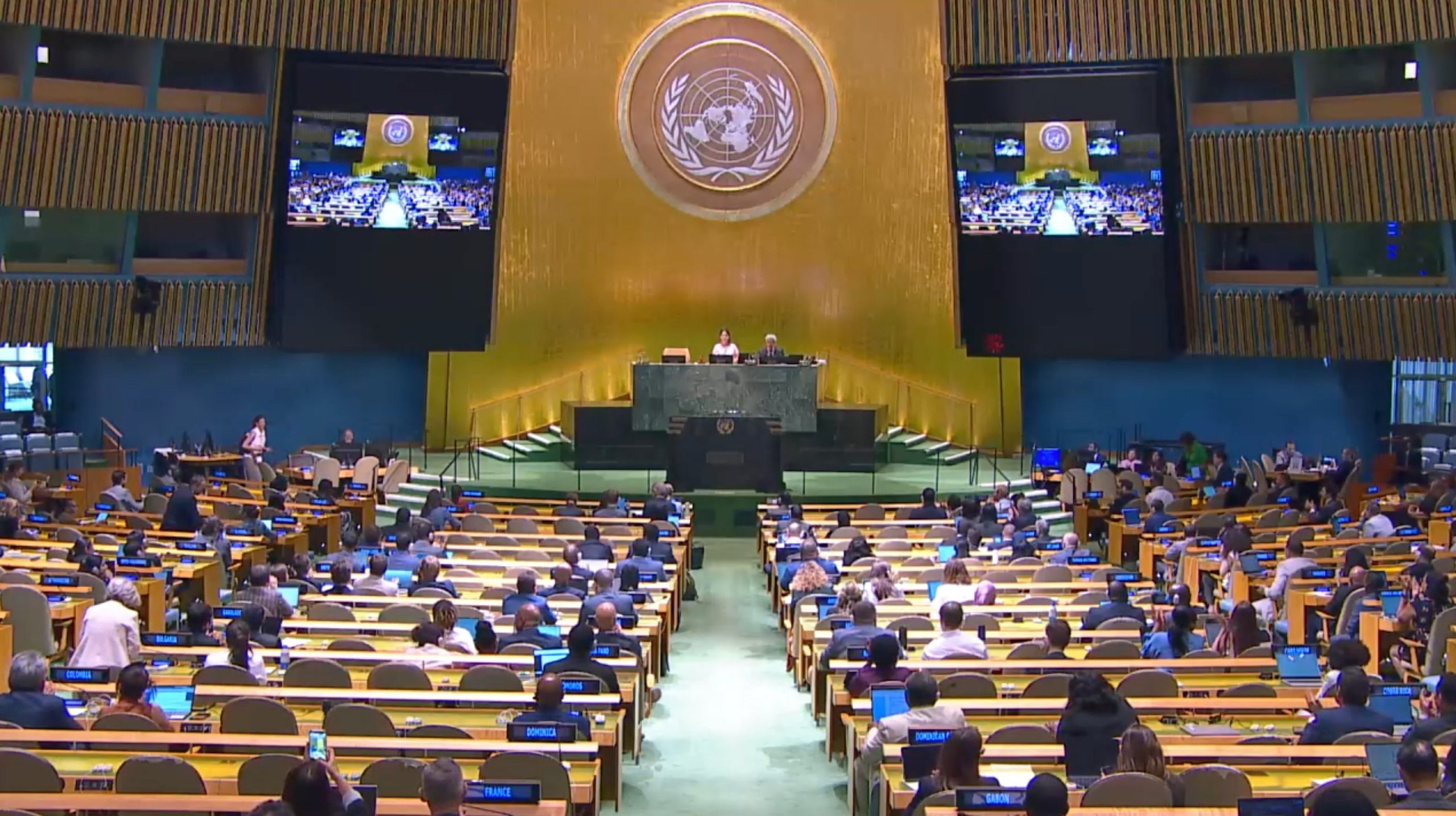
Alliance of Small Island States and climate advocates have welcomed the overwhelming United Nations General Assembly vote backing the International Court of Justice’s climate ruling, calling it a major step for climate justice and global accountability.
The resolution, adopted by a strong majority of UN member states, follows the ICJ Advisory Opinion that found countries have legal obligations under international law to address climate change.
Speaking on behalf of the Alliance of Small Island States (AOSIS), Belize’s UN representative Janine Coye-Felson said the resolution marked a defining moment for international law and climate action.
“When future generations look back at this moment, they will ask whether we rose to meet the defining crisis of our time with the full force of international law. Today, this General Assembly answers: yes,” she told the UN plenary.
Coye-Felson said the resolution and the ICJ opinion confirmed that climate obligations extended beyond the Paris Agreement.
“Climate change is not governed only” by the Paris Agreement, she said, adding that “climate justice requires the application of the full breath of international law”.
The Pacific island nations led the diplomatic push for the resolution alongside Latin American countries and the European Union.
The EU said the vote showed countries were moving beyond merely acknowledging the ICJ ruling.
“With the adoption of the resolution, countries are moving beyond ‘simply recognising’ the ICJ’s work and instead ‘actively upholding the legal integrity’ of the multilateral system by seeking to implement the court’s recommendations,” the bloc said.
At the same time, the EU warned the next phase should not create new legal mechanisms on state responsibility.
The adopted resolution calls on countries to reduce emissions by tripling renewable energy capacity, transitioning away from fossil fuels in energy systems and phasing out inefficient fossil fuel subsidies.
It also asks the UN Secretary-General to prepare a report by September 2027 on ways countries can comply with obligations linked to the ICJ findings.
France’s UN Ambassador Jerome Bonnafont said dependence on fossil fuels remained a major climate and economic risk.
“Science clearly establishes their role in climate change,” Bonnafont said.
“The recent increase in oil and gas prices, which have soared because of the war in Iran, underscores the cost vulnerability of this dependence.”
Environmental organisations and Pacific youth groups also welcomed the vote.
Vishal Prasad, whose group first pushed for the ICJ advisory opinion, said the resolution was a breakthrough for frontline communities.
“The world has not only reaffirmed that ruling, but committed to making it a reality.”
“This must be a turning point in accountability for damaging the climate. Communities on the frontlines, like in the Pacific, have been waiting far too long and continue to pay too high a price for the actions of others.”
“The journey of this idea from classrooms in the Pacific to The Hague and the United Nations gives us continued hope that when people organise, the world can be moved to act.”
The Global Climate and Health Alliance (GCHA) also welcomed the result.
Executive Director, Jeni Miller said the resolution sent a strong message about climate justice and public health.
“UNGA resolution sends a clear message: the era of impunity for fossil fuel-driven harm is coming to an end.”
“By welcoming and advancing the ICJ Advisory Opinion, governments have affirmed that climate action is not optional, it is a legal, moral, and public health obligation.”
“This is a powerful signal supporting the rightful claims of frontline communities, health workers, young people, Indigenous Peoples, and all those demanding a fair, sustainable, and healthy future,” Miller said.