


By Munkhtuya Altangerel, Resident Representative, UNDP Pacific Office in Fiji
On 20 May, the United Nations General Assembly will meet to consider a resolution that, for most of its members, represents one item among many on a crowded diplomatic calendar. For the Pacific, it is something else entirely.
The resolution, introduced by Vanuatu and a coalition spanning the Pacific, Caribbean, Africa, and beyond, endorses and builds upon the International Court of Justice’s Advisory Opinion on states’ obligations in respect of climate change. It marks another milestone in one of the most sustained, principled campaigns in the history of international law: the Pacific’s insistence that climate change is not only an environmental crisis, but a matter of legal responsibility.
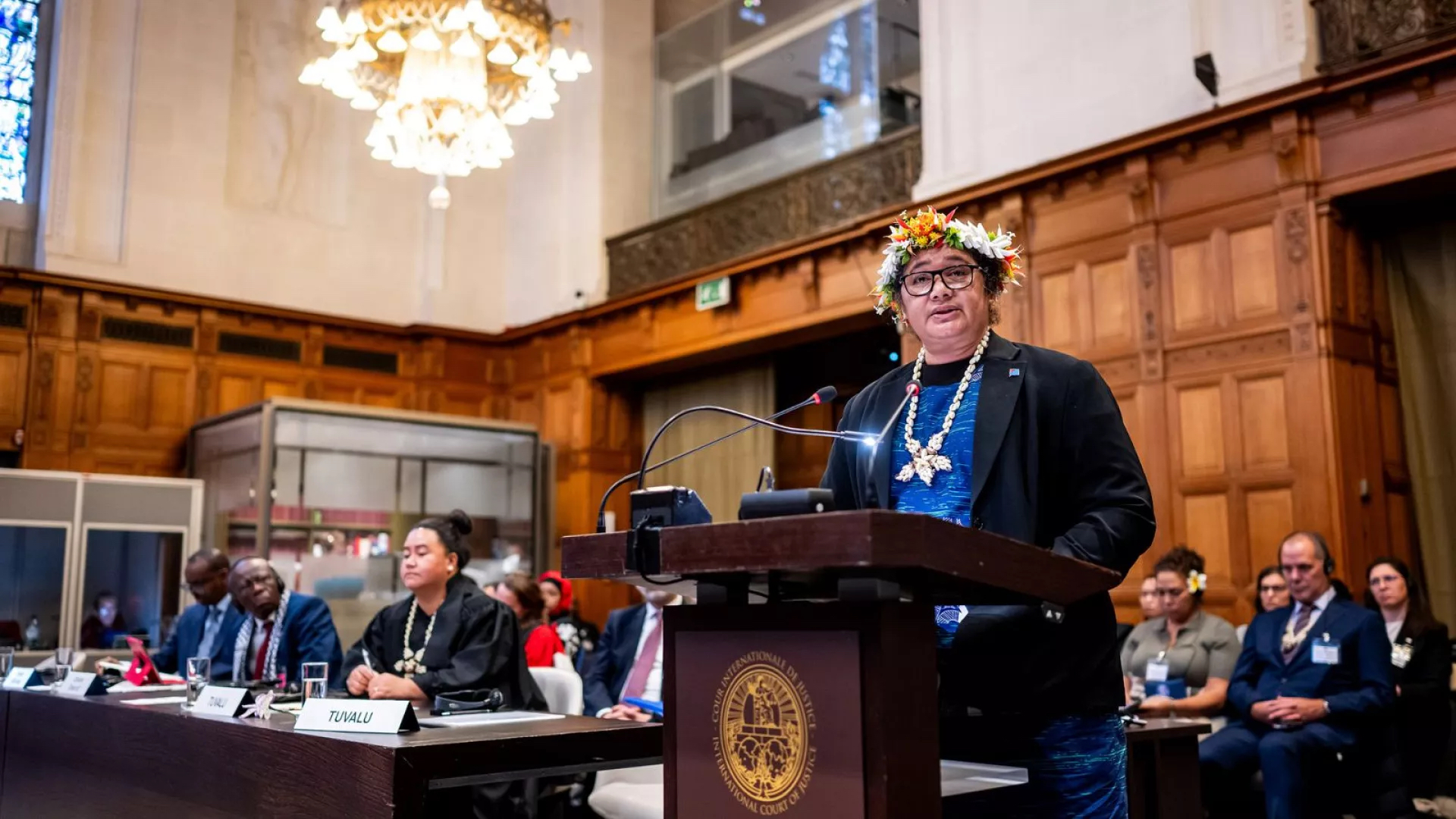
That campaign has been running for decades, pressed at every available forum by countries whose names rarely appear at the top of global power rankings but whose moral authority on this question is unmatched. Tuvalu’s Minister for Home Affairs and Climate Change, Dr Maina Talia, recently invoked the image of Noah’s Ark: a world preparing for a flood in profoundly unequal ways, where those least responsible for the crisis remain among the most exposed to its consequences.
It is a stark image, and an accurate one. But what distinguishes the Pacific’s position is that it has never been content with the image alone. The Pacific persists, and more than that, it builds.
What makes this campaign remarkable is not only its persistence but its character. Some of the most consequential advocacy behind this resolution has come from Pacific youth. Young people who have grown up watching coastlines they were told would always be there begin to disappear, and who decided that the appropriate response was not grief but action. They have shown up in negotiating rooms where they were not expected. They have made arguments that senior diplomats struggled to counter. They have refused the role of passive inheritors of a crisis they did nothing to create. They persisted, and the Advisory Opinion is, in important respects, the fruit of that persistence.
The Opinion affirms that states have obligations to prevent harm, that failure to act carries legal consequences, that loss and damage cannot be reframed as charity dispensed at the discretion of wealthier nations, and that the rights of Indigenous peoples and future generations are not aspirational language to be revisited at a later date but requirements grounded in international law. The court has said, with the clarity that only a court can provide, what the Pacific has been saying for a generation.
The question now is what follows. In Tuvalu, a parametric high-tide insurance scheme now covers hundreds of the most exposed households. When sea levels reach pre-defined thresholds, payments are triggered automatically. There are no damage assessments, no prolonged claims process, no bureaucratic distance between the moment of need and the moment of support. It is a small programme, but it carries an outsized lesson. The solutions the world claims to be searching for are not waiting to be invented. They already exist, designed by and for the communities most exposed to climate risk, and they work.
This is what Pacific leadership looks like in practice. Not declarations alone, but delivery of a particular kind: grounded, community-facing, and built on the understanding that speed and accessibility are not administrative conveniences but matters of survival.
The Pacific Resilience Facility(PRF), led by the Pacific Islands Forum, is being built on the same logic at a larger scale. Designed to channel climate and resilience finance directly to Pacific communities, it is fast, flexible, and inclusive by design. Not a proposal still waiting for approval, but a facility already shaped by Pacific priorities and Pacific hands. It is precisely the kind of instrument the ICJ’s reasoning demands. One that treats access to climate finance not as a favour extended by wealthier nations in moments of goodwill, but as a mechanism for discharging a legal and moral obligation.
Later this year, Fiji, Tuvalu, and Australia co-host the Pacific pre-COP, and the Facility will sit at the centre of those conversations. The pledging moment that follows will be one of the clearest tests yet of whether international partners are prepared to match the legal clarity the court has now provided with the financial commitment that clarity requires. The Loss and Damage Fund is a genuine step forward, but it remains dramatically under-resourced relative to the scale of need, and that gap runs across the full breadth of the climate finance landscape, from sea-level rise adaptation to biodiversity protection to the early warning systems that can mean the difference between a warning received in time and a community caught off guard.
The United Nations Development Programme, together with Australia, New Zealand, the Green Climate Fund, the Global Environment Facility and a broader coalition of partners, continues to support these efforts. But support is the operative word. This agenda is Pacific owned and Pacific led. The role of international partners is to help sustain that leadership, resource it at scale, and ensure climate finance reaches the communities facing the sharpest edge of climate risk, rather than pooling in the institutions and intermediaries most able to access it.
The measure of this resolution will not be found in its text. It will be found in whether a household in Funafuti receives support before the next high tide reaches their door, in whether a resident of Malaita receives an alert in time to move to higher ground, and in whether the finance that has been promised actually arrives in the right form, at sufficient scale, and before the window closes.
The court has clarified what responsibility looks like. The Pacific has demonstrated what acting on it looks like. What remains is for the rest of the world to decide whether it is willing to follow.