
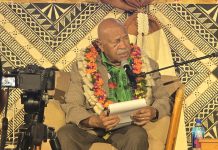

Guam Senator Will Parkinson is concerned about the potential fallout effects to Guam over reports that Japan plans to designate its distant island of Minamitorishima as a potential final disposal site for high-level radioactive waste.
Guam is less than 1,000 miles away from Minamitorishima, Parkinson said.
Concerned about the potential risks to Guam and the CNMI and having “many unanswered questions,” Parkinson wrote a letter to the Japan Consulate of Guam, seeking further clarification of waste inventory, disposal plan, and communication and transparency with local governments.
The Japan Consulate confirmed it had received the letter but has yet to provide an official comment.
Parkinson told the Pacific Daily News he also shared a copy of the letter with Governor Lou Leon Guerrero.
According to Nikkei Asia, Minamitorishima Island, about 1,900 kilometers southeast of central Tokyo, has no civilian population, with its only inhabitants being Japan Maritime Self-Defence Force members and government personnel.
Parkinson learned of the situation through “recent public reporting” in world and Japanese news media, where he read that Japan’s Ministry of Economy, Trade and Industry requested for Ogasawara Village to accept a literature survey concerning Minamitorishima as a possible site in the selection process of a final disposal site for high-level radioactive waste.
NHK World Japan reported that Mayor Shibuya Masaaki of Ogasawara Village, the municipality that administers the Ogasawara Islands, including Minamitorishima, received the literature survey on March 3.
The amount of radioactive waste to be disposed of or when the disposal would happen has not been specified.
However, NHK Japan reported that “roughly 2,500 canisters of vitrified high-level radioactive waste were being temporarily stored at Japan Nuclear Fuel’s plant in Aomori Prefecture and Japan Atomic Energy Agency’s facility in Ibaraki Prefecture” as of March 2025.
Parkinson’s letter said it is important for the public to understand what kind of material is at issue.
He wrote that according to technical materials published by the Japan Atomic Energy Agency, “Japan’s fuel cycle policy envisions spent nuclear fuel being reprocessed, after which the resulting high-level radioactive liquid waste is mixed with glass material, vitrified into a stable solid form, sealed in stainless steel containers, stored for approximately 30 to 50 years to cool, and then emplaced in a deep underground geological repository at a depth of at least 300 meters using a multi-barrier system that combines engineered barriers with natural geologic barriers.”
That description is significant, Parkinson said, because it clarifies the material is not ordinary low-level waste and explains why the hazard horizon is measured in millennia, not years or political terms.
Referencing U.S. Nuclear Regulatory Commission background materials, the senator also pointed out the risk of radionuclides from such waste entering groundwater or rivers and moving into food chains, especially when “some of the principal radionuclides associated with long-term hazard, such as plutonium-239, remain dangerous over extremely long time periods.”
“It concerns high-level radioactive waste requiring deep geologic isolation over extraordinary timescales…high-level wastes are dangerous because they can produce fatal radiation doses during short periods of direct exposure,” Parkinson wrote.
Parkinson said Minamitorishima may be remote from Japan’s main population centres, but it is not remote from the Mariana Islands in any meaningful Pacific sense.
“Minamitorishima is roughly 800 to 950 miles from Guam…and within comparable range of major population centres in the Northern Mariana Islands…the issue is not ordinary commerce or tourism, but the long-term handling, transport, storage, and possible burial of the most persistent and hazardous radioactive wastes created by human industry,” Parkinson wrote.
Depending on the Japan Consulate’s response, Parkinson said the matter may necessitate a substantive resolution voted on and duly adopted by the entire Guam Legislature “to express how the people of Guam feel once we have all the facts.”
Parkinson cautioned the radioactive waste dump plan as a repeat of unfavorable history in the Pacific region, how the Marshall Islands and French Polynesia were subjected to repeated nuclear testing.
Additionally, the National Academy of Science classified residents of Guam as “downwinders,” subject to the nuclear fallout from those tests in the form of dust particles carried 1,200 miles south to the island, Parkinson said.
The lingering contaminants continue to place Guam residents at high risk for serious illnesses, PDN archives show.
Parkinson said the Pacific has “too often been treated by great powers as a convenient place for what was too dangerous, too destructive, or too politically difficult” for domestic metropolitan centres.
He said the region continues to live with the legacy and looming threat of contamination and waste containment disputes.
“The broader Pacific remembers fallout, displacement, medical uncertainty, environmental harm, and the long afterlife of decisions made by distant governments that regarded oceanic islands as strategically useful but politically expendable. That memory is not ideological. It is historical fact,” Parkinson said.
Parkinson’s letter to the Japan Consulate included five specific requests for clarity, public accountability, diplomacy, transparency, and environmental responsibility.
The senator first requested formal clarification of what stage the Japanese government believes Minamitorishima has entered in its selection process for a disposal site, what a literature survey does and does not authorize, and what criteria would terminate the proposal at an early stage if serious concerns were identified.
Parkinson then requested a clear and public explanation of the potential waste inventory being contemplated for disposal, “including the expected waste form, radionuclide profile, estimated total volume, cooling assumptions, and whether the proposal concerns vitrified high-level waste alone or any related transuranic or associated materials.”
His third request was for a site-specific explanation of how a high-level radioactive waste disposal concept would function on a small coral island with low elevation, typhoon exposure, salt corrosion pressure, and limited land area, the geological conditions of Minamitorishima.
“This explanation should include surface infrastructure requirements, port and transport requirements, handling protocols, emergency planning, and the implications of climate and marine hazards over both operational and post-closure horizons,” Parkinson wrote.
The fourth request was that the government of Japan commit to consultation with the government of Guam and the Commonwealth of the Northern Mariana Islands, and other potentially affected Pacific stakeholders before any step beyond preliminary paper review is undertaken.
Parkinson said consultation should occur as early as possible and should include technical briefings by appropriate Japanese experts.
His final request was for a statement of how Japan intends to satisfy regional duties of transparency, notification, and cooperative engagement should any radiological accident, transport incident, or marine contamination scenario occur and how it would affect neighbouring Pacific jurisdictions.