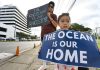


Palau President Surangel Whipps Jr is taking his campaign against deep-sea mining to a global stage, and his message for the Marianas is personal.
Speaking to The Guam Daily Post on Monday, a few days after delivering a keynote address at the World Ocean Summit in Montreal, Whipps said any deep-sea mining near the Marianas would directly harm Palau and the broader Pacific community.
“Although we love our neighbors from Guam and (the Commonwealth of the Northern Mariana Islands), but if you start deep-sea mining there, it will impact us,” Whipps said. “If we’re our Pacific brothers, then let’s make sure that what we do – let’s not hurt our brother.”
His remarks carry extra weight as the Bureau of Ocean Energy Management continues to push forward with plans to lease some 35.5 million acres of seafloor east of the Mariana Trench Marine National Monument for hard mineral extraction.
About two weeks ago, a closed-door BOEM meeting at the Ricardo J. Bordallo Governor’s Complex left acting Governor Josh Tenorio more unsettled than before, with the island getting no new environmental data, no revenue-sharing framework, and no binding commitment on how Guam will be kept in the loop.
Whipps, who recently signed an agreement with Biosphere Dynamics to deploy long-range unmanned aerial systems to monitor Palau’s vast exclusive economic zone, said the Pacific simply does not have enough scientific grounding to proceed with confidence.
“There is not enough science to know what the impacts are going to be,” Whipps said.
“We have to be careful. We have the options now of getting these materials from other places. Let’s focus on that, and let’s make sure that we don’t do something that we’ll regret and that has irreversible consequences.”
He said the ocean floor, long dismissed by some as barren, holds more than 8,000 species not yet identified, stores carbon critical to managing sea-level rise, and supports the fisheries that Pacific economies depend on.
Whipps expressed frustration that the United States is not among the roughly 37 countries that have signed on to a precautionary pause on deep-sea mining in international waters. He said Palau practices what it preaches.
“At home in Palau, we don’t. Deep-sea mining is not allowed. Deep-sea trawling is not allowed. Our ocean is protected.”
On the question of how regional partners can pressure Washington to align with that approach, Whipps acknowledged the limits of international leverage, particularly given the Trump administration’s recent withdrawal from dozens of multilateral organisations. But he did not give up on the process.
“To not believe in the multilateral process and to give up on it, I think, is the wrong approach,” he said. “We should try our best to have our shared voice working together.”
That multilateral instinct is shared in Guam. Melvin Won Pat-Borja, executive director of the Commission on Decolonisation, has argued that international forums are one of the only places where Guam can collaborate with other countries as an equal, saying that under any future status, “Guam would be empowered with dignified engagement as equals and partners” rather than as a subordinate territory.
Whipps plans to attend the International Seabed Authority meeting this year and noted French President Emmanuel Macron may also attend, giving regional advocates a potential ally at the table.
He said he also wants more Pacific nations to join the call for a precautionary moratorium.
The Pacific Islands Forum, which Palau will host in September, has been one venue where Whipps has tried to build consensus, though he acknowledged that unified opposition to deep-sea mining has been difficult to achieve. Nations like the Cook Islands, Nauru, and Tonga have pushed for the practice within their own waters.
“When it comes to your own sovereign territory, there’s not much we can say over that,” Whipps said. “What we’ve been most concerned about is all those areas beyond our EEZs that we believe is the common heritage of humankind.”
For Guam specifically, Whipps said the island’s strongest immediate tool may be the U.S environmental regulatory process itself.
“You have EPA, and I think you should be using the processes that have already been established, which are quite robust, to review and require that they follow that process,” he said.
His advice comes against the backdrop that Won Pat-Borja has described: Guam’s limited standing as a territory in these fights. Won Pat-Borja has pointed out that the federal government did not seek Guam’s consent on the mining question and that the absence of sovereign power leaves the island with fewer tools to push back.
The Guam Legislature unanimously passed emergency legislation earlier this year reaffirming a moratorium on deep-sea mining and objecting to federal plans to lease ocean floor minerals near the Marianas.
Lawmakers later introduced a bill that would ban seabed mining in Guam’s waters and allow the island to deny port access to deep-sea mining vessels and equipment
Whipps acknowledged the tension between U.S security interests in rare earth minerals and Pacific environmental priorities but said common ground exists.
“We have a shared interest. We want a free and open Indo-Pacific. We want to make sure that we have an environment that we pass on to the next generation that’s better than what we’ve received.”
Beyond the PIF leaders’ meeting in September, Whipps said a busy calendar of ocean summits this year, including gatherings in Tokyo, Indonesia, Kenya, and a Melanesian Ocean Summit in May, gives the Pacific region multiple chances to press its case.
“These are all important times where we should talk about the importance of the ocean,” he said, “and remind people why a precautionary pause is important,” said Whipps.