
The United States has reaffirmed its long-term commitment to building strong economic and security partnerships with Pacific Island countries, highlighting investment, private sector engagement and shared prosperity as central to its approach in the region.
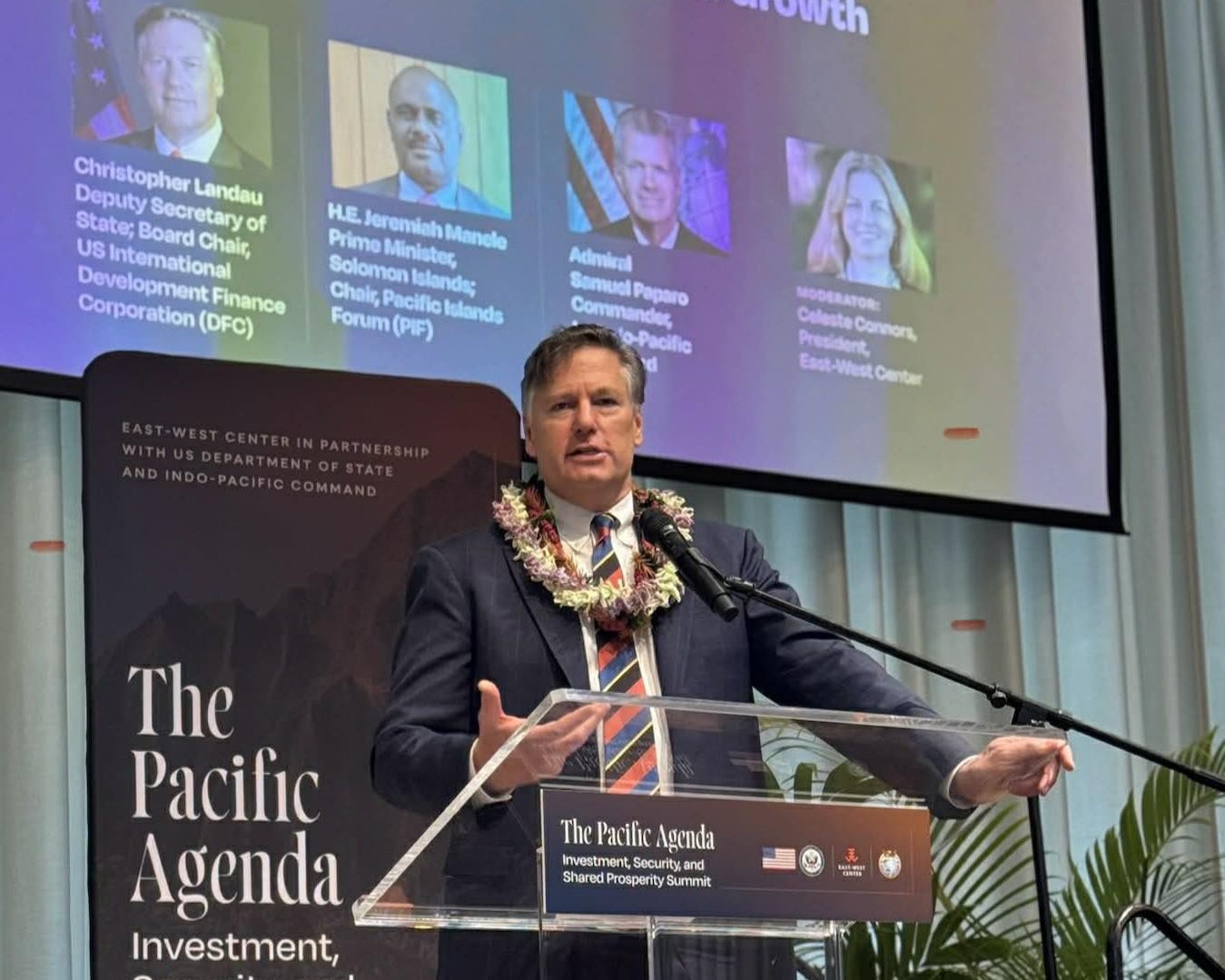
Speaking at the Pacific Agenda for Investment, Security and Shared Prosperity Summit in Hawaiʻi, Christopher Landau, Deputy Secretary of State and Board Chair of the U.S International Development Finance Corporation, said the summit reflects the deep and enduring ties between the United States and the Pacific.
Landau thanked the East-West Centre for hosting the event and acknowledged close collaboration with the U.S Indo-Pacific Command, describing the partnership as essential to advancing shared goals in the region. He also welcomed Pacific leaders, including Pacific Islands Forum (PIF) Chair and Solomon Islands Prime Minister Jeremiah Manele, and representatives from across the Pacific.
“The United States is a Pacific nation,” Landau said, stressing that Hawaiʻi, Guam, the Northern Mariana Islands and American Samoa demonstrate the country’s deep geographic, cultural and historical connections to the region. He said these ties are reinforced by longstanding human bonds, shared history and cooperation dating back to the 19th century and the Second World War.
Landau said the United States is committed to working in partnership with Pacific nations to foster prosperity and security, noting that security and economic development are inseparable. He said the summit was designed to bring Pacific political leaders together with American private sector leaders to encourage practical connections and investment opportunities.
“We are here to highlight the tools available in the economic realm and the dynamism of the American private sector,” he said, describing the private sector as a key driver of innovation, growth and job creation.
He said the summit provides opportunities for engagement across critical sectors, including infrastructure, energy, minerals, fisheries, agriculture, tourism, health and biotechnology, banking and financial services, telecommunications, artificial intelligence and the digital economy. According to Landau, these sectors represent areas where partnerships can directly improve livelihoods and strengthen local economies.
Landau said affordable and reliable energy remains a foundation for development in the Pacific and highlighted the potential for new technologies to significantly reduce electricity costs in island economies.
He also emphasised the importance of infrastructure such as roads, seaports and airports, as well as strengthening fisheries value chains to ensure more economic benefits remain in Pacific countries.
He said attracting investment requires welcoming and stable legal and regulatory frameworks, adding that capital flows where it is treated well and where certainty exists. The United States, he said, is ready to support Pacific governments in strengthening governance systems that attract investment while ensuring benefits reach communities and are not undermined by corruption.
Landau also emphasised the role of U.S institutions, including the Development Finance Corporation, the Millennium Challenge Corporation and the Trade and Development Agency, which he said are working together to reduce risk for investors and support feasibility studies and infrastructure development across the Pacific.
“This is not a partisan issue in the United States,” Landau said. “This is an American issue.” He said U.S engagement in the Pacific has broad bipartisan support and will continue beyond any single administration.
He expressed hope that the summit would be remembered as a turning point in U.S–Pacific relations, laying the foundation for a new era of partnership, shared prosperity and regional security.