

Attempts to secure a landmark treaty combating plastic pollution descended into disarray on the penultimate day of talks on Aug 13 as dozens of countries rejected the latest draft text, leaving the talks in limbo.
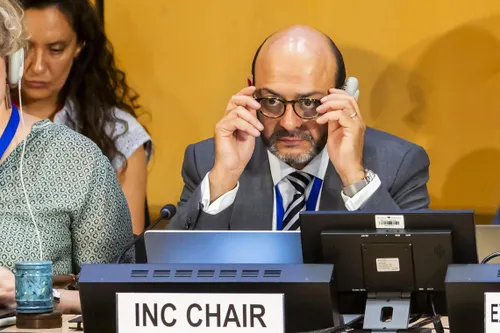
With time running out to seal a deal among the 184 countries gathered at the United Nations in Geneva, several countries slammed a proposed compromise text put forward by talks chair Luis Vayas Valdivieso of Ecuador.
A larger bloc of countries seeking more ambitious actions blasted what they consider a dearth of legally binding action, saying the draft text was the lowest common denominator and would reduce the treaty to a toothless waste-management agreement.
But oil-producing states said the text went too far for their liking, crossing their red lines too and not doing enough in paring down the scope of the treaty.
The talks towards striking a legally binding instrument on tackling plastic pollution opened on 05 August.
Five previous rounds of talks over the past two and a half years failed to seal an agreement, including a supposedly final round in South Korea in 2024.
But countries seem no closer on a consensus on what to do about the ever-growing tide of plastic rubbish polluting land, sea and human health.
With a day left to go, Vayas presented a new draft but the discussions quickly unravelled as the text was savaged from all quarters.
Panama said the goal was to end plastic pollution, not simply to reach an agreement.
“It is not ambition: it is surrender,” their negotiator said.
The European Union said the proposal was “not acceptable” and lacked “clear, robust and actionable measures”, while Kenya said there were “no global binding obligations on anything”.
Tuvalu, speaking for 14 Pacific island developing states, said the draft risked producing a treaty “that fails to protect our people, culture and ecosystem from the existential threat of plastic pollution”.
Britain called it a text that drives countries “towards the lowest common denominator”, and Norway said “It’s not delivering on our promise… to end plastic pollution.”
Bangladesh said the draft “fundamentally fails” to reflect the “urgency of the crisis”, saying that it did not address the full life cycle of plastic items, nor their toxic chemical ingredients and their health impacts.
“This is, as such, without ambition entirely,” it said.
A cluster of mostly oil-producing states calling themselves the Like-Minded Group – including Saudi Arabia, Russia and Iran – want the treaty to focus primarily on waste management.
Kuwait, speaking for the club, said the text had “gone beyond our red lines”, adding that “Without consensus, there is no treaty worth signing.”
“This is not about lowering ambition: it’s about making ambition possible for all,” it said.
Saudi Arabia said there were “many red lines crossed for the Arab Group” and reiterated calls for the scope of the treaty to be defined “once and for all”.
Meanwhile, COP30 host Brazil has distanced itself from the most ambitious proposals at UN talks on ending plastic pollution held in Geneva this week, including a ban on some plastic products, which diplomats and activists suggest could harm trust in the country’s climate ambitions.
Eleven diplomats from different regions told Climate Home that Brazil’s positions have become more aligned with major oil producers during the current round of talks this month.
While the Latin American country has not backed plans to curb soaring production of plastics, which is feeding pollution, it previously supported a narrower initiative to ban certain problematic products, such as single-use plastics. It has now backtracked on this position while linking initiatives on certain plastics ban and design of products to the provision of funding.
Countries are negotiating this week a new global treaty to reduce pollution from plastics, with talks reaching a stalemate after oil-producing nations pushed back on any measures to control soaring production, and instead favour recycling approaches.
A draft text issued by the talks’ chair on Wednesday afternoon did not include a reference to curbing production – and was rejected by many countries that regard this as a red line.
Speaking at a plenary to discuss the draft proposal, lead Brazilian negotiator Maria Angélica Ikeda said her country wants a treaty that is “robust and significant” with “balanced” measures on production and consumption of plastics, adding that it would need to include financial aid.
“We had previously said in INC sessions to all our colleagues that science tells us that we need to focus on plastics not only as waste but as products per se. Definitely a balanced approach is needed,” said Ikeda. It was not clear whether that includes any curbs on production.
Juan Carlos Monterrey, Panama’s head of delegation, said before the plenary session that Brazil’s stance on a new global plastics pact in Geneva will influence expectations of the UN climate summit host.
“What Brazil does here — the ambition it pushes — will be read across the world as a preview of what will be on the table at COP30 in Belém,” he said.
Nearly all plastic is made using plant-heating fossil fuels and, as production is projected to double or triple in the next 25 years, that spells trouble for efforts to limit global warming and stem the flood of plastic waste clogging up the Earth’s oceans and littering its land.
At the end of last year in Korea, Brazil backed a ban on certain types of plastics proposed by Mexico and Switzerland, which was also supported by more than 100 nations. This has not been the case in Geneva.
Here, the country is co-facilitating — alongside Germany — a contact group of negotiators on the most contentious articles of the deal, including issues such as measures to reduce the production of virgin plastic, chemical additives, and broader production-related measures.
In written statements, the Brazilian Foreign Ministry said it is seeking to facilitate polarised talks between those who believe plastic pollution should be addressed through waste management and those who argue for direct limits on plastic production. “In general, the latter focus excessively on the production phase,” the note emphasised.
Diplomats interviewed by Climate Home said the COP30 host nation has not been clear about its positions, sometimes expressing different opinions from one day to the next — creating confusion about the direction the country wants the negotiations to take.
A delegate from an African country told CHN that Brazil’s behaviour does not appear to signal its commitment to a strong deal to end plastic pollution, but rather to a reduced scope focused on waste management — a position similar to the stances of oil majors grouped in the Like-Minded Countries (LMC) bloc.
According to three LMC members, the South American country’s recent positions align with theirs. One noted that big oil-producing countries do not need to formally join the LMC to share their stance, and added that this has been the case with Brazil.
The Brazilian delegation has submitted three proposals that do not include curbing production — including guidelines for the manufacturing of plastic products — and has conditioned all actions on the availability of funding.
In a written statement sent to Climate Home, Brazil’s Foreign Ministry said there is “a clear lack of willingness by many developed countries to support developing nations”, both with financial assistance and technical support.
“At most, [developed countries] seek to broadly restrict the countries that can receive any form of support,” the statement added.
Some diplomats told Climate Home this could be read as a delaying tactic. Other UN treaties such as the Paris Agreement allow for countries to propose conditional actions, depending on the available funding.
Brazil has also defended voluntary commitments — an approach that would make the agreement work through a set of general guidelines to be implemented at the national level. Oil producers in the LMC have also backed this approach.
“Maintaining environmental commitments in your rhetoric while defending voluntary measures in negotiations is totally contradictory,” said WWF-Brazil’s public policy manager, Michel Santos.
“Brazil can — add must — be a protagonist in this agreement, exercising real leadership and demanding a strong treaty, with concrete rules and proposals to tackle the plastics crisis.”
The Foreign Ministry said it has sought to defend “those paths that can count on the support of all United Nations member states”.
Around 70 ministers arrived in Geneva on Tuesday on a mission to unlock the talks, but Brazil’s environment minister Marina Silva is not attending. As the Brazilian government grapples with tricky logistics for COP30 and a Congress-led bill to weaken environmental licensing rules, it is represented at the plastics talks by vice environment minister Adalberto Maluf.
The Brazilian government noted that Maluf has been involved in the plastics negotiations since the start. But a European negotiator lamented Silva’s absence, saying it pointed to a lack of ambitious leadership from Brazil.
Silva met on Tuesday in Brasilia with her counterparts from the Democratic Republic of Congo (DRC) and Indonesia, to coordinate COP30 rainforest cooperation initiatives such as the Tropical Forest Forever fund (TFFF).
Aleksandar Rankovic, an observer at the plastics negotiations and director of the think tank The Common Initiative, said Brazil was preserving its political capital in Geneva, so as to be able to bridge divisions. But that strategy will not be enough when the country presides over the COP30 climate conference, he added.
“At COP30 I hope they will be more proactive and put their skills at the service of getting out of fossil fuels,” he said.
For chemical engineer Rafael Eudes, a member of the steering committee of the Zero Waste Brazil Alliance, the signal of leadership must begin in Geneva. “Since plastics are fossil fuels, the leadership role of oil-producing countries that manufacture plastics is essential,” he said, referring indirectly to Brazil