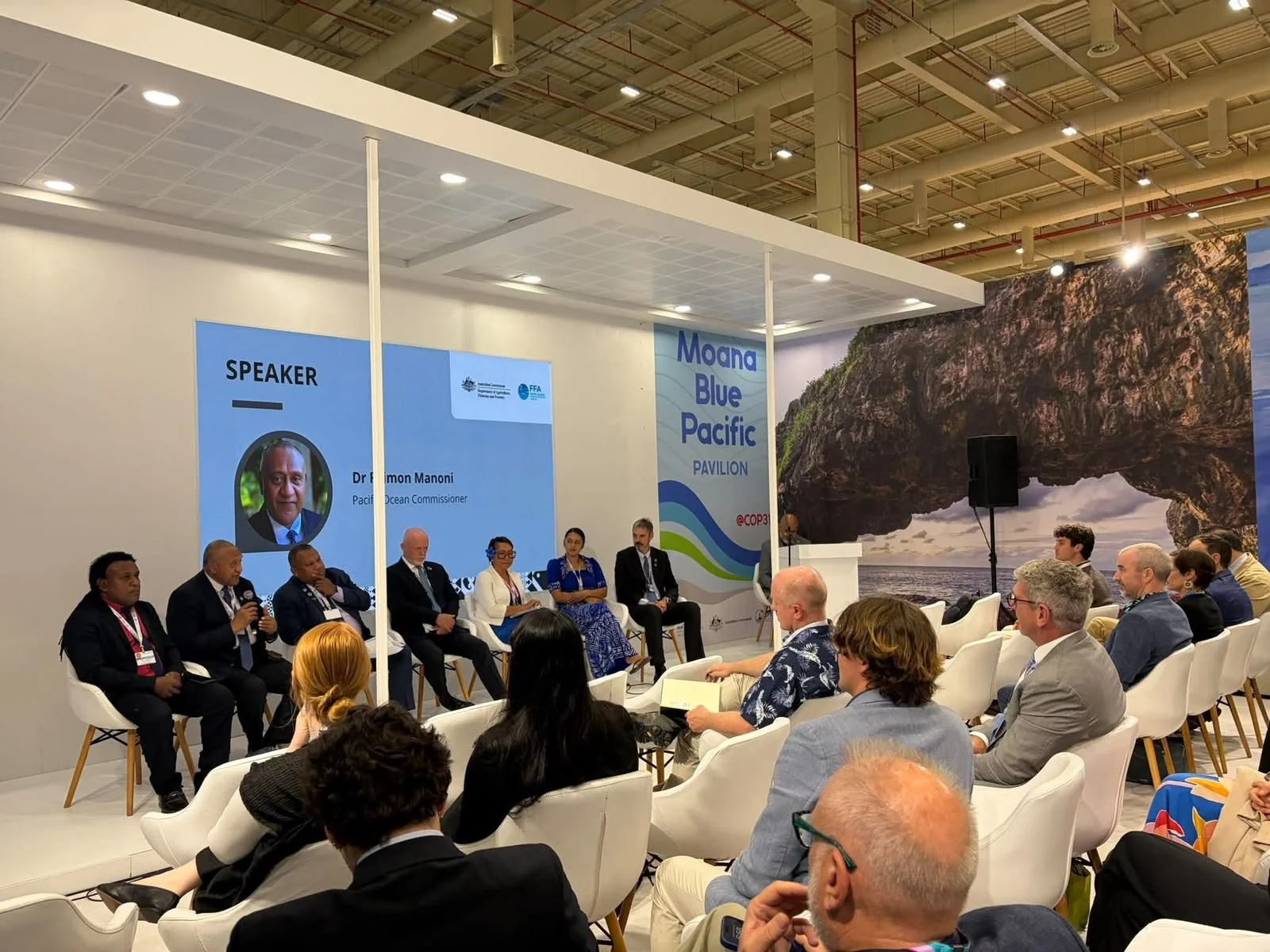
Pacific leaders, climate financiers and development partners gathered at the Moana Pavilion at COP31 on 17 November 2026 for Fish & Sips 3.0, co-hosted by the Government of Australia and the Pacific Islands Forum Fisheries Agency (FFA) under the theme “Resilient Fisheries for Climate Resilient Large Ocean States”.
Speakers pressed one case: the Western and Central Pacific supplies over half the world’s tuna — some 2.5 million tonnes a year and around US$500 million in access fees to Pacific governments — and that asset is predicted to move east with a warming ocean, out of the zones the region manages and earns from.
Ambassador Peter Thomson, UN Secretary General’s Special Envoy for the Ocean said: “The Pacific tuna fishery is the most complete proof our world possesses that ocean governance can work — and the three negotiations now surrounding this COP will either strengthen it, or quietly undo it.”
He asked COP31 to implement the High Seas Treaty with regional fisheries bodies, to count sustainable Pacific fisheries as conservation, and to put fisheries adaptation into the COP’s finance outcomes.
Mona Ainuu Pacific Political Champion for the Ocean said: “For us in the Pacific it is not a part of the economy — it is the economy. When we talk about the tuna moving, we are not talking about a business risk. We are talking about the viability of a state.”
She set out three propositions ready for co-investment: sustain science and management capacity, protect the fishery through a new Regional Fisheries Surveillance Centre, and grow Pacific earnings through ports, cold storage and processing.
Inia Seruiratu, COP31 Special Envoy for Oceans emphasised the critical importance of the 1.5 degree target for the Pacific and oceans and highlighted the importance of investing in science to ensure science based decisions. “If the fish are going to move, our science has to move faster. Every decision we take is only as good as the evidence underneath it — and that evidence is not free.”
Dr Filimon Manoni “More than half of the world’s tuna is caught in this ocean. That makes its sustainability a global responsibility, not a Pacific burden to carry alone.”
Exsley Taloiburi “We are working to make our processes more efficient — simpler, faster, and better matched to the scale and urgency of what Pacific countries are dealing with.” A GCF office will be opened in Suva in 2027, he said, “and will open opportunities the region has not had before”, bringing the Fund closer to the countries it serves.
Greenpeace Pacific Campaigner, Moenoana Schwenke, closed the panel session highlighting the importance of youth at the negotiations.
“Young people are not the future of these negotiations. We are part of the present, and we will live with what is agreed here — we need to be at the table when these decisions are made. And the finance has to reach the villages on the front line of a rising ocean.”
The event was moderated by Tevita Tupou (FFA) and opened by Brett Molony (CSIRO). FFA supported its membership and will continue to advocate on the importance of coinvestment in tuna fisheries as a climate resilience solution.