

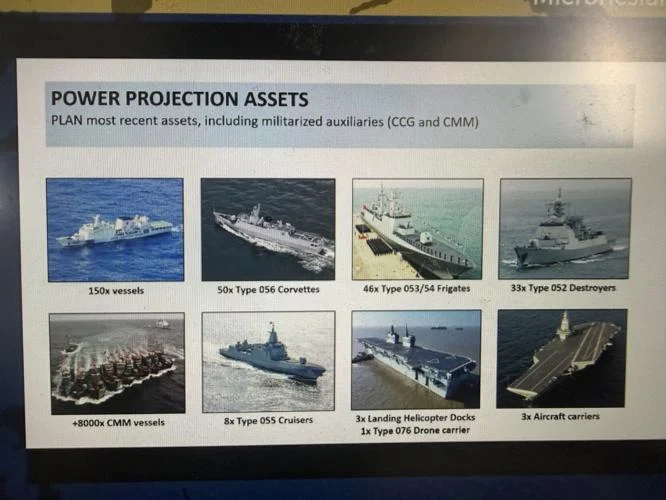
Surrounded by hundreds of maritime assets, Micronesia is “on the front line” of China’s activity and growth in the Pacific, according to Benjamin Blandin, research fellow with the Institute for National Defence and Security Research.
Blandin was a presenter at Friday’s Developments in Micronesian Security webinar, hosted by the Pacific Centre for Island Sustainability, explaining the rapid growth of China’s activities in regions including French Polynesia, New Caledonia and Guam.
He is a French scholar specializing in geopolitics with a focus on China’s asymmetric warfare along the first island chain. According to PCIS, Blandin’s research examines the integration and deployment of unmanned and unconventional maritime systems, as well as the role of civilian and paramilitary auxiliaries.
“That is to illustrate that there will not be the construction or land reclamation of China in this area anytime soon. But clearly Micronesia is on the front line of those activities,” Blandin said.
However, with so many established buildings, ports, airports and other infrastructure throughout the Pacific, Blandin said there is no risk of China using them as military bases.
“I wouldn’t be afraid of those. They are fairly small infrastructure, to be honest … China did it more to gain influence in those countries than for any other type of activities,” Blandin said.
He said China has been quietly building an additional capacity of 500 missile silos over the past decade, now possessing a total capacity of 800 missile silos, dispersed across the country.
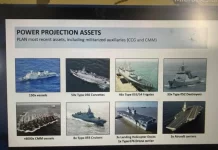
Extending to the waters, Blandin said China has hundreds of naval assets deployed in the Yellow Sea, East China Sea and the South China Sea, including buoys, drones and decommissioned oil rigs.
With 23 offshore platforms in the East China Sea alone and eight Type 055 Cruisers, three aircraft carriers, 33 Destroyers, 46 Frigates and more throughout the region, Blandin said the Chinese Navy is stretched to near its absolute operation limit.
“Because of that, the Chinese Navy needed to be reinforced with auxiliaries, which leads to the militarisation of the Chinese Coast Guard. It has been demonstrated that they were conducting either influence projection, intelligence gathering or sabotage of subsea cable,” Blandin said.
The danger of these assets, Blandin added, is they rarely, if ever, announce they’re coming and going, never declare their location, never cooperate with local authorities and never share the findings of the research.
“I hope those illustrated the risk that we have for Micronesia and the South Pacific island nations because the presence of China in this area,” Blandin said.
During a Q&A portion of the webinar, Blandin was asked how effective the United Nations is as a tool for Pacific Islands to engage against geopolitical threats.
“China is manipulating international maritime law. China has nominated a judge at the International Tribunal for the Law of the Sea, and in the meantime, it’s refusing to recognise the validity of the Permanent Court of Arbitration ruling in 2016,” Blandin said.
When China does port calls, when it gives medical care, when it builds a road or stadium or these kinds of things, the presence of China piles up in a country. Blandin said this often leads to the behaviour of that country changing.
He said it leads to manipulation of the proper functioning of the UN, because countries start voting for China at the UN, or against texts that are against Chinese interests at the UN.
Blandin also said China’s activity, despite rapid growth, is uncorrelated to any recent U.S movement. He said the U.S military has undergone an overall reduction by comparison in the past 30 years within the Pacific region.
“If you listen to a spokesperson of the Chinese Ministry of Defence or Foreign Affairs, they always present their action as self-defence against the U.S., but the U.S. has reduced its troops in Japan by 80 percebt, in South Korea by two-thirds, and within American territory, 8 out of 11 Navy shipyards have been closed,” Blandin said.
Blandin said China is rather exercising a net investment in its capacities than reacting to any American capacities.
“What we can say, nonetheless, is it’s true that the U.S has conducted hypersonic missile tests in the Pacific, but it’s really just once in a while. There’s no buildup of any hypersonic missile capacity. There’s not a single more soldier, ship, or plane of the United States Armed Forces in the region than there was 10 or 20 years ago,” Blandin said.