

By Pita Ligaiula
Pacific leaders and partners have called for faster emissions cuts, greater access to climate finance and stronger protection of vulnerable island communities, warning that every fraction of a degree of warming increases the risks facing the Pacific.
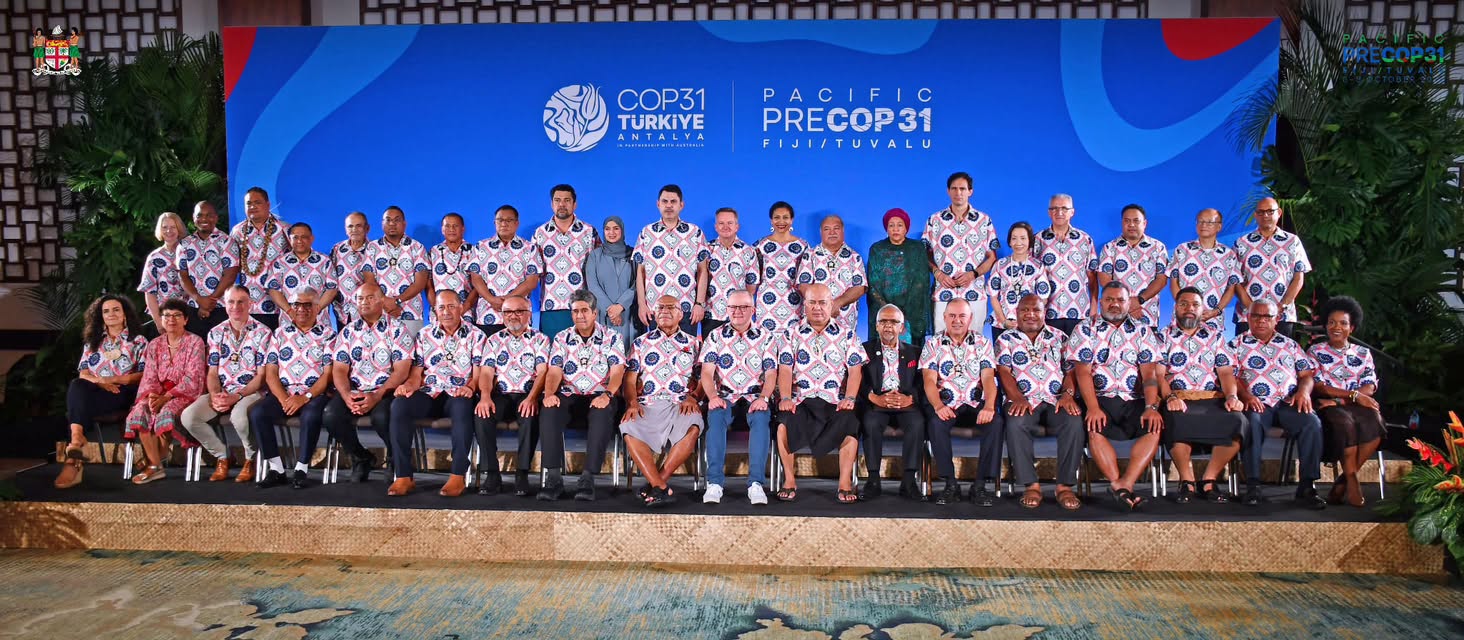
The call is contained in the Taku Pakasoa Declaration, adopted ahead of COP31 following the Pacific Pre-COP31 meetings in Tuvalu and Fiji.
Taku Pakasoa, a Tuvaluan expression representing strength through unity and collective action*, brings together calls for stronger global action to keep the 1.5°C temperature goal within reach and address the impacts of climate change already affecting Pacific communities.
The declaration states that communities across the Pacific are facing the consequences of a changing ocean, with climate change threatening livelihoods, culture and ways of life.
“Today, the same ocean threatens this way of life,” the declaration states.
It warns that as global temperatures approach 1.5°C and strong El Niño conditions persist, every fraction of additional warming will accelerate climate impacts and increase the risk of irreversible loss and damage, particularly for Small Island Developing States (SIDS) and Least Developed Countries (LDCs).
The declaration calls on all parties to the Paris Agreement to accelerate collective action during the critical decade and ensure the 1.5°C target remains within reach.
“The science is unequivocal. Deep, rapid and sustained emissions reductions are required to minimise the magnitude and duration of overshoot,” it states.
It also urges countries that have not yet submitted their 2035 Nationally Determined Contributions to do so as soon as possible.
The declaration reaffirmed the importance of climate science in national and international decision-making, particularly the work of the Intergovernmental Panel on Climate Change.
On energy, the countries reaffirmed commitments to accelerate the global transition to clean energy, including efforts to triple renewable energy capacity and double the annual rate of energy-efficiency improvements by 2030.
The declaration also calls for a transition away from fossil fuels in energy systems “in a just, orderly and equitable manner” and for action consistent with achieving net zero emissions by 2050.
Access to climate finance is identified as another priority, with the declaration calling for reforms to the international financial architecture to provide funding at the speed and scale required by vulnerable countries.
It calls for increased grant-based and concessional finance, particularly for SIDS and LDCs with limited capacity to respond to climate impacts.
The declaration welcomes work on the Statement and Action Plan on Access to Climate Finance for SIDS and LDCs, aimed at turning existing commitments into practical outcomes.
It also commends the establishment of the Pacific Resilience Facility(PRF), which is designed to support regional resilience, disaster preparedness, adaptation and responses to loss and damage.
The declaration calls on countries with the capacity to contribute to the facility to strengthen support for community resilience and locally led climate action.
The declaration places the ocean at the centre of Pacific climate concerns, recognising its importance to Pacific, Indian and Atlantic Ocean nations and to Indigenous Peoples and local communities.
It highlights accelerating ocean warming, acidification, sea-level rise and marine biodiversity loss as interconnected crises requiring collective action.
The declaration describes the ocean as the planet’s primary climate regulator, largest active carbon sink and a key driver of global food security and weather stability.
It calls for stronger ocean science and action to limit warming to below 1.5°C to reduce risks to ocean currents and circulation systems.
The declaration also welcomes efforts under the UN climate process to strengthen the role of ocean solutions in climate action, including through the ocean and climate change dialogue and the second Global Stocktake.
The leaders further reaffirmed the importance of maintaining statehood and sovereignty and the associated rights and duties of countries facing sea-level rise.
They stressed the importance of States being able to maintain maritime zones established under international law despite physical changes caused by climate change.
The declaration also recognises the role of Pacific island countries in advancing the International Court of Justice Advisory Opinion process, the UN General Assembly resolution on climate change obligations, and the Advisory Opinion of the International Tribunal for the Law of the Sea.
“In the spirit of Taku Pakasoa, this Declaration brings our voices together, in unity, resilience and power, as a call to action to address our shared challenges, protect our cultures and build our shared future,” it states.
Ahead of COP31 in Türkiye, the declaration calls on all parties to join the Pacific in advancing global climate action and implementation.