

By Pita Ligaiula
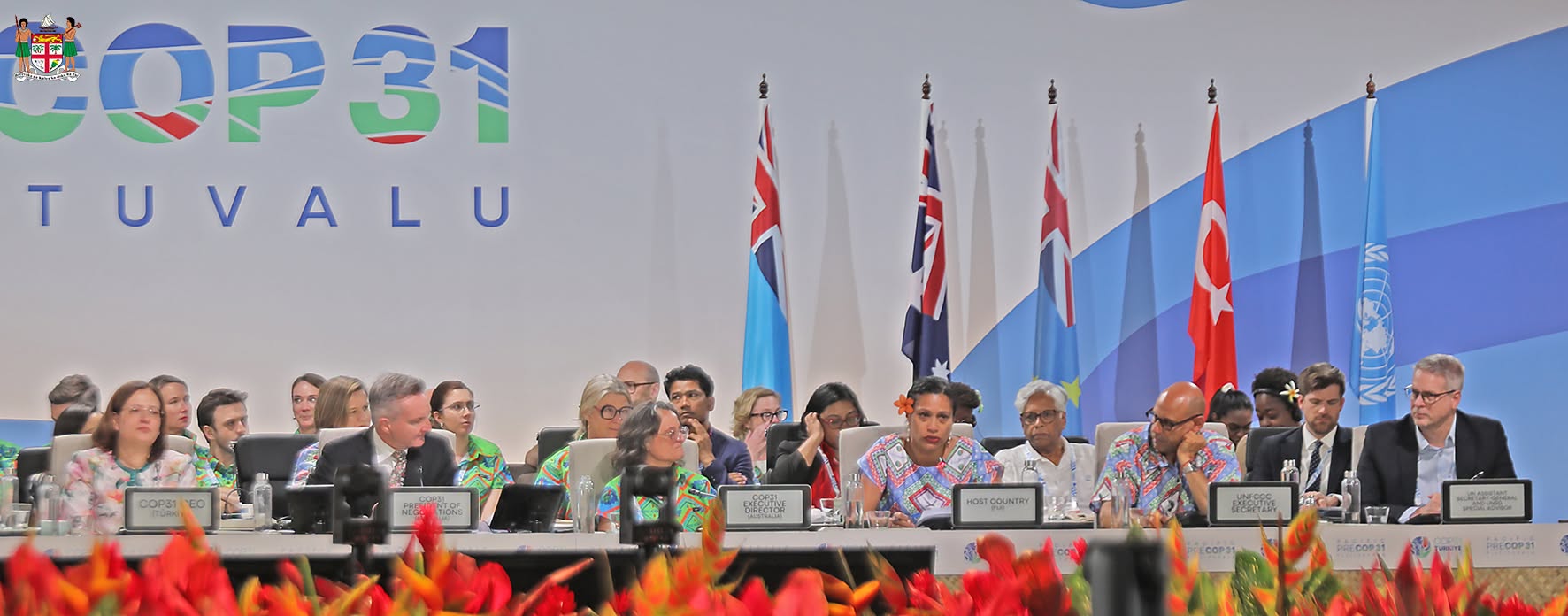
The Pacific Pre-COP in Fiji has ended with Pacific priorities set to shape negotiations at next month’s COP31 climate summit in Türkiye, with leaders calling for urgent action to keep 1.5°C within reach, improve access to climate finance and put the ocean at the centre of global climate policy.
About 4,000 participants from more than 100 countries took part in four days of discussions, announcements and negotiations focused on energy security, electrification, climate resilience and the economic opportunities linked to the clean energy transition.
The meeting was designed to build momentum towards COP31 in Antalya, Türkiye, and elevate the priorities of Pacific island countries in the global climate process.
Fiji’s Minister for Information, Environment and Climate Change, Lynda Tabuya, said the Pre-COP had delivered important outcomes but the focus must now shift to implementation.
“We’re very proud of what we have achieved this week. So many of these achievements are rooted in Indigenous knowledge, traditions of our custodianship working together with climate science.
“But our work is not done,” Tabuya said.
She said Pacific priorities going into COP31 were clear.
“We must achieve the following outcomes: keeping 1.5 degrees within reach, get climate finance into the hands of the people who really need it, and of course, putting the ocean in its rightful place in the climate agenda,” Tabuya said.
COP31 President-designate and Türkiye’s Minister for Environment, Urbanisation and Climate Change, Murat Kurum, said holding the Pre-COP in the Pacific was a deliberate decision because of the region’s exposure to climate impacts.
“It was intentional to choose the Pacific as the venue for the Pre-COP because this is the frontline of the climate crisis.
“We travelled to Tuvalu, heard firsthand what people are experiencing. We witnessed it ourselves,” Kurum said.
Kurum said Tuvalu had contributed little to climate change but was facing an existential threat.
“Science is clearly warning us the 1.5-degree target is in jeopardy. We do not have a single minute, a single day to lose.
“So, this 1.5-degree goal is a matter of survival — the survival of cultures, history, memories, your homeland, your homes — it’s that important,” he said.
Australia’s Climate Change and Energy Minister Chris Bowen, who will serve as COP31 President of Negotiations, said the Pre-COP had given Pacific island countries a stronger platform ahead of the summit.
He said Australia and Türkiye had agreed from the outset to use the Pre-COP as a launching pad for COP31 and to give greater voice to countries that had struggled to be heard at previous climate conferences.
“Small island developing states best represented here by the Pacific.
“It’s something we have worked hard to deliver over the last few days, and it’s something that has seen the Pacific give COP31 the best chance of hearing their voice,” Bowen said.
UN Climate Change Executive Secretary Simon Stiell said the Pacific had demonstrated how determination, cooperation and practical solutions could respond to the climate crisis.
“Throughout the week, this region has shown again how to meet danger with determination, innovation, cooperation, and practical solutions,” Stiell said.
He said COP31 must focus on turning existing commitments into action.
“This is what COP31 can and must do: Help convert promises into more real-world results,” Stiell said.
Stiell said improving access to affordable climate finance would be central to that effort.
“Every nation is now on the front lines of the climate crisis. Every economy is already getting hammered. Now, El Niño is upping the ante and supercharging these climate costs. But few nations have as much at stake as small islands,” he said.
Australia used the Pre-COP to launch the Global Rooftop Solar Pledge, becoming the first country to sign onto the initiative.
The pledge, developed by Australian community-based group Solar Citizens and sub-national governments, aims to see 300 million solar panels installed on rooftops globally by 2030.
Bowen said Australia already had one of the world’s highest rates of household rooftop solar, with one in three Australians having rooftop panels and more than 500,000 household batteries installed.
“Australians and people who are undertaking this journey around the world are prosumers — producers and consumers — of energy, and they are therefore so much more in charge
“The grid’s more secure. The household’s more secure, and everyone’s better off,” he said.
Australia also launched an Access to Finance Statement and Action Plan aimed at making climate finance faster, simpler and more accessible.
The initiative focuses on reducing barriers that delay climate funding reaching vulnerable communities, with other countries able to join the action agenda.
More than US$16 billion in climate finance has been committed to Pacific countries since the Paris Agreement, but more than US$5 billion remains undisbursed.
Ensuring existing commitments reach communities on the ground was a major focus of the Pre-COP.
The ocean was another major focus, with Pacific countries calling for it to be given greater weight in the COP process.
UN Secretary-General’s Special Envoy for the Ocean, Peter Thomson, said Türkiye had committed to working towards an Antalya Ocean Declaration.
“Türkiye has assured us that it will work towards an Antalya Ocean Declaration that recognises the centrality of the ocean-climate nexus in the regulation of the planet’s climate and will support ocean-based climate action going forward,” Thomson said.
He said the message from the Pacific Pre-COP should be clear.
“Never again should Mother Ocean, the planet’s primary climate regulator, be consigned to the back rows of deliberations,” Thomson said.
Fiji’s Minister for Lands and Mineral Resources Filimoni Vosarogo said the ocean could not be separated from climate policy.
“If you were designing the climate architecture from scratch today, would you leave out the planet’s largest sink of excess heat? And its largest active reservoir of carbon?.
“The ocean has absorbed around a quarter of the carbon dioxide that we emit as humans and more than 90 percent of the excess heat that we have trapped” Vosarogo said.
He said the ocean was paying the price for regulating the global climate.
“It is the planet’s climate regulator and the largest carbon sink active, and the reason the world is not already far warmer than it is. And it’s paying for this service with its health,” said Vosarogo.
The Pre-COP now moves the focus to COP31 in Türkiye, where Pacific countries want the commitments made in Fiji and Tuvalu translated into stronger global action and practical results for communities on the frontline of climate change.