
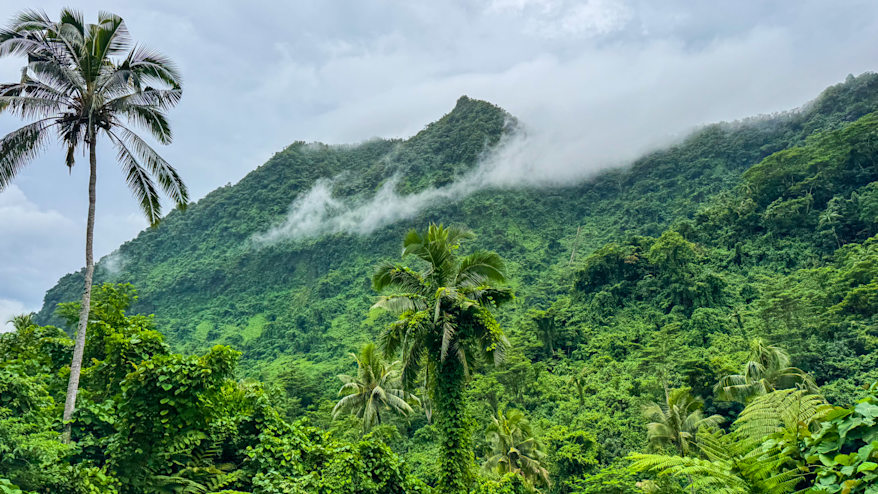
Over the course of four weeks, National Geographic Pristine Seas will survey marine life in Samoa’s newly-protected marine areas, home to a dazzling array of fish, whales and turtles
National Geographic Pristine Seas begins an expedition this week in the South Pacific nation of Samoa to support the country’s pioneering legal protection of 30 percent of its ocean, home to nearly 1,000 recorded marine species.
At the invitation of and in partnership with the government of Samoa, through its Ministry of Natural Resources and Environment (MNRE), the expedition will survey biodiversity in reef, mid-ocean, and deepwater sites spread across the country’s new marine protected areas (MPAs). Team members will also study locales outside the MPAs to understand ecological linkages and address broader data gaps. The research will inform the nation’s ambitious ocean protection plan, which seeks to sustainably manage all of Samoa’s waters.
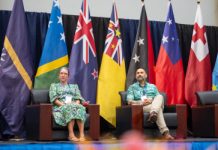
“Samoa has taken an important step by bringing its Marine Spatial Plan (MSP) into effect, but effective ocean management must be supported by strong scientific information,” remarked Samoa’s Prime Minister and Acting Minister for MNRE Laaulialemalietoa Polataivao Fosi Schmidt.
“This expedition responds directly to research priorities identified by Samoa and will strengthen our understanding of biodiversity within our new marine protected areas, as well as the ecological connections across our wider ocean. The findings will provide an important baseline for long-term monitoring and help guide effective implementation and management of our MSP.”
In 2025, Samoa endorsed the legal adoption of its MSP, following a multi-year consultation process involving government agencies, communities and other stakeholders. The MSP provides a national framework for achieving the sustainable management of 100 percent of Samoa’s ocean. In April 2026, Prime Minister Laʻauli Leuatea Schmidt signed the executive order bringing the MSP into effect. The plan expands Samoa’s national marine protections through nine new offshore MPAs and a formalized network of coastal community MPAs. Together, these areas protect 30 percent of Samoa’s ocean, approximately 36,000 square kilometers — roughly seven times the size of Grand Canyon National Park in the United States.
“Amid headlines about dying coral reefs, warming ocean waters and rising sea levels, Samoa’s bold ocean stewardship is the solution the ocean and the world needs right now,” said Paul Rose, head of Pristine Seas’ expedition to Samoa.
“By prioritising protection of the ocean — a valuable asset — they are safeguarding their cultural heritage, food supplies and local economies. At the same time, they are helping all of us stay safe by keeping the ocean healthy.”
New Reserves Home to the Ocean’s Wonders
Many of the newly-established MPAs have yet to be comprehensively studied by scientists. To address these knowledge gaps, Pristine Seas will conduct formal scientific surveys of sea life and geology under the waves. This includes the offshore seamounts of the Toamoana MPA, the deep reef slopes off northern Savai’i, and inshore areas around Upolu and Savai’i where scientific information remains limited.
“Local communities have extensive knowledge of the waters we’ll research and are essential partners in designing this expedition,” remarked Tye Kindinger, scientific lead for Pristine Seas’ expedition to Samoa. “And MNRE — which regularly surveys and monitors Samoa’s resources both on land and in the ocean — is skillfully guiding our planning to ensure we focus our research on areas that have yet to be explored.”
It’s already well known that the country’s fish life is among the richest in the world, with up to 991 species recorded. The waters of Samoa are also home to some 2,000 species of sea snails and 200 species of coral. The nation’s waters lie along important migration routes for the endangered humpback whale and other threatened whale species. The endangered hawksbill sea turtle also nests on Samoan beaches and breeds in Samoan waters.
Cutting Edge Science and National Geographic Filmmaking
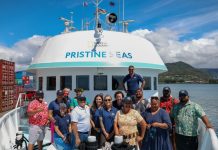
Working aboard Pristine Seas’ research vessel, the Argo, the team of local and international experts will capture data and footage of marine life from above the ocean’s surface to the mysterious sea floor. Scientists will conduct surveys while SCUBA diving, drop deep sea cameras to the bottom of the sea to collect overnight footage, float video systems ten meters below the surface to document the marine life swimming by, and even survey bird life above the waves. Using environmental DNA (eDNA) sampling, the team will collect small bits of matter that can later be sequenced to identify organisms not always seen with cameras or the naked eye.
Scientists and partners from Samoa will plunge into the unknown in Pristine Seas’ state-of-the-art submersible, the Argonauta, to observe first-hand the “twilight zone,” a frontier of deep-sea biodiversity teeming with marine life. The Argonauta is outfitted with mud and water samplers, a nearly 360 underwater view, imaging sonar and more — allowing the team to gather valuable data from one of the least understood parts of the planet.
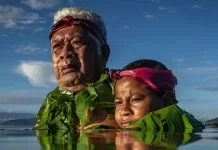
Throughout the expedition, Pristine Seas filmmakers will capture footage for a documentary film about Samoa’s stunning marine biodiversity. Filming in communities and aboard the Argo, the team hopes to highlight people’s special relationship to the ocean and illustrate the critical importance of ocean protection to people’s everyday lives. The documentarians will follow the Samoa Voyaging Society as its traditional voyaging canoe becomes a floating classroom, inspiring communities across Samoa to better understand and steward their land and ocean.
Samoa’s Ministry of Education and Culture and Pristine Seas are working together to extend ocean literacy into classrooms. With an eye on cultivating future ocean stewards, the partners hosted a Pacific Education subregional workshop in Apia earlier this week, in collaboration with The Pacific Community (SPC). Educators and Ministries of Education from six countries co-created resources for their national curriculum and attendees received training on eDNA analysis along with a tour of the Argo.
Building Ocean Literacy, Communities, and Resilience
MPAs are a proven solution for countries looking to conserve their ocean. Reserves where fishing and other damaging activities are banned restore marine life within their boundaries. That, in turn, replenishes nearby fish populations and improves local fishing, provides jobs and economic benefits, and builds resilience against natural disasters and a warming ocean.
“This October, countries of the world will gather in Armenia for a nature summit to assess their progress towards a global goal to protect 30 percent of the planet by 2030,” remarked Kevin Chand, Pristine Seas’ Senior Director of Pacific Ocean Policy.
“Samoa has shown the Pacific and the world how this can be achieved. By incorporating science into their Marine Spatial Planning implementation process, they are ensuring that the biodiversity they have protected is studied and understood to support future monitoring and management efforts, including strengthening of protection.”
Many local communities, national organisations, scientific institutions, and regional and international partners have supported the development of Samoa’s MSP, strengthened the country’s marine knowledge base, and helped lay the foundation for this expedition.
Pristine Seas started its Global Expedition in 2023 with a mission to spend five years exploring the tropical Pacific and supporting communities and governments in their efforts to protect the ocean. Since 2023, the team has explored and studied the Southern Line Islands, Tongareva, Niue, The Republic of the Marshall Islands, the Federated States of Micronesia, Palau, Papua New Guinea, Solomon Islands, Fiji, Tuvalu and Vanuatu.
For more information, contact: Jenelle Eli, Sr. Director of Communications, jeli@ngs.org
Florence Wood, Burness, fwood@burness.com