

Pacific civil society organisations have warned that attempts to weaken the role of science in international climate negotiations risk undermining climate justice and the ability of vulnerable nations to prepare for an increasingly uncertain future.
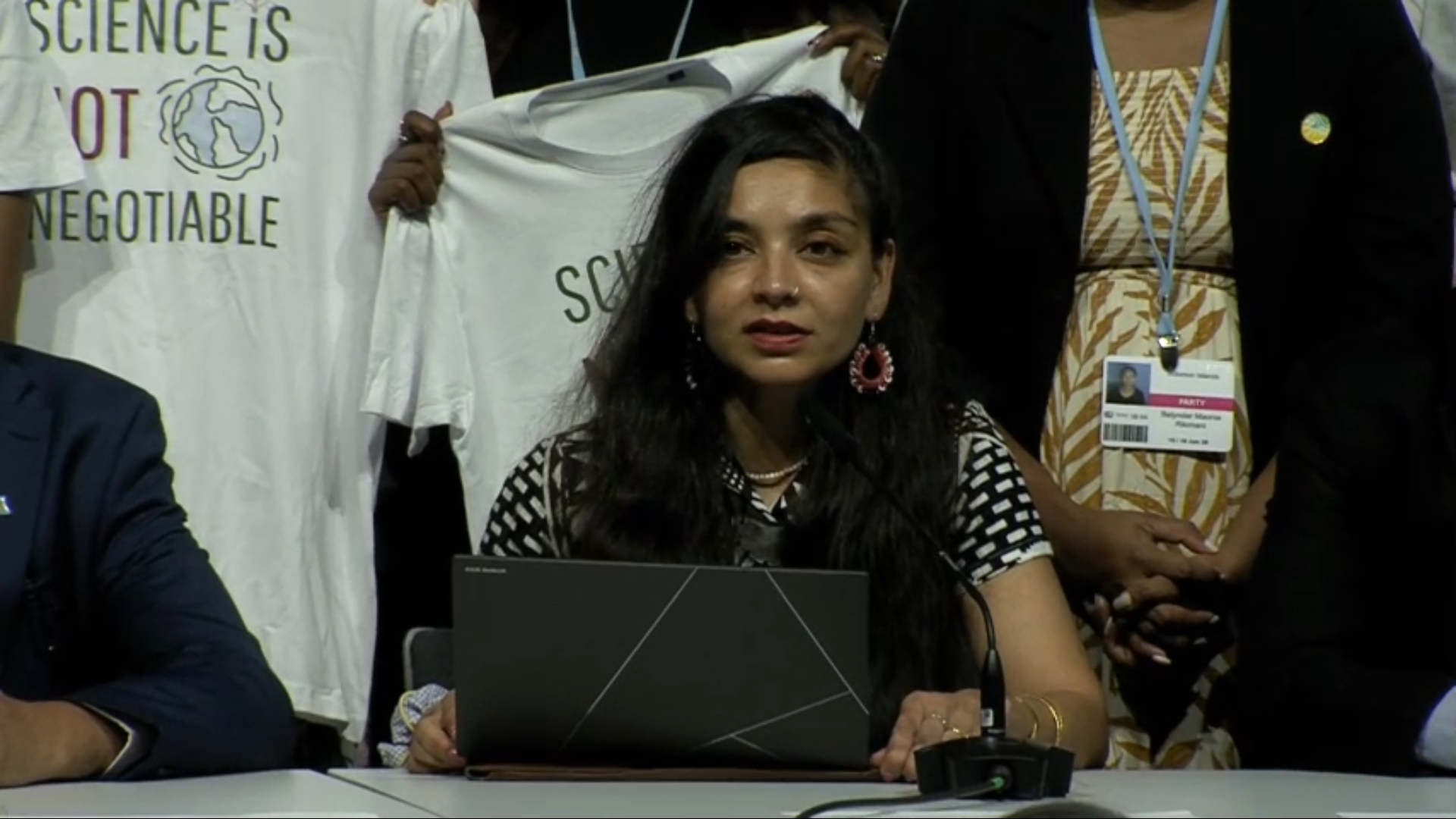
Speaking at the Defend the Science press conference during the United Nations June Climate Meetings (SB64) in Bonn, Dr Sindra Sharma, the International Policy Lead of the Pacific Islands Climate Action Network (PICAN), said science remains the foundation upon which Pacific communities build their climate responses and future planning.
Dr Sharma, representing more than 260 Pacific civil society organisations across the Blue Pacific, stressed that for Pacific Island nations, exceeding the 1.5 degrees Celsius global warming threshold is not merely a scientific projection but a lived reality with devastating consequences.
“For us, overshoot is not a pathway; it is a harm event,” she said.
“It is something that happens to people, to reefs, to cyclone seasons, to the mothers and grandmothers and daughters to whom the harm lands the hardest.”
Dr Sharma said Pacific communities have observed the impacts of climate change for generations, long before they were documented in scientific studies.
“Our people have spoken these truths long before they were measured, studied or validated,” she said.
“What we are seeing now is science listening more deeply and learning from other ways of knowing and evolving in the process.”
She noted that the Intergovernmental Panel on Climate Change (IPCC) plays a critical role in translating generations of Indigenous and local observations into evidence-based assessments that inform global decision-making.
“It takes what Pacific communities have observed across thousands of years; the currents, the seasons, the silences where certain birds used to be; and it places that reality into assessed literature that the world cannot ignore,” she said.
“When we say 1.5 degrees is a survival threshold, that is not politics. That is the ocean measured.”
Dr Sharma stressed that scientific findings establish the minimum obligations required from the international community to address climate change.
“There is a floor of obligation. There is a floor of consequence, and below these floors, no agreement is legitimate. No outcome is just,” she said.
“Science built that floor, and science names what is already happening. It tells us exactly how little time we have.”
She warned that efforts to delay scientific assessments or weaken their influence on climate negotiations would disproportionately affect vulnerable nations, including those in the Pacific.
“When anyone in these negotiations suggests we delay the science or soften its connection to the decisions we are here to make, I want them to understand what that means in practice.
“When you deny us the science, you deny us the ability to come here on a level playing field and you deny us the ability to plan for our own uncertain future,” she said.
Dr Sharma said the erosion of scientific foundations within the climate process could have far-reaching consequences across all areas of climate action.
“We know what to do,” she said.
“When we start to erode the base effect that will enable us to do that, then were going to erode every single agenda item that were working towards to enable us as a collective community to be able to progress into a really uncertain future.”
Addressing concerns surrounding the IPCC’s ongoing Seventh Assessment Report (AR7), Dr Sharma sought to clarify the panel’s role, noting that it does not generate research itself but assesses existing scientific and technical literature from around the world.
“It doesn’t produce literature. It assesses existing literature,” she said.
She welcomed efforts to increase the diversity of knowledge and perspectives included in future assessments, particularly from developing countries and Indigenous communities.
“AR7 will carry more diverse voices than any report before it. More Global South knowledge, more of what it means to live inside a climate and not above it,” she said.
Dr Sharma also encouraged researchers, practitioners and communities to contribute knowledge that can be assessed by the IPCC in future reports.
“It’s our responsibility to develop the literature that can be assessed by the IPCC,” she said.
“If you want to see your concerns, publish it. It doesn’t have to be peer-reviewed, and it will be assessed. That’s why the IPCC is important.”
As negotiators in Bonn prepare the groundwork for COP31 in Antalya, Türkiye, Pacific advocates say defending scientific integrity remains essential to ensuring climate decisions reflect the realities facing communities on the frontlines of the crisis.