

Pacific Island nations have delivered a sharp rebuke to countries seeking to weaken climate ambition at the UN climate negotiations in Bonn, warning that efforts to sideline science threaten the future of the world’s most vulnerable communities.
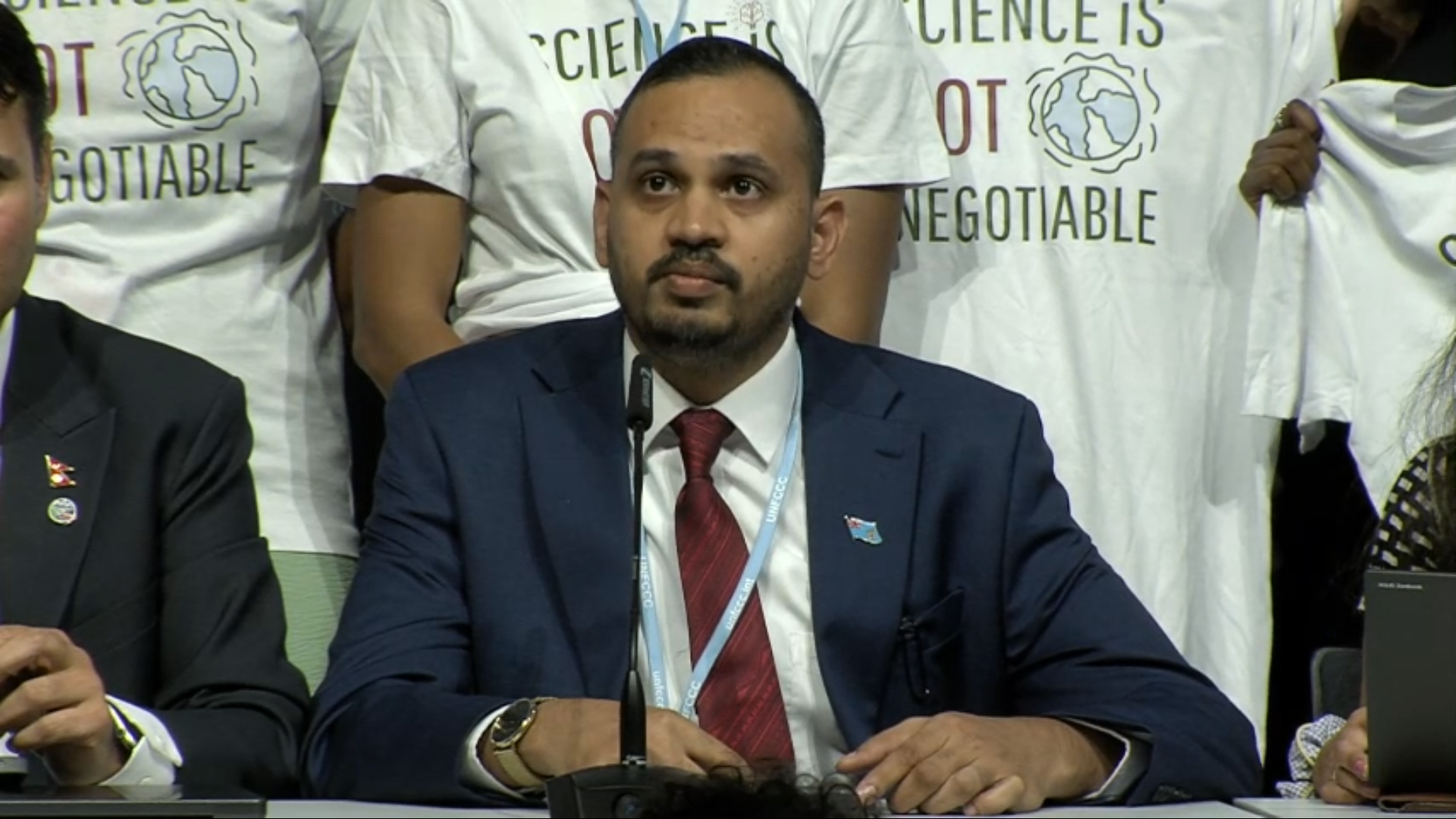
Speaking on behalf of the 14-member Pacific Small Island Developing States (PSIDS) group at the Defend the Science press conference on Wednesday, Fiji’s Permanent Secretary for Environment and Climate Change, Dr Sivendra Michael, condemned attempts to remove references to climate science and the 1.5 degrees Celsius temperature limit from negotiation texts.
“Let me be absolutely clear, anyone that is blocking references to science, they are not our friends,” Dr Michael said.
The statement came amid growing concerns from Pacific negotiators that scientific evidence underpinning global climate action is increasingly coming under attack during discussions at the Bonn Climate Change Conference (SB64).
Dr Michael described scientists as the Pacific’s “closest allies” and said the work of the Intergovernmental Panel on Climate Change (IPCC) remained central to the fight for climate justice.
“Scientists are our closest allies. The IPCC is the backbone of our climate diplomacy regime,” he said.
“There is no equity for the most vulnerable if we fail to protect the science and stay within the 1.5-degree temperature limit.”
He warned that some negotiators were attempting to create a false choice between science and equity, a narrative that Pacific nations firmly reject.
“There are attempts to argue that science gets in the way of equitable solutions,” he said. “Science and equity go hand in hand.”
For Pacific Island countries already grappling with rising seas, coastal erosion, stronger storms and increasingly unpredictable weather, science provides critical evidence of the risks they face and the actions needed to avoid catastrophic impacts.
“Science has shown us the suffering that will come if we do not keep fighting for the 1.5 degree,” Dr Michael said.
“Science has revealed that our ocean’s pulse is failing as we approach one of the world’s greatest climatic tipping points. Science has confirmed that we need trillions in dollars more to adapt and save lives.”
He also criticised what he described as efforts by powerful interests to delay meaningful climate action.
“There are powerful interests desperate to protect their wealth and influence,” he said.
“Science reveals when the solutions they put forward are false. A healthy future lies not in unproven technologies but the fast and fair phase out of fossil fuels.”
Dr Michael said Pacific countries were witnessing coordinated attempts to weaken previously agreed language on climate science and temperature goals across multiple negotiating rooms.
“We are seeing efforts to remove references to IPCC and the 1.5-degree temperature limit,” he said.
“The Paris Agreement does not have temperature goals. It has a temperature goal of 1.5 degree.”
Questioning why countries were seeking to revisit previously agreed decisions, he added: “If it’s a pre-agreed text, why are we renegotiating an agreed decision?”
Dr Michael warned that the challenge extended beyond formal negotiations.
“We are seeing a very coordinated attack across rooms and this is not only happening inside the rooms, but also outside the room” he said.
He pointed to what he described as a growing “polluted narrative” suggesting that countries must choose between following science and pursuing equity.
“We reject this notion,” he said.
“Science and equity for us as PSIDS are interlinked.”
Pacific nations say defending science remains essential to protecting vulnerable communities and ensuring climate decisions are grounded in evidence rather than political convenience.
“This is how we fight for outcomes that are based in science.
“We can’t solve everything in the process today, but with groups represented here we can fight for science to stay at its heart,” Dr Michael said.