
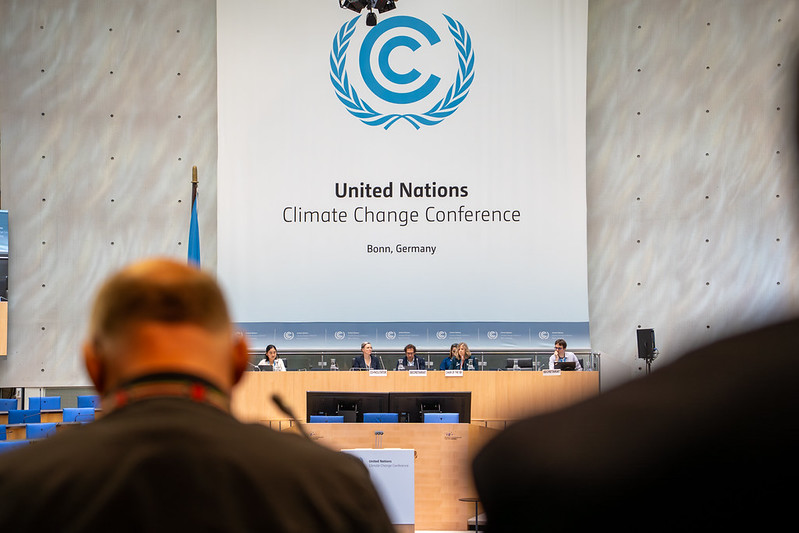
The Global Climate and Health Alliance (GCHA) has accused developed countries of obstructing progress on climate finance negotiations and failing to honour commitments to increase adaptation funding, warning that the deadlock is putting lives and public health at risk as the UN climate talks concluded in Bonn.
In a statement released as the 64th Sessions of the UNFCCC Subsidiary Bodies (SB64) closed on 18 June, the health advocacy group said negotiations on the Global Goal on Adaptation were hindered by developed countries’ reluctance to address climate finance commitments made at COP30 just seven months ago.
“During this week’s negotiations, developed countries seemed unable to recall their commitment to tripling adaptation finance by 2025 – a pledge they made just seven months ago at COP30”, said Jess Beagley, Policy Lead at the Global Climate and Health Alliance.
“There can simply be no health without finance for adaptation action. The same applies for wider climate finance, including for mitigation or loss and damage.”
The criticism comes amid growing frustration among developing countries and civil society groups over the pace of climate finance negotiations, which remain one of the most contentious issues under the UN climate process.
The Global Climate and Health Alliance said progress in other climate finance discussions was also slow despite efforts to place the issue higher on the international agenda.
The group highlighted a recent letter from Brazil requesting that the COP32 Presidency establish a dedicated work programme on climate finance, including Article 9.1 of the Paris Agreement, which obligates developed countries to provide financial support to developing nations for both mitigation and adaptation efforts.
According to the Alliance, the failure to address climate finance obligations is undermining broader climate negotiations and limiting the ability of vulnerable countries to respond to worsening climate impacts.
“Developed countries have hindered implementation and blocked progress across negotiations by failing to refer to climate finance – while developing countries already bearing the health impacts and wider burdens of climate impacts are unable to implement national climate plans without it”, continued Beagley.
The Alliance also linked the lack of progress to the influence of fossil fuel and other polluting industries within the climate process.
“This block on progress is compounded by the influence of harmful polluting industries such as fossil fuels, contributing to a lack of progress on outcomes relating to mitigation and science.”
The organisation called for tighter rules governing participation in UN climate meetings following recent discussions involving the UNFCCC Secretariat, the COP31 Presidency, governments and observer organisations.
“Following the dialogue between the UNFCCC Secretariat, the COP31 Presidency, Parties and Observers convened last week, we urge Parties to regulate participation in UNFCCC meetings in a manner commensurate with the health risks to national populations”.
The group expressed disappointment over the outcome of negotiations on the Mitigation Work Programme, saying delegates were unable to agree on a substantive decision for consideration at COP31 in Antalya.
“Yet even after almost two weeks of discussion in Bonn, it was not possible for a substantive decision on the mitigation work programme to be forwarded for consideration in Antalya”.
“If the mitigation work programme is to continue, it must make clear links to the Global Stocktake, or else dialogues will remain talkshops, isolated from the implementation so desperately needed to protect populations from the accelerating health impacts of climate change,” concluded Beagley.
The Alliance also raised concerns about discussions relating to the role of the Intergovernmental Panel on Climate Change (IPCC), saying some countries sought to weaken the body’s role in providing scientific guidance to negotiators.
Nova Tebbe, a Post-Doctoral Researcher with the Global Climate and Health Alliance, warned that undermining the IPCC could weaken the scientific foundation of international climate policy.
“The climate change problem cannot be resolved without a clear understanding of the evidence”, said Tebbe.
“The IPCC’s vital role must be bolstered, including by strengthening evidence by and about developing and vulnerable countries; and by protecting IPCC findings and recommendations from inappropriate influence.”
Tebbe said strengthening climate science remains essential to protecting public health and ensuring informed policymaking.
“Conducting research and scientific advancements on climate change is essential to tackling climate change and ensure healthy lives for all”, added Tebbe.
“Though research gaps exist and there needs to be improvements towards inclusive participation of researchers from around the world, the IPCC remains foundational to the UNFCCC process.”
She also urged governments to ensure the findings of the IPCC’s Seventh Assessment Report are incorporated into the second Global Stocktake process.
“As such, all efforts must be made to ensure the upcoming IPCC AR7 report is integrated into the second global stocktake as we evaluate progress on the Paris Agreement for the second time. Protecting and improving health is dependent on it.”
On negotiations surrounding a Just Transition mechanism, the Alliance acknowledged some progress while warning that major differences remain.
“During SB64, progress was made on what a mechanism for a just transition mechanism might look like, but with several diverging views that will lead to more conversations at COP31”, said Tebbe.
“It is essential that health is included in the scope of the mechanism, along with adequate resources and support, in order to save lives and build resilience by transitioning away from fossil fuels.”
The Alliance also warned that the lack of progress on adaptation and mitigation negotiations would have direct consequences for countries already experiencing climate-related loss and damage.
Although loss and damage was not formally on the Bonn agenda, Michele Baker, Policy Coordinator at the Global Climate and Health Alliance, said developments in other negotiating tracks could significantly affect vulnerable communities.
“Although loss and damage did not appear on the agenda in Bonn, the failure of countries to make progress in other negotiations has grave implications for loss and damage”, said Baker.
“The failure to make meaningful progress on mitigation to reduce emissions and limit climate change impacts, coupled with the failure to advance adaptation finance to make our communities more resilient to the impacts of climate change, will only result in greater loss and damage, and the cost will be the health and lives of people around the world”
Baker also highlighted concerns over the financial state of the Fund for Responding to Loss and Damage, arguing that current resources fall far short of actual needs.
“These challenges are further compounded by a Fund for Responding to Loss and Damages that remains severely underfunded compared to what is required to meet the needs of communities most vulnerable to the climate crisis”, said Baker.
Looking ahead to COP31, the Alliance called for urgent action to ensure that work on measuring loss and damage remains on schedule and that additional resources are mobilised for vulnerable countries.
“In the lead up to COP31, the State of Loss and Damage Report timeline and outputs must stay on track to reveal the true scale of needs faced by vulnerable communities”, concluded Baker.
“In addition to greater pledges from developed countries, a resource mobilisation strategy is critical to support the fund’s sustainability ensuring availability of life saving funds for those who need them most.”
The remarks underscore growing tensions over climate finance ahead of COP31, with developing countries and advocacy groups continuing to argue that progress on adaptation, mitigation, health protection and loss and damage will remain limited unless developed nations fulfil existing financial commitments under the Paris Agreement.