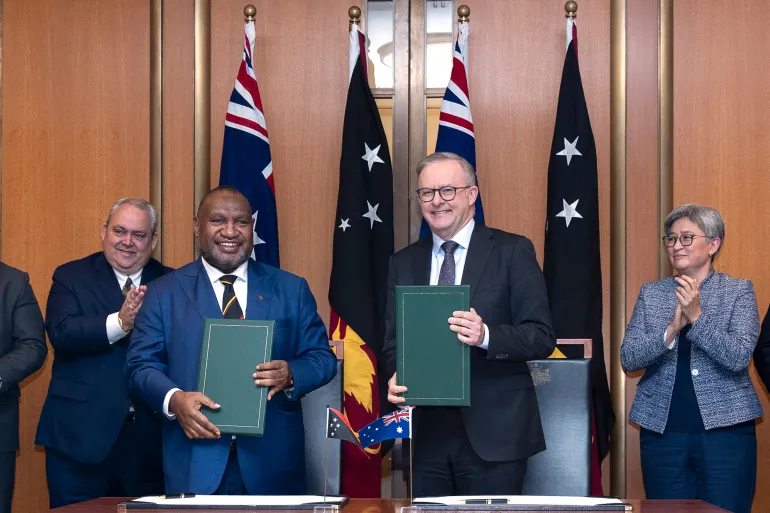
Australia and Papua New Guinea have thrown their support behind greater Pacific security cooperation, with both countries endorsing efforts to explore a regional security pact proposed by Solomon Islands Prime Minister Jeremiah Manele.
The ministers were questioned in Adelaide on Wednesday about a proposal floated by Solomon Islands Prime Minister Jeremiah Manele for a regional security pact.
Tkatchenko said regional cooperation remained essential to maintaining stability in the Pacific.
“Look, for our region, we all need to work together in partnership.”
“And Australia’s been doing a fantastic job in signing up all different Pacific Island countries with treaties and defence cooperation agreements and what have you to ensure is that the whole region works together as one.”
“And we’re all for that.”
He said the Australia-PNG alliance could serve as a model for other Pacific countries.
“The historical alliance that we now have with Australia and Papua New Guinea sets the tone and also sets the precedent for the other countries which are now following suit.”
“So, yes, it’s a great idea for all of us to work together as one.”
Responding to the same question, Wong said regional security should continue to be anchored within the Pacific Islands Forum framework.
“Well, first can I just say, I’ll pick up where Justin left off, which is the meaning of the Alliance, and not just between us, but what it means to the region.”
“Papua New Guinea is after Australia, the largest Pacific country, it’s the largest Pacific Island nation. And it is a leader in the region, and Prime Minister Marape and his cabinet have led this.”
“And the point that Minister Tkatchenko is making is the really critical one, which is we all have a role in assuring stability and security in our region, and we believe that that security is best provided within the PIF family.”
“It is from that principle which enables security, and that is one of the foundational principles of Pukpuk,” she said.
Asked what had been achieved during the visit, Tkatchenko said discussions covered a broad range of strategic issues affecting both countries and the wider Pacific region.
“Basically, I’ve come here to see Penny’s backyard, number one. And it was a wonderful invitation for me to come to Adelaide for the first time in nearly 30 years.”
“We discussed the security in the region. We discussed the upcoming entry into force of the Pukpuk Treaty in Sydney coming in the next weeks with both our Prime Ministers.”
“We discussed our regional situation and the situation of Bougainville in Papua New Guinea as well with their independence push and the vote coming up there. And you know, fuel security and also things moving forward for the benefit of both our countries,” he said.
Tkatchenko said Australia remained Papua New Guinea’s principal security partner and that the alliance between the two countries had entered a new phase.
“So, Australia is our traditional security partner.”
“Now we’ve taken it to a level where we have one ‘banis’, meaning one fence and two houses. In that security pact where we’re together as one.”
“The security issues of Australia will be a concern for Papua New Guinea. And Papua New Guinea’s security issues are a concern for Australia.”
“So, we all work together in partnership to ensure that we have a mutual understanding and agreement.”
The PNG Foreign Minister also outlined plans for greater defence cooperation, including opportunities for Papua New Guineans to serve in the Australian Defence Force.
“We’re going to have many thousands of Papua New Guineans entering into the Australian Defence Force over the next 10 years to assist in the security of partnership going together in that regard.”
“And that’s a process that is new and we’re walking through how we will succeed to do that,” he said.
He said the success of the partnership depended on both countries maintaining a common approach to regional security challenges.
“The most important thing is that we’re all on the same page. We’re all together as one and why change something that’s working well? I think that’s the situation.”
Tkatchenko praised cooperation between the governments of Prime Minister James Marape and Australian Prime Minister Anthony Albanese, saying it was contributing to regional peace and security.
“Local politics, whatever it might be, the Albanese Government with our government under James Marape is working very, very well for peace and security in the region, not only for Australia, but also for all the other Pacific Island countries as well.”
“We assist and work together as one so that we can all have an understanding that what we’re doing is not just for Australia, it’s not just for Papua New Guinea.”
“But it’s for all the other island nations as well, especially our brothers and sisters in the Solomon Islands as well, working with them.”
“They’re all part of the program and the process of making our area a safe and secure place now and into the future,” he said.
The discussion also turned to the impact of recent disruptions in global fuel markets and whether the easing of tensions in the Middle East could reduce fuel pressures across the Pacific.
Asked if she was hopeful that recent developments would ease the fuel shock experienced in the region, Wong said Pacific nations had been heavily affected because of their dependence on fuel supplies linked to Asian refineries.
“Of course. I mean, you’ve heard me speak about, the Prime Minister speak about the fact that we are, because of the nature of the way the global market works, how much of the oil coming through the Strait is bound for the refineries of Asia from where most of us get most of our fuel.”
“Obviously, it’s had a disproportionate impact on our region,” said Wong.
Wong said the effects of recent disruptions could continue for some time but expressed optimism that fuel markets would stabilise.
“I would assume that there will still be a tail on the disruption.”
“But we certainly are hopeful that we see fuel supplies returning to normal in the very near future and that it would be a good thing for the people of our region and for the people of Australia,” she said.