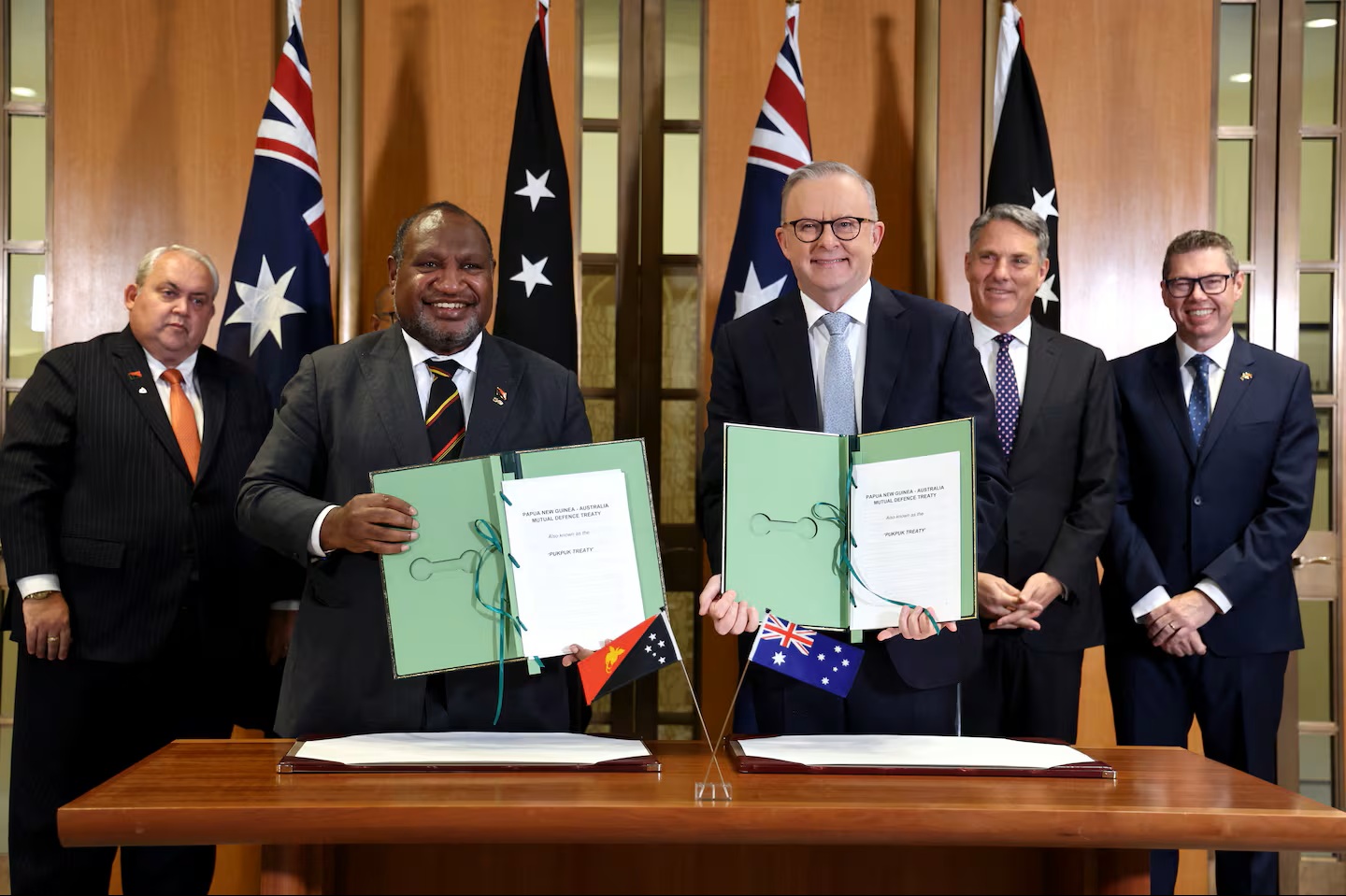
Australia and Papua New Guinea have reaffirmed their commitment to bringing the Pukpuk Treaty into force, with Foreign Ministers Penny Wong and Justin Tkatchenko describing the alliance as a major step in strengthening regional security, economic cooperation and stability across the Pacific.
Speaking at a joint press conference in Adelaide on Wednesday, Wong said both countries had completed their domestic processes and were now looking forward to the treaty formally entering into force.
“Papua New Guinea and Australia are more than just neighbours. We’re close friends. We’re bound by shared history and trust,” Wong said.
She noted that 2025 marked 50 years of Papua New Guinea’s independence and highlighted the growing partnership between the two countries.
“And we also made an historic decision to become allies. And I want to thank again Papua New Guinea, Prime Minister Marape, Deputy Prime Minister Rosso, Foreign Minister Tkatchenko, the whole of the Papua New Guinea Government for proposing the Pukpuk Treaty.”
“It’s such an honour to be part of that Alliance with Papua New Guinea and we look forward to our leaders bringing the Treaty into force in the near future. Both of our countries have gone through our domestic processes so we look forward to the Treaty coming into force.”
Wong stressed that the alliance extends beyond defence cooperation.
“I want to emphasise it’s an Alliance that is about more than defence. It deepens cooperation in health, education, infrastructure and trade, all of which are about our two countries working together for peace, for stability and prosperity in our region.”
Tkatchenko said the treaty reflected the closest relationship the two countries had enjoyed since Papua New Guinea’s independence.
“Papua New Guinea is not only an ally, we’re in partnership with friends that goes back many, many years.”
“And with that, our relationship is the strongest that it’s ever been since our independence with the Marape-Albanese shared understanding between governments.”
“We look forward to the final implementation of the Pukpuk Treaty, our alliance. This strengthens our security, strengthens our social well-being, and ensures that Australia and Papua New Guinea will be closer than ever before, looking after each other in these very challenging times.”
Tkatchenko also credited Wong and Australian Prime Minister Anthony Albanese for advancing the relationship.
“So, your leadership, Penny, in bringing us together with your Prime Minister is not a mistake. It’s well overdue and we look forward to our continual partnership, our continual relationship for the benefit of both our peoples.”
The ministers also addressed the recent agreement between the United States and Iran, with Wong welcoming the development and describing it as important for global and regional energy security.
“We know reliable energy supply is an important part of a stable region, and in this context can I indicate Australia welcomes the deal this week between the United States and Iran.”
“We have long called for de-escalation and an end to this conflict. We do believe it’s gone on too long, and we are very pleased that an agreement has been reached.”
Wong said the reopening of the Strait of Hormuz was critical for global energy markets and Pacific economies.
“Obviously, restraint and dialogue will be central to securing a lasting agreement.”
“The Government also welcomes, as I’m sure all Australians do, the reopening of the Strait of Hormuz and the restoration of freedom of navigation.”
“It’s really important that supply flows through the Strait freely without barriers, tolls or impediments. We want critical energy supplies to flow where they are most needed, including to our region and including to the Pacific. It matters to all of us.”
Asked about the impact of the Middle East conflict on Papua New Guinea and the government’s fuel subsidy programme, Tkatchenko said the effects of the crisis were felt globally despite PNG’s distance from the region.
“On the international side of things, any peace deal is most important. We need to have peace and stability in the whole world, basically.”
“Even though Papua New Guinea is so far away from Iran and from this crisis, it affects us greatly.”
Tkatchenko said the PNG Government had committed more than K100 million (US$22 million) to subsidise fuel prices and maintain affordability.
“Our government has put subsidies in for fuel for our people, over 100 million Kina (US$2 million).”
“And I can say without fear or favour, that our fuel prices are nearly the lowest in the world, only three Kina for a litre of diesel.”
“So that really assists our people greatly in these uncertain times when it comes to fuel security.”
He also moved to reassure Papua New Guineans about future fuel supplies.
“We are secure, we produce our own fuel, we sell our own fuel and our suppliers and our contractors have guaranteed that our fuel supply is secure now and into the future.”
When asked whether PNG would seek Australian support or extend the fuel subsidy programme beyond its current expiry date, Tkatchenko said no assistance had been requested.
“We have not asked Australia for support, as we do not need it at this point in time.”
“And we look forward to ensuring that now that Trump and the American government have come to some sort of agreement, which we look forward to seeing in detail, this will make it so much easier for all of us, said Tkatchenko.