

Bougainville Regional MP and Works Minister Peter Tsiamalili Jr has urged Papua New Guinea’s Parliament to support the proposed Sessional Order on Bougainville, arguing that lawmakers must first agree on the process for considering the region’s political future before debating the outcome of the 2019 independence referendum.
Speaking during debate on the Sessional Order Tuesday, Tsiamalili stressed that Parliament was not being asked to vote on Bougainville’s independence but to establish the framework through which future decisions would be made.
“Today is not the day Parliament decides the political future of Bougainville. Today is not the day Parliament votes on independence.
“Today is not the day Parliament accepts or rejects the Referendum Result.
“Today is the day Parliament decides the procedure through which that future decision will be considered,” he told Parliament.
He said the Sessional Order would set out the rules and procedures for Parliament’s consideration of key documents related to Bougainville’s future status.
“The matter before us is the Sessional Order,” Tsiamalili said.
“The Sessional Order establishes the process, the rules and the framework through which Parliament will subsequently consider the substantive matters relating to Bougainville.”
“Let us first agree on the process. Let us first agree on the rules. Let us first agree on the pathway,” he stressed.
Tsiamalili said Parliament would later consider three substantive documents: the Bougainville Referendum Result, the Joint Consultation Report and the Melanesian Framework.
“The Minister for Bougainville Affairs will subsequently table:
1. The Bougainville Referendum Result;
2. The Joint Consultation Report; and
3. The Melanesian Framework.
These are the substantive documents that Parliament will consider when the time comes to deliberate on Bougainville’s political future,” he explained.
The Bougainville MP also used his speech to place the issue in a broader historical context, saying Bougainville’s political aspirations predate both the 2001 Bougainville Peace Agreement and the 1989 crisis.
“Today is not merely another day in the Parliamentary calendar. Today represents another important step in a journey that spans generations.”
“Before I address the Sessional Order before this House, I wish to remind Parliament that the story of Bougainville did not begin with the Referendum of 2019.
“It did not begin with the Bougainville Peace Agreement of 2001. It did not begin with the Crisis of 1989.”
“The political journey that brings us here today reaches back more than 140 years,” he explained.
Tsiamalili argued that the origins of the Bougainville issue lie in colonial-era boundary decisions.
“Its origins can be traced to the colonial partitioning of the Northern Solomons in 1884 and the subsequent arrangements of 1886 and 1899, when foreign powers drew boundaries across Melanesia and separated peoples who shared kinship, trade, culture, ancestry and identity for countless generations.”
“Long before Papua New Guinea became an independent nation, decisions concerning Bougainville were being made by distant colonial administrations.
“The people of Bougainville did not create those boundaries. Those boundaries were imposed upon them,” he emphasised.
He said the issue should be viewed as a colonial legacy rather than a dispute between Bougainville and Papua New Guinea.
“Therefore, the Bougainville question is not fundamentally a dispute between Bougainville and Papua New Guinea. It is fundamentally a colonial question.”
“Bougainville and Papua New Guinea are not the creators of this problem. In many respects, both are inheritors of a colonial legacy that has required wisdom, patience and statesmanship to resolve,” he told Parliament.
Tsiamalili praised the Bougainville Peace Agreement for creating a constitutional pathway to address the issue.
“That is why the Bougainville Peace Agreement stands as one of the greatest achievements in our nation’s history.
It transformed a colonial question into a constitutional process. It transformed conflict into dialogue. It transformed grievance into democratic choice,” he said.
He also acknowledged Bougainville Affairs Minister Manasseh Makiba for bringing the matter before Parliament.
“At the outset, I wish to acknowledge and commend my brother and colleague, tManasseh Makiba, Minister for Bougainville Affairs, for faithfully discharging his constitutional responsibility in bringing this matter before Parliament.”
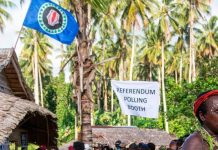
Referring to the 2019 referendum, Tsiamalili noted that Bougainville voters had overwhelmingly chosen independence.
“The people of Bougainville were given two constitutional pathways towards lasting peace: Greater Autonomy or Sovereign Independence.
“The people made their choice. An overwhelming 97.7 percent voted for Sovereign Independence.”
“Whether one agrees with that outcome or not, no one can deny the legitimacy of the process through which that choice was expressed,” he stressed.
He urged Parliament to focus on establishing the process before making any final decision on Bougainville’s future.
“History will judge this, Parliament.
“Today, however, we are not deciding the destination. Today we are agreeing on the road.
“Before we decide where the journey ends, let us first agree how we will travel together.
“That is the purpose of the Sessional Order.That is why I support it,” Tsiamalili said.