
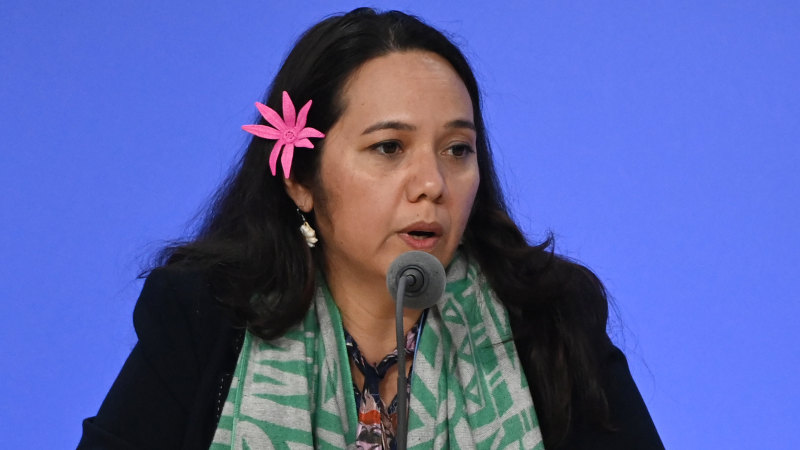
The Republic of the Marshall Islands (RMI) has become co-chair of the Coalition on Phasing Out Fossil Fuel Incentives Including Subsidies (COFFIS), bringing Pacific Island leadership into the heart of the coalition’s governance as its members gather in Santa Marta for the First International Conference on the Just Transition Away from Fossil Fuels.
The announcement marks a significant step for a coalition that has grown to 17 nations since its launch at the 28th United Nations Climate Change Conference (COP 28) in Dubai.
The announcement comes as a deepening energy crisis lays bare the cost of the world’s continued dependence on fossil fuels. Energy markets have been upended by conflict in the Gulf, with the closure of the Strait of Hormuz causing the largest disruption in global oil supply in living memory, pushing Brent crude prices above USD$100 per barrel.
Fuel, heating, and food costs have surged simultaneously, and millions of households—many already stretched by years of economic pressure—are facing bills they cannot afford.
“The Republic of the Marshall Islands joined COFFIS last year because we believe that keeping the promises made in Dubai—to transition away from fossil fuels and the subsidies that prop them up—is not optional. It is a matter of survival for countries like ours,” said Tina Stege, Climate Envoy for the Republic of the Marshall Islands.
“We are stepping into the role of co-chair at a moment when the human cost of fossil fuel dependence is being felt in homes and communities around the world. Last month RMI declared a 90-day state of economic emergency as fuel prices hit USD$8 a gallon, and as part of a wider Response Plan we were forced to bring in temporary support measures. These are subsidies we cannot afford and don’t want to pay. That’s why the work of this coalition is vital preparation for getting us all off the fossil fuel rollercoaster before the next supply shock hits,” she said.
COFFIS members recognise the gravity of what people are going through. Governments everywhere, including coalition members, have faced immense pressure to shield their populations from immediate hardship, with some introducing temporary emergency measures in response to spiking prices.
However, several have chosen not to introduce new fossil fuel subsidies even under pressure, demonstrating that governments can use alternative policy options to respond more selectively and effectively when prices spike.
The Netherlands, for instance, announced a EUR 967 million (US$1.13 billion support package, centred on targeted relief rather than fuel price cuts: direct support for low-income households facing high energy bills, an increased tax-free travel allowance for commuters, and structural investment in home retrofits, heat pumps, and energy efficiency.
New Zealand opted for cash transfers to low-income households, while France combined energy vouchers for 3.8 million low-income households with a doubling of electrification support to EUR10 billion (US$7.13 billion) annually by 2030, explicitly linking short-term relief to reducing fossil fuel dependence.
Blanket fossil fuel subsidies are highly ineffective tools to protect people from price shocks.
In middle-income countries, the top earning 20 percent of the population receives 11 times the level of subsidies compared to the lowest, IMF data shows—with the bulk flowing to those who consume the most energy, not those who most need relief.
Direct, targeted support, combined with electrification and improved energy efficiency measures, offers consumers more durable protection. More fundamentally, stopping the flow of public money to fossil fuels is the first concrete step any government must take if its transition plans are to be credible. This is why COFFIS members argue that subsidy reform belongs at the centre of every national transition roadmap being discussed here in Santa Marta.
Stientje van Veldhoven, Minister of Climate and Green Growth of the Netherlands and co-chair of COFFIS, said: “We warmly welcome the Marshall Islands as co-chair of this coalition. Their leadership reflects what this work is truly about—energy security, economic resilience, and a fair transition for communities on the frontlines. The current situation in global energy markets is a serious reminder of the costs of dependence on fossil fuels, and of why the work of COFFIS members matters. We also extend an open invitation to the governments gathered here in Santa Marta: phasing out fossil fuel subsidies is a vital part of delivering on the promise of a just transition. We encourage all willing countries to join us.”
Progress within COFFIS reflects real commitment in practice. Eight members—Austria, Belgium, France, Ireland, the Netherlands, Spain, Switzerland, the United Kingdom—have now published fossil fuel subsidy inventories, a foundational step toward reform, with more expected in 2026. The Netherlands has published a national phase-out plan, and all other founding members are continuing to develop their own—a process that, as members have acknowledged, is technically and politically complex and takes time to do well.