

A court has ordered parliament to convene with a no-confidence motion in the air. The PM is appealing. Here’s what happens next.
By Connor Graham
In the 48 years since Solomon Islands gained independence, only twice has a prime minister survived a full parliamentary term. No incumbent PM has ever been re-elected, and several governments have been toppled by no-confidence votes.
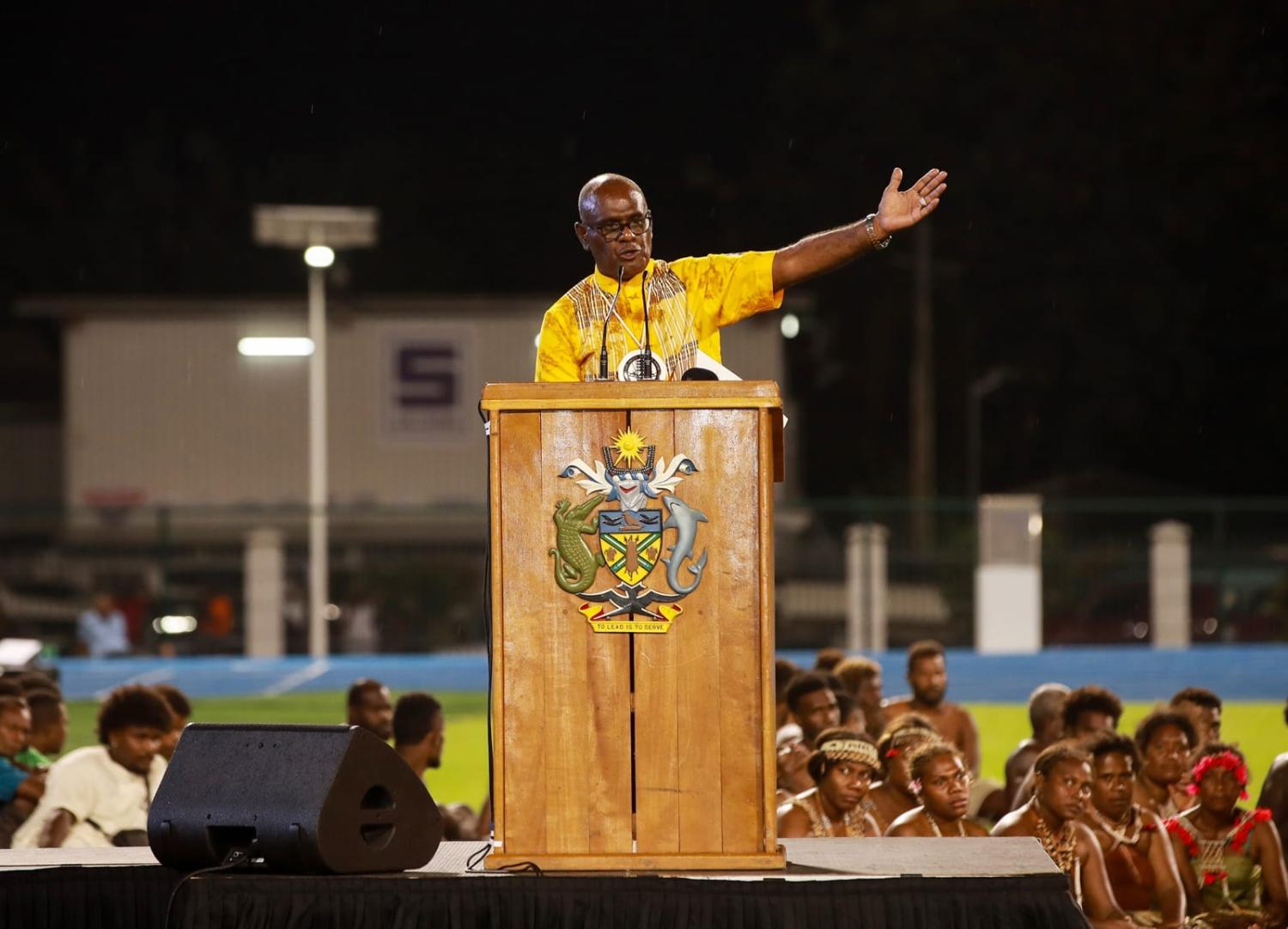
The latest chapter in Solomon Islands’ tumultuous political history occurred this week. High Court Chief Justice Sir Albert Palmer ruled on Tuesday that Prime Minister Jeremiah Manele had acted unconstitutionally by refusing to convene parliament to face a no-confidence motion backed by an opposing coalition of 28 of 50 MPs. Palmer ordered compliance within three days and ruled that the governor-general holds residual powers to convene parliament should the PM refuse. Manele announced he will appeal the decision.
For now, the ruling answers a previously unresolved question in Solomon Islands: what happens when a prime minister refuses to comply with the constitution’s accountability mechanisms? The High Court’s answer will likely now be tested in the Court of Appeal, and on the floor of parliament. As the three-day deadline for parliament to convene looms, several more questions persist.
Does Manele’s appeal suspend the court order?
Almost certainly not automatically. In Solomon Islands, following inherited English common law, filing a notice of appeal does not stay a High Court order. The appellant must apply separately for a suspension and persuade a court to grant it. No stay application has been reported. Without one, failure to convene parliament by 17 April could constitute contempt of court by Manele.
Will the Governor-General act if Manele defies the order?
Unclear. This is where the ruling breaks new ground. Palmer’s invocation of “residual powers” for the governor-general directly contradicts a 1998 Court of Appeal precedent that held the governor-general must not intervene in parliamentary political processes. Governor-General David Tiva Kapu already cited that precedent in March when he refused an earlier call from the opposition to force parliament to convene. If Manele does not convene parliament by 17 April, the governor-general could step in, though the appeal gives him a plausible reason to wait – perhaps what Manele is counting on.
A cabinet with varying views on Beijing would represent a different calculation from the current configuration that pairs Manele with Sogavare, one of Beijing’s most reliable allies in Pacific politics.
Can the 28-seat opposition coalition hold?
Coalition arithmetic in Solomon Islands has a habit of shifting at the last moment. That vulnerability gives the opposition every motivation to expedite proceedings. Manele has survived two previous no-confidence attempts by flipping opposition MPs at the last moment via calculated ministerial appointments and recruiting crossbenchers. He also controls vital constituency development funds – the money MPs can distribute in their electorates – with the allocation and timing historically leveraged for political gain in Solomon Islands. With 28 of 50 MPs currently part of the opposition coalition, and the threshold for passing a no-confidence motion a simple majority, Manele needs only three defectors. The opposition coalition has held for a month, but it is yet to be tested on the floor of parliament.
What changes if the government falls?
Not so long ago, Solomon Islands’ dealings with China dominated headlines in Australia. A change in government would not deliver the stark international realignment some in Canberra might hope for – but it would not be inconsequential. The most likely PM candidate from the opposition is Peter Shanel Agovaka, who served as Manele’s foreign minister until March this year. As recently as May 2025, Agovaka stated that Solomon Islands “stands firmly with China”. His defection was driven by internal cabinet grievances, not foreign policy. Yet the opposition also includes MPs such as Matthew Wale, who opposed the 2022 China security pact. A cabinet including Wale and others with varying views on Beijing would represent a different calculation from the current configuration that pairs Manele with Deputy Prime Minister Manasseh Sogavare, the architect of the China pact and one of Beijing’s most reliable allies in Pacific politics.