


The Republic of Vanuatu, together with the Core Group of States leading the UN General Assembly resolution responding to the International Court of Justice (ICJ) Advisory Opinion on the Obligations of States in respect of Climate Change, calls on all Member States to support the resolution when it is taken up for action on 20 May 2026.
The ICJ Advisory Opinion was requested by the General Assembly in resolution 77/276 (29 March 2023), and delivered by the Court in 2025. It provides authoritative guidance on how existing obligations under international law apply in the context of climate change, including obligations of prevention and cooperation and the legal consequences of internationally
wrongful acts.
The draft resolution before the General Assembly is a carefully balanced, cross-regional product of sustained engagement by the wider membership. It welcomes the Court’s Opinion; calls on States to comply with their obligations under international law and, for Parties to the Paris Agreement, their treaty obligations as identified by the Court; and provides for concrete follow-up through a report of the Secretary-General and continued consideration by the General Assembly.
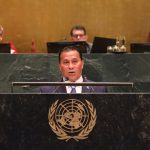
“In a time when multilateralism is under strain, the Court has spoken with one voice. The General Assembly now has an opportunity to speak with one voice as well—by welcoming the Opinion and committing to act on it in good faith, in accordance with equity and the principle of common but differentiated responsibilities and respective capabilities,” said Ambassador Odo Tevi, the Permanent Representative of Vanuatu to the United Nations.
In recent days, a small number of delegations have tabled late amendments. While Vanuatu respects the procedural rights of Member States, these proposals risk reopening a carefully negotiated package, weakening the resolution’s clear alignment with the ICJ Advisory Opinion, and diverting attention from the immediate task before the General Assembly: to provide an appropriate, unified, and forward-looking institutional response to the Court’s guidance.
“The world is watching. The question before us is not whether climate change is real or urgent, but whether the United Nations will collectively uphold the rule of law in the face of it. The vote—and the public record—will show who stands behind the Court’s legal blueprint for climate action and climate justice,” said Lee-Anne Sackett, Vanuatu’s Special Envoy for Climate Justice.
Vanuatu and the Core Group urge all delegations to maintain and expand co-sponsorship of the resolution, and to support its adoption without amendments. The Core Group remains available for engagement with all regional groups and delegations in the lead-up to action.