


By Virginia Comolli
Drug trafficking is expanding rapidly across the Pacific. Countries that were once primarily transit points have experienced a surge in domestic consumption, with some also emerging as production sites. Drug legislation, however, is struggling to keep pace with these shifting regional dynamics.
Because many of the region’s drug laws were drafted when cannabis was the main policy concern, many states have been poorly equipped to respond to the spread of cocaine and synthetic substances. As a result, communities, law enforcement agencies and health services are facing challenges that existing legal frameworks were not designed to address.
Against this backdrop, recent political posturing, including periodic proposals by state officials in Fiji, Tonga and Papua New Guinea to reintroduce the death penalty, highlights the pressure governments are under to respond quickly and robustly to communities’ fear and frustration – and to be seen to do so.
Drug law reform across the Pacific
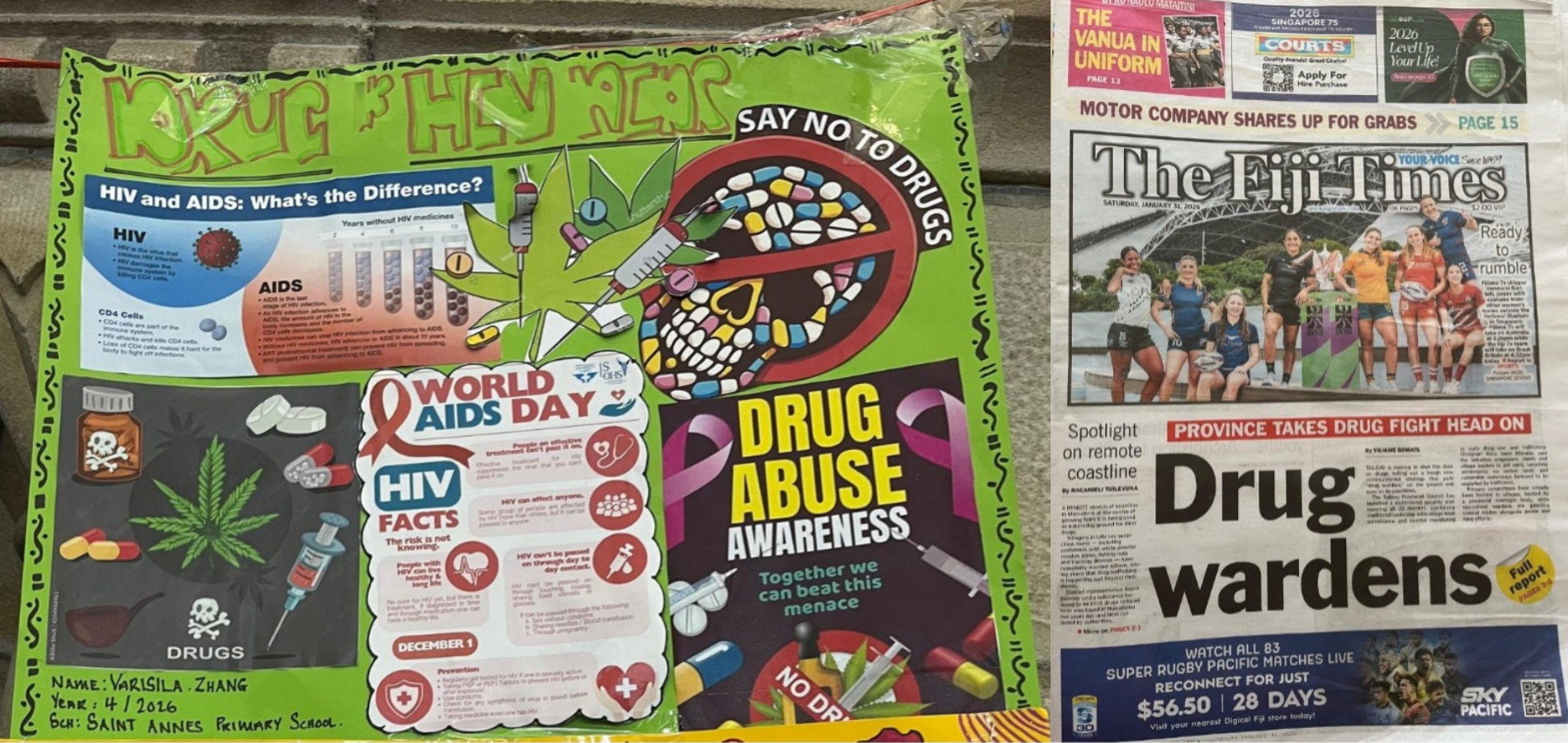
Fiji currently faces one of the most severe drug problems in the Pacific, particularly in relation to its HIV epidemic, which disproportionately affects people who inject drugs. However, debates on drug laws are gaining momentum across the region as states reassess laws written for a very different trafficking landscape.
Solomon Islands, for instance, was caught off guard by its first seizure of methamphetamine in 2023, as state legislation did not classify the substance, or other synthetics such as ketamine and ecstasy, as ‘dangerous drugs’. This legal loophole was only addressed in late 2025, and the country is now updating its legal provisions.
Policymakers are consulting the public ahead of amending the Dangerous Drugs Act to introduce harsher penalties for offences, including life imprisonment. However, critics have argued that a narrow focus on methamphetamines fails to anticipate the possible introduction of other drugs, which would leave enforcement authorities unprepared once again.
Fiji’s drug policy consultation
Recent developments in Fiji illustrate the policy challenges involved in updating drug legislation. The Melanesian country has taken a notable step through its National Counter Narcotics Strategy 2023–2028, which integrates supply, demand and harm-reduction pillars, alongside the proposed Counter Narcotics Bill. The latter would also facilitate the restructuring of the country’s Counter Narcotics Bureau, which encountered significant operational and integrity issues following its initial launch in 2024.
To inform the process, the government launched an extensive consultation process. Public meetings, community consultations and talanoa discussions – a process centred on open and respectful dialogue – have brought together government representatives and civil society organisations, including the GI-TOC. Churches and traditional authorities, such as the Great Council of Chiefs, also played a prominent role in these discussions, reflecting the social significance of the issue.
Beyond legislative reform, the consultations assessed whether existing frameworks are adequate to respond to the recent changes in the organised crime landscape. Seizures alone cannot disrupt drug markets if the systems that enable trafficking, such as financial flows and border vulnerabilities, remain intact, and if the credibility of law enforcement is not guaranteed.
The process also examined broader responses relating to prevention, treatment and community resilience. In doing so, it acknowledged the intersection of drug policy with public health, social cohesion and economic pressures.
When communities regulate drug use
In the Pacific region, village chiefs, councils and elders play a central role in maintaining social cohesion. In fact, in certain iTaukei (indigenous Fijian) villages, the chiefly system and the vanua, broadly understood as the traditional order, carry more weight than formal law or policing structures. This has important policy implications, as approaches designed for urban environments may be difficult to implement in settings where community authority structures remain highly influential.
The situation also raises complex legal and human rights concerns. Some Fijian communities have attempted to address drug use through internal mechanisms such as by-laws and customary rules. In certain cases, communities have considered excluding or banishing people accused of drug use. Such measures may conflict with constitutional protections and due process, and risk marginalising individuals who are already vulnerable. The talanoa sessions highlighted cases in which people expelled from their villages because of drug use had become homeless. Participants also noted that women and young girls in such situations may be pushed toward sex work as a means of survival or to sustain drug dependence.
Churches are also influential in Pacific societies, providing moral guidance, community support and various social services. In the context of limited state resources for countering drug addiction, these institutions can play an important role, particularly through prevention and rehabilitation initiatives. Tensions have arisen, however, around certain public health interventions. For instance, needle and syringe programmes, designed to prevent HIV transmission among people who inject drugs, have encountered resistance from some religious groups, who perceive them as condoning drug use, despite decades of scientific evidence demonstrating their effectiveness.
Toward systemic responses
While attempts to modernise drug legislation across the Pacific are an important step forward, they will not be sufficient on their own. Criminal networks are adept at exploiting weaknesses in maritime routes, customs procedures, financial oversight and legal systems, and adapt quickly to new enforcement strategies. Effective responses will therefore require a broader shift from reactive policymaking to systemic disruption.
Crucially, responses should include the acknowledgment that transnational organised crime is a regional threat that requires improved regional cooperation across intelligence sharing, financial investigations and law enforcement capacity.
At the same time, public health systems must be equipped to address the consequences of drug use, including addiction, mental health pressures and the growing risk of HIV transmission. Prevention, treatment and harm reduction initiatives are all essential components of a sustainable response. Community institutions already shape how drug issues are managed, and these can be powerful assets for prevention, social support and rehabilitation. However, their engagement must align with national law, human rights protections and evidence-based health policies.
Ultimately, the challenge for policymakers in the Pacific is not simply to update or create legislation. Rather, it is to develop integrated responses that connect law enforcement, public health and community authority systems, while also targeting the financial and institutional enablers of organised crime.
Without coordination and the tangible measurement of outcomes, governments risk remaining trapped in a cycle of reactive policymaking, continually playing catch-up with drug markets that adapt faster than the laws designed to control them.
Virginia Comolli is the Head of Pacific Programme, Global Initiative against Transnational Organised Crime.